Posts falsely link 5G to heatwaves in Europe
- Published on July 13, 2026 at 11:35
- 3 min read
- By Ramadani SAPUTRA, AFP Indonesia
As Europe struggles with record-breaking temperatures, social media posts shared a conspiracy theory claiming that 5G technology is to blame for the region's heatwaves. The posts are baseless, experts told AFP; 5G does not have any effect on the weather, and exposure to its radio waves only produces a negligible temperature rise in the body -- "far too weak" to heat the atmosphere or create weather systems.
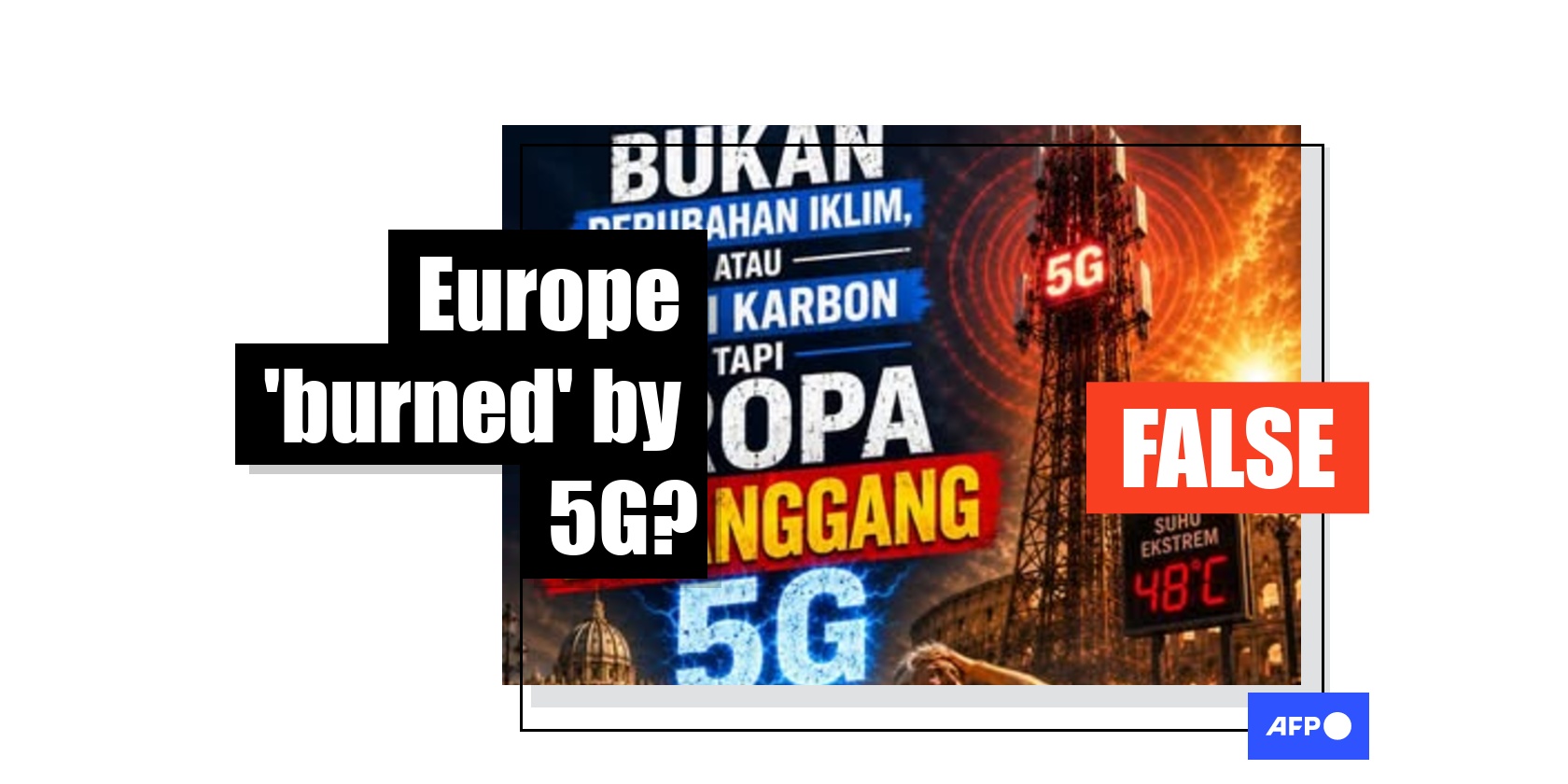
"Not by climate change or carbon emission but Europe was burned by 5G," reads the Indonesian text in a graphic posted on Facebook on July 5, 2026.
The graphic featured a 5G tower looming menacingly over people sweating under a scorching sun.
The post's caption claims that the heatwaves in Europe were caused by "a combination of geo-engineering", enabling "the greenhouse effect that increases the temperature".
"The effect of 5G exacerbates such conditions," it continues in a post that was reshared more than 300 times.

5G is the fifth generation of cell tower technology that allows for wider bandwidth and the ability to transmit more data over a range of radio frequencies (archived here and here). It improves the speed, connectivity and reliability of its transmissions, compared to its predecessors.
The technology has also long been at the centre of several false narratives, ranging from it being used to control the weather to the wireless networks causing Covid.
Like many conspiracy theories, the caption on the false post -- which was also shared on Instagram -- also blamed the so-called "global elite".
"As we all know, climate change is one of the global elite's agenda," it says.
But much of the scientific community is in agreement that climate change is the main culprit for extreme weather events like the current heatwaves striking Europe, with its Western countries experiencing its hottest June on record (archived here and here).
"Heatwaves like this are what we expect to see in a changing climate," said John Kennedy, head of climate information at World Meteorological Organization (WMO) in article published on WMO'S official website on July 9 (archived link).
“In the 50 years since the historic heatwave in 1976, Europe as a whole has warmed by around two degrees. It’s the fastest warming (continent) and extremes of temperature have increased too."
5G radio waves are also "extremely weak compared with the energy involved in heating the atmosphere in Europe", said Khoirul Anwar, the associate professor from the School of Electrical Engineering at Indonesia's Telkom University (archived link).
"5G has no possibility to affect weather of heatwaves like in Europe... They do not make ionisation to skin or make the environment hot," he told AFP in a July 8 email.
'Completely physically incorrect'
Milan Kloewer, a climate scientist, said there was no credible evidence to support the claim (archived link).
"There is no credible physical mechanism or evidence that normal 5G signals can cause heatwaves or change weather. 5G uses radiofrequency electromagnetic waves; at regulated exposure levels, the main known interaction is tiny heating, far too weak to heat the atmosphere or create weather systems," he told AFP on July 10.
"WHO notes that radiofrequency exposure from current wireless technologies causes negligible temperature rise in the body, not large-scale environmental heating."
Concurring with Anwar and Kloewer, climate scientist Daniele Visioni told AFP that the claim linking 5G to causing Europe's heatwave phenomenon "is utterly bizarre and completely physically incorrect" (archived link).
"5G doesn’t have any effect on weather," the assistant professor in the Department of Earth and Atmospheric Science at Cornell University told AFP in an email on July 8.
"It’s like trying to move a person using a flashlight -- the photons don’t have enough energy to move people, nor air, nor water."
Instead heatwaves are caused by "a combination of rising global temperatures due to more greenhouse gases and meteorological patterns" like a high pressure system, which traps hot air to stay in one place too long, he explained.
The world had witnessed some of the worst heatwaves that killed ten of thousands of people long before the establishment of 5G in 2019 (archived here and here). Europe particularly suffered from a deadly heatwave in 2003, which killed more than 71,000.
"Science worldwide is in agreement that heatwaves are natural phenomena, made worse by human-made climate change," Visioni said.
"Only by stopping the burning of fossil fuels can we stop from making them worse."
AFP previously had debunked misleading claims on climate issues.
Copyright © AFP 2017-2026. Any commercial use of this content requires a subscription. Click here to find out more.
Is there content that you would like AFP to fact-check? Get in touch.
Contact us