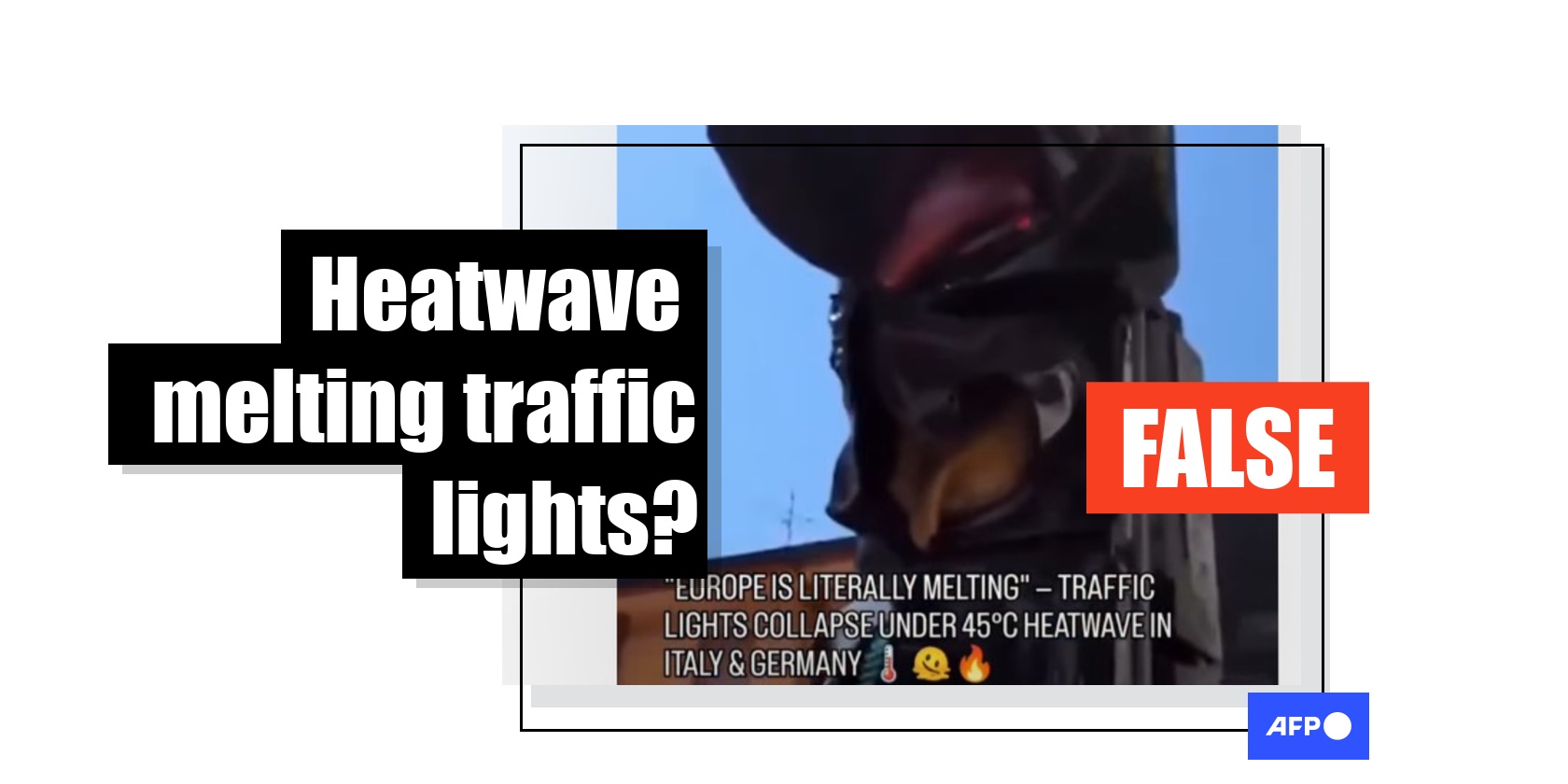
Clips of fire damage falsely shared as Europe heatwave aftermath
- Published on July 8, 2026 at 23:21
- 4 min read
- By Judith KANTNER, AFP Germany, AFP Middle East & North Africa
- Translation and adaptation AFP USA
Images of deformed traffic lights spread across social media in posts claiming the fixtures melted amid the intense heat that struck Europe in June. This is false; the signals were damaged in accidental fires unrelated to the 2026 heat dome.
"Extreme heat across parts of Europe is reportedly causing traffic lights to warp and malfunction as temperatures climb to 40-45°C in several regions," claims an Instagram reel shared on June 29.
"Authorities and local reports indicate that some traffic signals in Italy and Germany have been damaged by the intense heat," continues the caption for the post which shares two different clips of melted traffic lights.
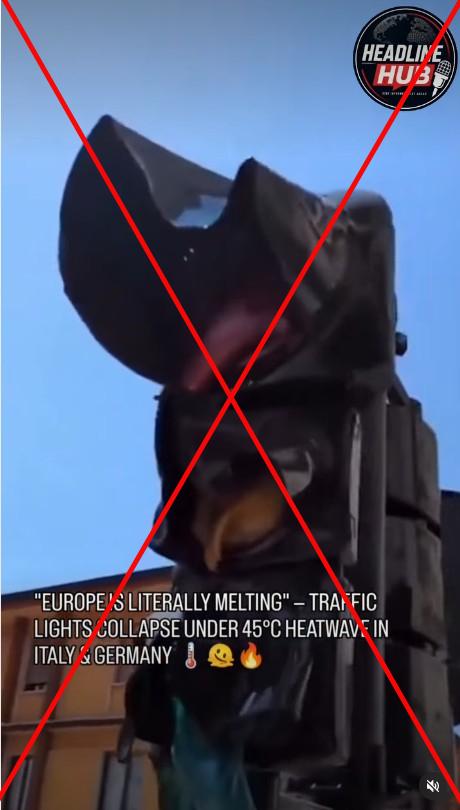
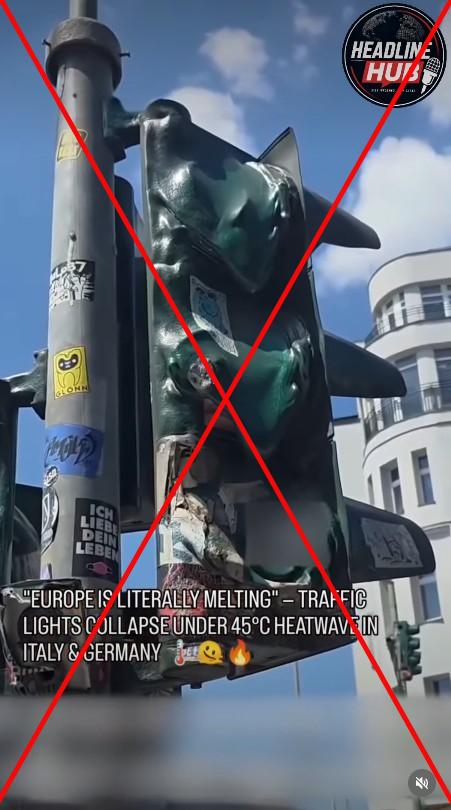
Similar claims sharing the images reverberated across platforms including Threads, YouTube, Facebook, and X as several European countries broke temperature records in late June 2026.
A heat dome trapped hot air from North Africa over the Iberian Peninsula before spreading as far as the United Kingdom and eventually weakening over central and eastern parts of the continent in early July.
While the posts accurately identified the countries where the videos were taken, they do not depict outcomes of intense heat in Germany or Italy.
Italian clip
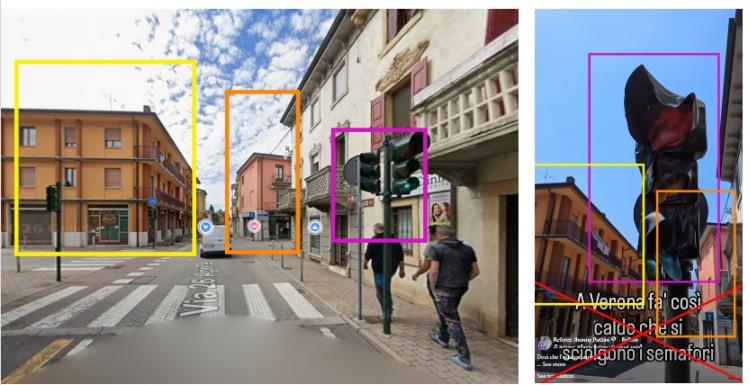
Through reverse image searches, AFP found the Italian clip was first posted June 24 on Facebook and Instagram by accounts which indicate they belong to a Verona resident.
The text over the video says in Italian that it is so hot the "traffic lights are melting," but many commenters seemed to take the post as a joke.
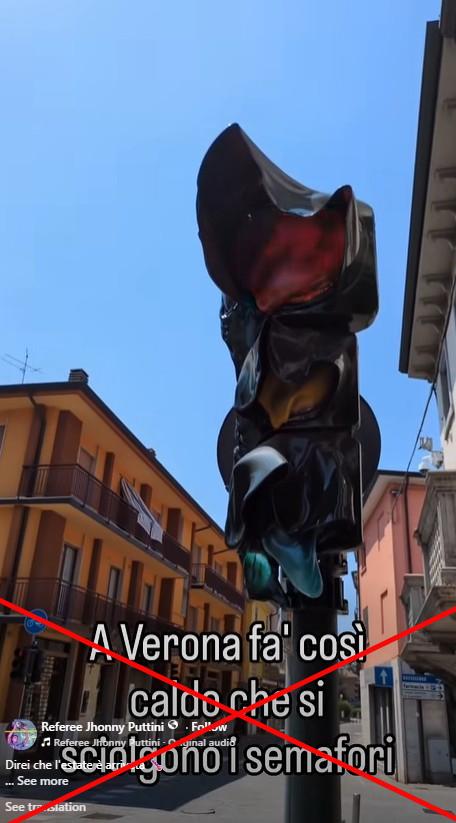
AFP reached out to the user for comment, but a response was not forthcoming. On Instagram, he commented a day later on his reel with a link to an Italian article that said the stoplight melted due to a local fire (archived here).
A local news outlet published footage matching the location of the clip showing a car fire on June 23 in Lugagnano, Verona (archived here, here, and here).
Through a search on Google Maps, AFP was able to verify that the locations of the misleading video shared on social media and the small Verona fire matched (archived here and here).
German clip
Similarly, the clip placed in Germany is also taken out of context.
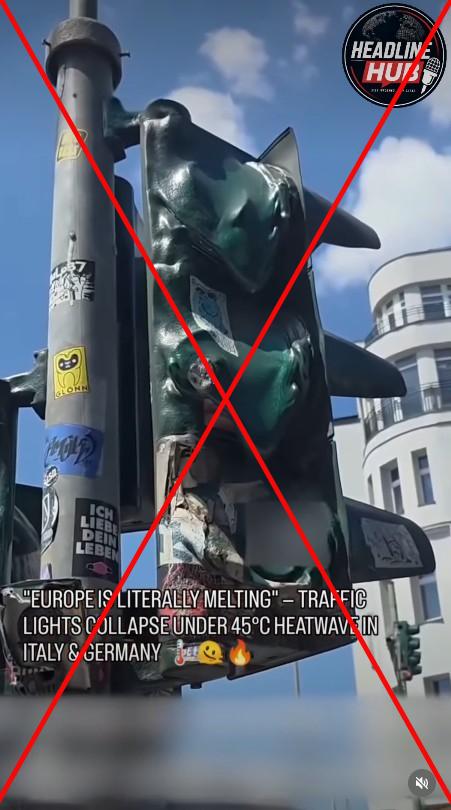
German news agency Deutsche Presse-Agentur (DPA) debunked the false claim on June 29 (archived here).
The damaged traffic light was located at an intersection in the Berlin district of Friedrichshain-Kreuzberg, near the Spree River, DPA reported -- which AFP confirmed through a search on Google Maps (archived here).
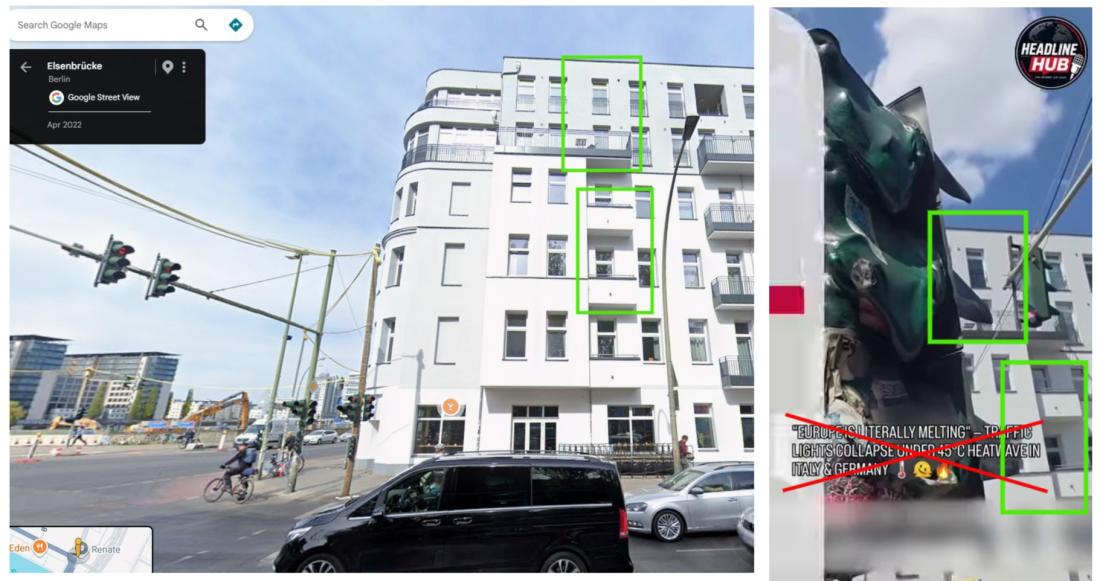
InfraSignal, a Berlin-based company responsible for managing the city's network of traffic lights, told DPA that a fire caused the damage (archived here).
InfraSignal also confirmed to AFP that the damage to the traffic light was caused by a fire which destroyed a night club, a year prior.
"We are not aware of any case in which signal heads suffer such damage at 40°C," said an InfraSignal spokesperson in a June 29, 2026 email to AFP.
Several commonly used materials for urban infrastructures have vastly higher melting points than the temperatures observed across Europe (archived here).
"Metal has very high temperature thresholds before it can buckle like the one in the videos," University of Cambridge sustainable built environment and health professor, Ronita Bardhan, told AFP on July 2 (archived here).
A recent analysis by scientific consortium World Weather Attribution concluded that intense heat events are increasing rapidly, "with such events tens to hundreds of times more likely since only 2003 and virtually impossible just 50 years ago" (archived here and here).
Thousands of excess deaths were recorded during the extreme weather events ravaging Europe, as this kind of heat puts human bodies under intense pressure, sometimes leading to dehydration, heatstroke and death.
AFP has debunked other heatwave claims.
Copyright © AFP 2017-2026. Any commercial use of this content requires a subscription. Click here to find out more.
Is there content that you would like AFP to fact-check? Get in touch.
Contact us