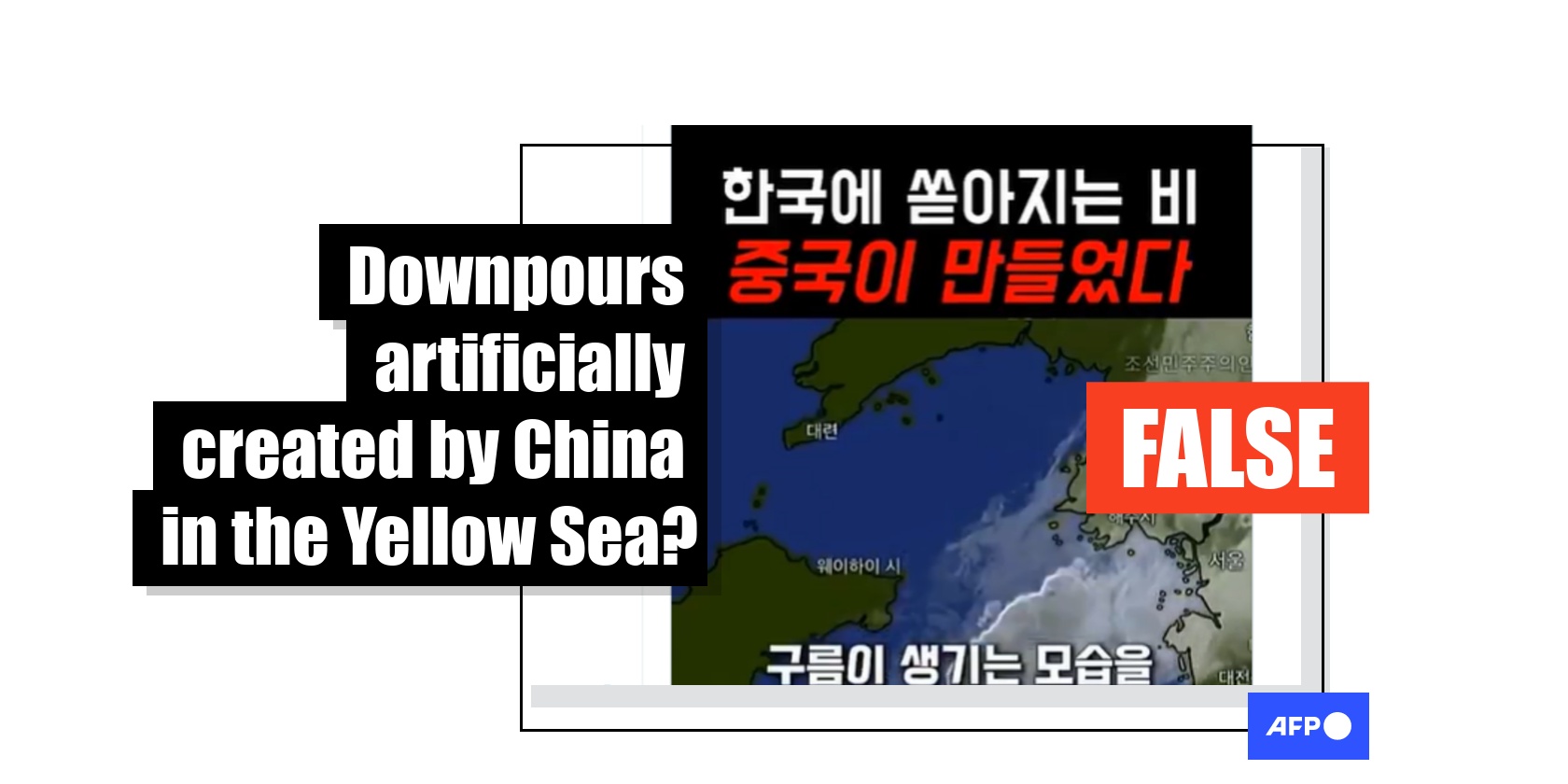
Heavy rains in South Korea revive false claims about Chinese cloud seeding
- Published on July 28, 2026 at 05:34
- 3 min read
- By Grace MOON, AFP South Korea
As South Korea was drenched by heavy downpours during its annual rainy season, social media posts falsely claimed China was manipulating weather from structures in the Yellow Sea. Such claims have been refuted by the South Korean government since 1995, and weather experts told AFP there was nothing unusual about the rain clouds that formed in the narrow sea that divides the countries, nor could cloud-seeding technology be effective at such distances.
"China really uses cloud-seeding technology and is spraying it over South Korea," says part of a Korean-language X post shared on June 20, 2026.
The post claims that "artificial cloud formations have been confirmed" near the Chinese maritime structures installed in a disputed area of the Yellow Sea, known as the West Sea in South Korea.
The installation of what the Asia Maritime Transparency Initiative described as aquaculture platforms was condemned by South Korean lawmakers in 2025 (archived here and here). The structures were installed in a jointly managed area known as the Provisional Measures Zone (PMZ), which was established through a 2001 bilateral pact (archived link).
A video attached to the post appears to show clips of flooding in South Korea along with graphics and satellite imagery of rain clouds forming in the narrow Yellow Sea and drifting towards the Korean peninsula.
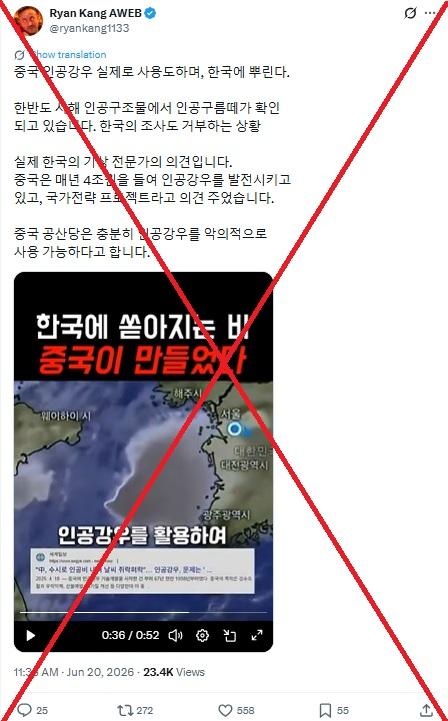
Similar claims about China using cloud seeding to interfere with South Korea's weather systems were also shared elsewhere on X and Threads, as forecasters warned of heavy downpours across the country and that a passing typhoon could disrupt the start of the summer rainy season (archived here and here).
Cloud seeding is the addition of microscopic particles to clouds to trigger precipitation, and has been used for years to induce rain over localised areas (archived link). The technique has been used to combat drought, increase agricultural water supply, and to suppress hail (archived link).
But experts told AFP there is no scientific evidence that cloud-seeding technologies can trigger rainfall across such large distances and the weather maps shared in the circulating posts do not show any unusual patterns.
The South Korean government has also refuted claims that China's cloud-seeding experiments are impacting weather in the country since as early as 1995 (archived link).
Despite extensive research into cloud seeding, climate sceptics often latch onto the technique to explain weather phenomena.
Too large a distance
Chang Ki-ho, a senior researcher at the National Institute of Meteorological Studies, told AFP that once cloud-seeding particles are dispersed, they "dilute rapidly" (archived link).
"The effects of cloud seeding last no more than four hours on average," he said on July 23. "Since clouds typically move at around 25 kilometres per hour (15.5 miles per hour), it could influence an area only up to around 100 kilometres (62 miles)."
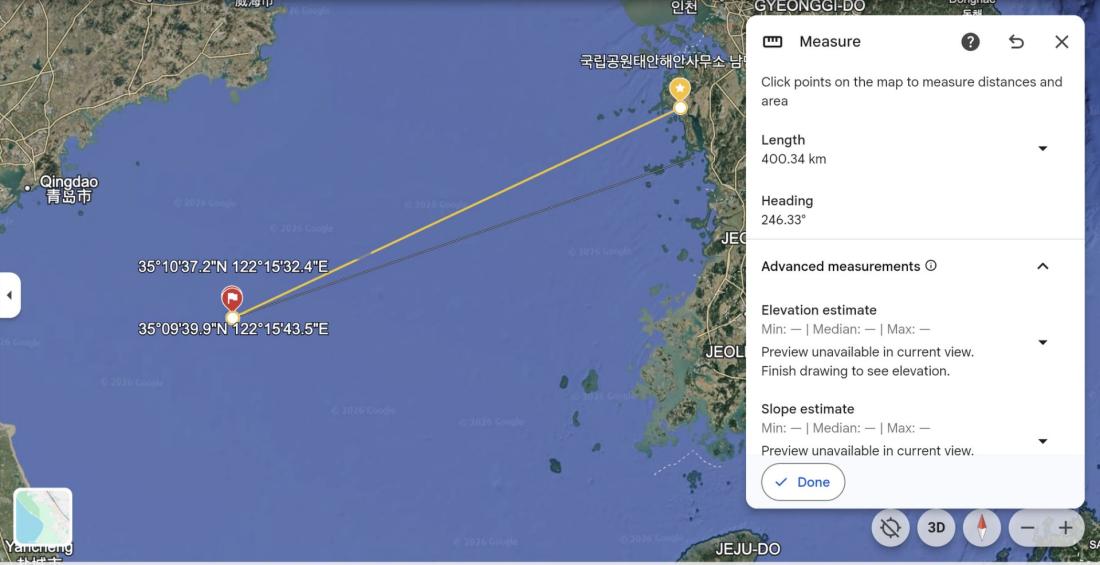
In January 2026, China's foreign ministry said it had begun relocating one of the three disputed structures inside the PMZ (archived here and here). Using estimates from a June 2025 report by the Center for Strategic and International Studies, AFP plotted the approximate locations of two remaining Chinese aquaculture cages on Google Earth (archived link).
AFP found the distance between the offshore facilities and the coastal peninsula in Taean county is roughly 400 kilometres.
"It would be extremely difficult for the effects to remain active over such a large distance," Chang said.
Professor Lee Hyun-ho, who teaches at Kongju National University's department of atmospheric science, where he leads the Cloud Physics Laboratory, also said "cloud condensation nuclei are quickly washed out by rainfall" (archived here and here).
In fact, cloud seeding during the summer could have the opposite effect and reduce rainfall, Lee said, explaining that rain-bearing clouds associated with summer low-pressure systems "can already generate rainfall naturally without cloud seeding".
Both experts reviewed satellite video shared by several false posts and told AFP that it depicts typical cloud formations.
"These rain clouds are not unique and can form anywhere," Lee said.
AFP has previously debunked other false cloud seeding claims.
Copyright © AFP 2017-2026. Any commercial use of this content requires a subscription. Click here to find out more.
Is there content that you would like AFP to fact-check? Get in touch.
Contact us