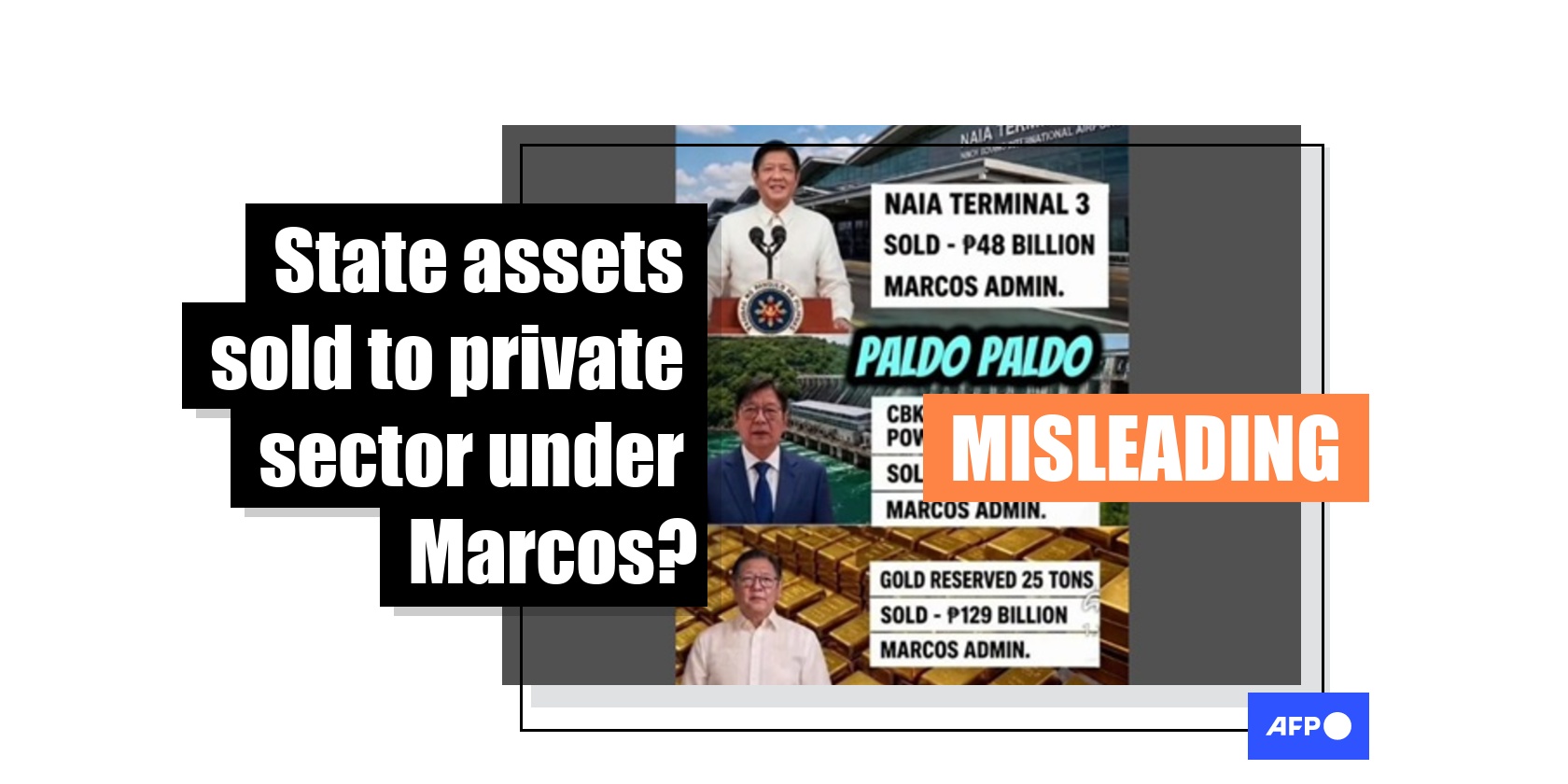
Posts misrepresent sale of Philippines airport terminal plot as part of privatisation drive
- Published on July 28, 2026 at 06:20
- 3 min read
- By Tatiana MALIGRO, AFP Philippines
After land housing a terminal of the Philippines' busiest airport was sold in a 48-billion-peso (US$778 million) deal, posts falsely claimed the transaction marked another state asset lost to a privatisation drive under President Ferdinand Marcos. The deal was in fact between two government bodies, with the land remaining in state hands. Two other examples were cited in the post -- a hydroelectric plant that was privatised and sales of gold reserves. The selling off of gold reserves was in fact carried out by the country's central bank, which acts independently from the government.
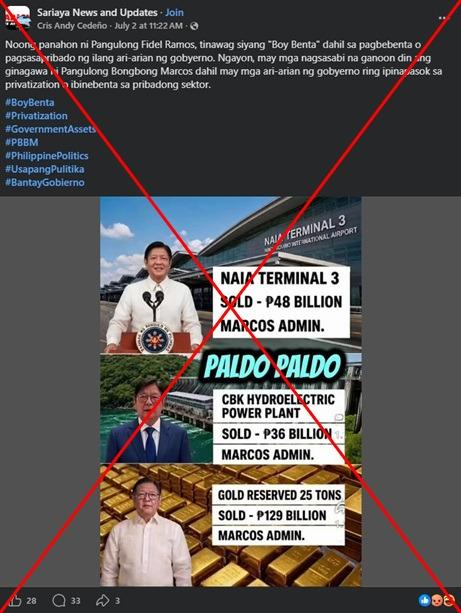
A graphic showing three state assets supposedly privatised under President Ferdinand Marcos's watch was shared on Facebook on July 2, 2026.
It lists Terminal 3 of the Manila's Ninoy Aquino International Airport (NAIA) as sold for 48 billion pesos, the Caliraya-Botocan-Kalayaan (CBK) hydroelectric power complex as sold for 36 billion pesos, and 25 tons of gold reserves as sold for 129 billion pesos.
Its Tagalog-language caption likens Marcos to former president Fidel Ramos, who it says was known for selling government assets to the private sector.
Similar claims that Marcos was selling off government assets were shared elsewhere on Facebook in mid-June.
"The BMM legacy is to sell all government assets," reads a comment on one of the posts.
Another says: "This useless president will really drain the Philippines of its assets."
But of the three sales cited in the posts, only one of the deals -- the sale of the CBK hydroelectric power plant -- can be considered an example of privatisation (archived link).
The complex was sold by the government in February 2026 for approximately 36 billion pesos to a consortium led by AboitizPower (archived link).
Airport terminal deal
The false posts circulated after the ownership of a 61-hectare property occupied by NAIA Terminal 3 was transferred from the Bases Conversion and Development Authority (BCDA) to the Manila International Airport Authority (MIAA) for 48 billion pesos (archived here and here).
While the airport is operated and maintained by the private New NAIA Infra Corporation, as part of a deal signed in May 2024 to rehabilitate the gateway, the property remains a government asset (archived link).
The BCDA is a government-owned and controlled corporation that converts former military bases to public infrastructure, while the MIAA is a government agency that regulates the airport's operations.
The Philippine law establishing the BCDA mandates the conversion authority to generate revenue for state programmes through real estate joint ventures, concession fees and land dispositions such as the NAIA terminal sale (archived link). Prior to the transfer, BCDA rented out the property to MIAA (archived link).
According to a joint press release, the deal will allow MIAA to pursue "substantial and lasting" developments as NAIA's passenger traffic continues to grow (archived link).
"By securing ownership of the Terminal 3 property, MIAA strengthens its stewardship of a strategic government asset and reinforces its ability to support the long-term development of the country's premier gateway," MIAA General Manager Eric Jose C. Ines said.
Central bank decision
The assertion that the sale of the Philippines' gold reserves amounts to privatisation is also false.
The gold reserves are held and managed by the Philippines' central bank (BSP) as part of the country's gross international reserves (GIR) (archived link).
The BSP enjoys fiscal and administrative autonomy from the national government through the Philippine Constitution and other local laws (archived link).
The central bank said in February 2025: "The BSP has been buying and selling gold over the years as part of its core functions. When the BSP sells gold, the proceeds revert to and stay within the GIR."
In another statement dated September 24, 2024, the BSP explained that it sold some 25 metric tons of gold in the first half of the year as part of its "active management strategy" of the country's gold reserves (archived link).
The monetary authority said it took advantage of high gold prices in the market to make additional revenues without compromising its primary goal of holding gold as a safety net from external economic shocks and defending the value of the Philippine peso.
The BSP became an active gold trader in 2020 -- two years before Marcos took office -- as part of its management strategy of the GIR (archived here and here).
Its then-governor Benjamin Diokno cited a World Bank study saying gold should ideally comprise just 9.8 percent of the country's GIR, but gold's share of reserves at the time exceeded 10 percent (archived link).
AFP has previously debunked other misinformation about the BSP’s gold sales.
Copyright © AFP 2017-2026. Any commercial use of this content requires a subscription. Click here to find out more.
Is there content that you would like AFP to fact-check? Get in touch.
Contact us