Energy fears spark inaccurate fuel countdown posts in Australia
- Published on April 30, 2026 at 10:18
- 5 min read
- By Dene-Hern CHEN, AFP Australia
Public concern over petrol reserves in import-reliant Australia spiked as the Middle East war raged, but posts claiming to show the country's fast-diminishing energy supply in "real time" are misleading. They misinterpret figures from a website that publishes modelled estimates based on publicly available data. While useful for illustrating Australia's vulnerability to energy shocks, the figures are not an accurate measure of the country's current fuel supply, experts told AFP.
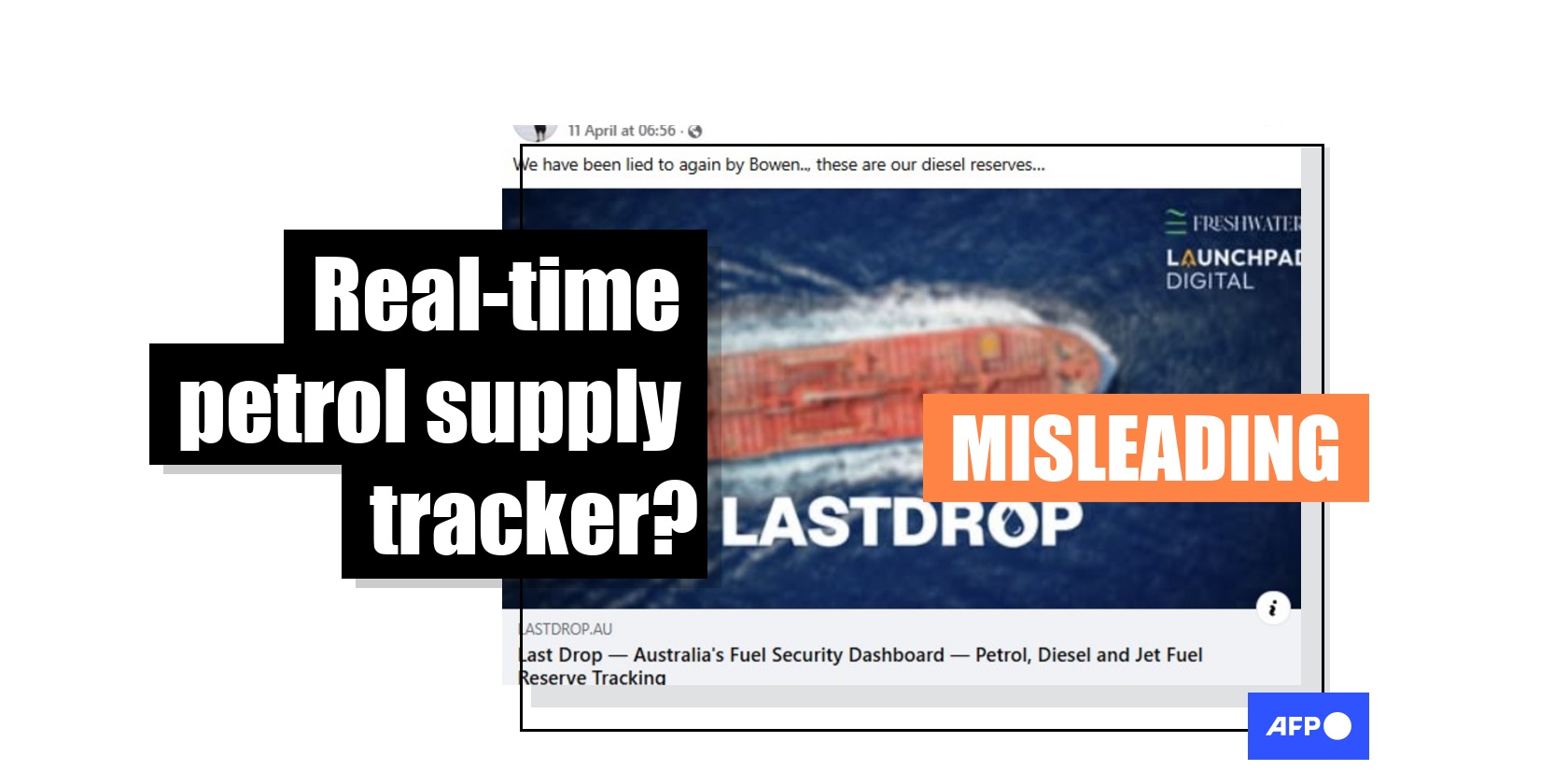
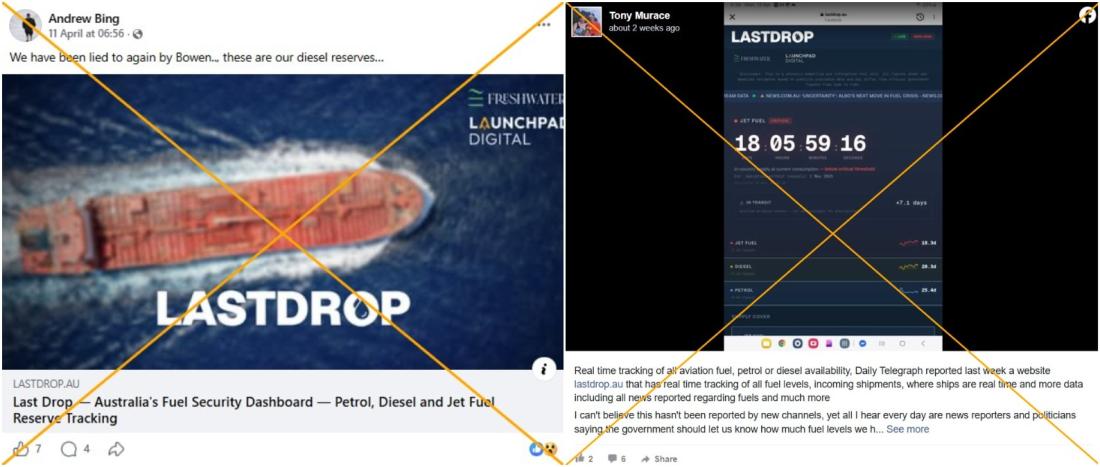
"We have been lied to again by (Energy Minister Chris) Bowen... these are our diesel reserves," says an April 11 Facebook post that shares a link to Last Drop -- a website billed as "Australia's Fuel Security Dashboard".
The homepage of the site prominently features a clock counting down the days until Australia's current jet fuel reserves run out, while a column on the right also shows the figures for diesel and petrol.
"Real time tracking of all aviation fuel, petrol or diesel availability," reads another post that shared a screenshot of the website on April 12. It states the country has only 18 days of jet fuel supply left.
"This is not good news for anyone booked to leave the country in May onwards," the lengthy caption adds.
The site -- promoted in early April on Facebook by outlets owned by Australia's largest media group News Corp -- was also used in similar X posts saying the country's fuel situation is "far worse" than what the government has told the public.
It was shared against a backdrop of heightened anxiety over Australia's fuel reserves, with global energy markets roiled since late February after Iran effectively closed the Strait of Hormuz in response to joint US-Israeli strikes (archived link).
The Australian government has urged the public to take measures to conserve petrol, and Prime Minister Anthony Albanese secured an additional 570,000 barrels of diesel from Brunei and South Korea to boost stocks (archived here and here).
But the fuel countdown posts circulating online do not provide an accurate picture of the country's energy supply, according to several experts.
Modelled estimates
The Last Drop website has a disclaimer at the top of the page saying it is "a scenario modelling and information tool only."
"All figures are modelled estimates based on publicly available data and may differ from official government figures from time to time," it adds.
Its terms and conditions page also says that the data may be "delayed, incomplete or based on source data that is out of date" (archived link).
"We make reasonable efforts to ensure accuracy but do not guarantee the completeness, reliability, or timeliness of any information displayed."
Last Drop lists its data sources and methodology on the website.
As of April 27 at noon, the site showed jet fuel stocks at 26 days, petrol at 37.1 days and diesel at 28.9 days.
The government releases official figures weekly on Saturdays, with the latest update on April 26 showing fuel stocks held April 21 (archived link).
According to the government website, the country has 30 days worth of kerosene, also referred to as jet fuel. It also has 44 days worth of petrol and 33 days of diesel.
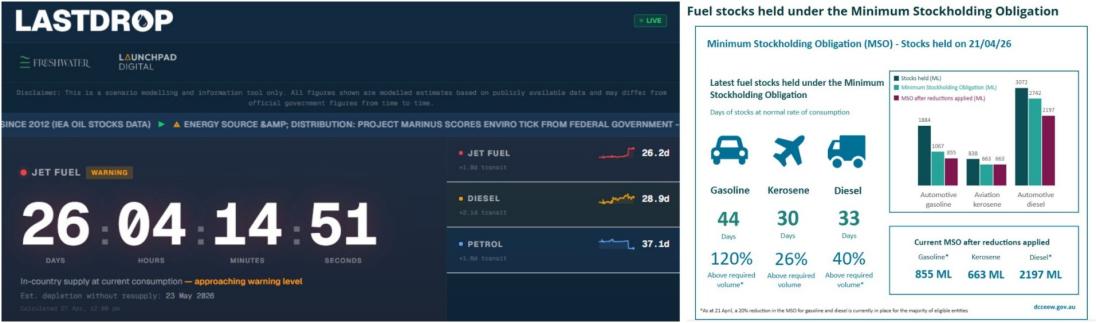
A spokesperson for the Energy Minister said Last Drop "is not accurate or a reliable source of information", adding that the correct information is released by the minister each Saturday and available on his department's website (archived link).
"Misleading and alarmist information should be avoided and is irresponsible," they told AFP in an April 23 email.
'Inferred rather than confirmed'
Pointing to the site's disclaimer and methodology, Hussein Dia, a professor of engineering at Swinburne University, told AFP in an April 16 email that Last Drop "is modelling the system based on a set of assumptions" -- including on consumption, import disruptions and panic buying (archived link).
But it is "not measuring what is happening on the ground".
There were also uncertainties in how the site handles shipping data, Dia explained.
"Fuel types and volumes are inferred rather than confirmed, and national averages are applied to individual shipments. That introduces a level of uncertainty that can compound through the model."
Dia concedes the site has "more merit" than another fuel tracker page previously debunked by AFP.
However, Last Drop "should still be interpreted as a stress-test scenario rather than an accurate measure of current fuel availability".
"It's useful for illustrating vulnerability, but not for determining exactly how many days of fuel Australia has left."
Lurion de Mello, an energy economist specialising in behavioural finance at Macquarie University, separately took issue with the site's use of a countdown clock (archived link).
"While the site includes disclaimers, it presents speculative fuel run‑out countdowns and depletion dates using authoritative visuals that closely resemble official warnings," he told AFP on April 21.
"The public-interest risk is not fake data, but misattribution. During a crisis, modelled estimates can be mistaken for official advice, potentially driving panic buying and undermining trust."
Creators of the page
The Last Drop website features the logos of Freshwater Strategy and Launchpad Digital, consultancies with ties to the opposition Liberal Party (archived here and here).
Freshwater's co-founder Michael Turner was previously the chief pollster for the party, while Launchpad's director, identified as Josh B on LinkedIn, was previously the party's head of digital (archived here and here).
Turner also wrote in a LinkedIn post that Last Drop was "shared exclusively for National News Pty Limited" -- NewsCorp (archived link).
Additionally, a video created by NewsCorp's Herald Sun -- which also published a story on April 10 about Last Drop -- featured its reporter saying, "We've launched a new live tracker that reveals in real time how much fuel Australia has left" (archived here and here).
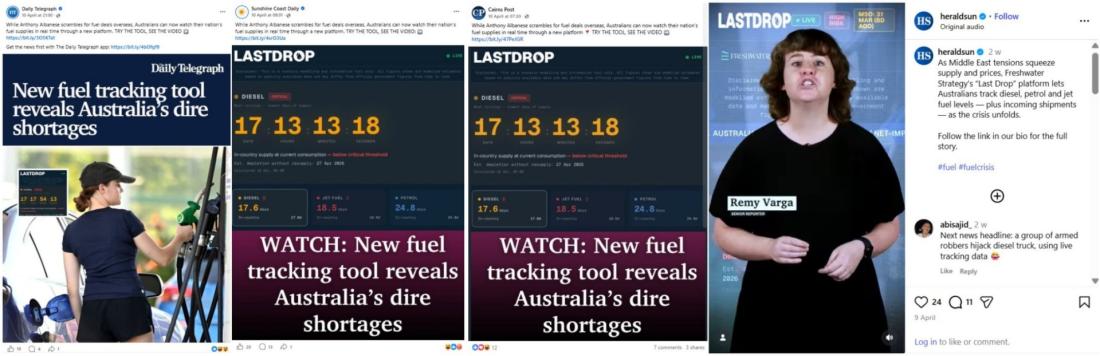
A spokesperson for Freshwater and Launchpad told AFP in an April 23 email that the platform "was not created for any clients, commercial or political".
"It was an independent, non-partisan exercise," they said, adding that they regularly do projects and make them available to media partners.
In an April 24 email to AFP, a News Corp Australia spokesman said it is "incorrect" to assert News Corp is behind the creation of Last Drop (archived link).
"Last Drop is a practical tool charting Australia's fuel supplies that we are happy to share with our audience to help them make informed cost of living choices in these uncertain times".
News Corp did not immediately respond to follow-up requests for comment on the assumptions and uncertainties of the site's modelling pointed out by experts.
Australian broadcaster ABC has also written about Last Drop (archived link).
More of our reporting on misinformation sparked by the war in the Middle East and the global energy crisis can be found here.
Copyright © AFP 2017-2026. Any commercial use of this content requires a subscription. Click here to find out more.
Is there content that you would like AFP to fact-check? Get in touch.
Contact us