Misleading fuel countdown posts stoke alarm in Australia
- Published on April 20, 2026 at 06:37
- 5 min read
- By Dene-Hern CHEN, AFP Australia
The global fuel crisis caused by the Middle East war has sparked public concern in import-reliant Australia, and triggered baseless forecasts that petrol supply is diminishing faster than official estimates. But the misleading posts cite a fuel counter website that is not a reliable source of information, a spokesperson for the energy minister said. The page's creator, as well as energy experts, separately told AFP the figures were based on modelled assumptions and should not be taken as a literal countdown to empty tanks.
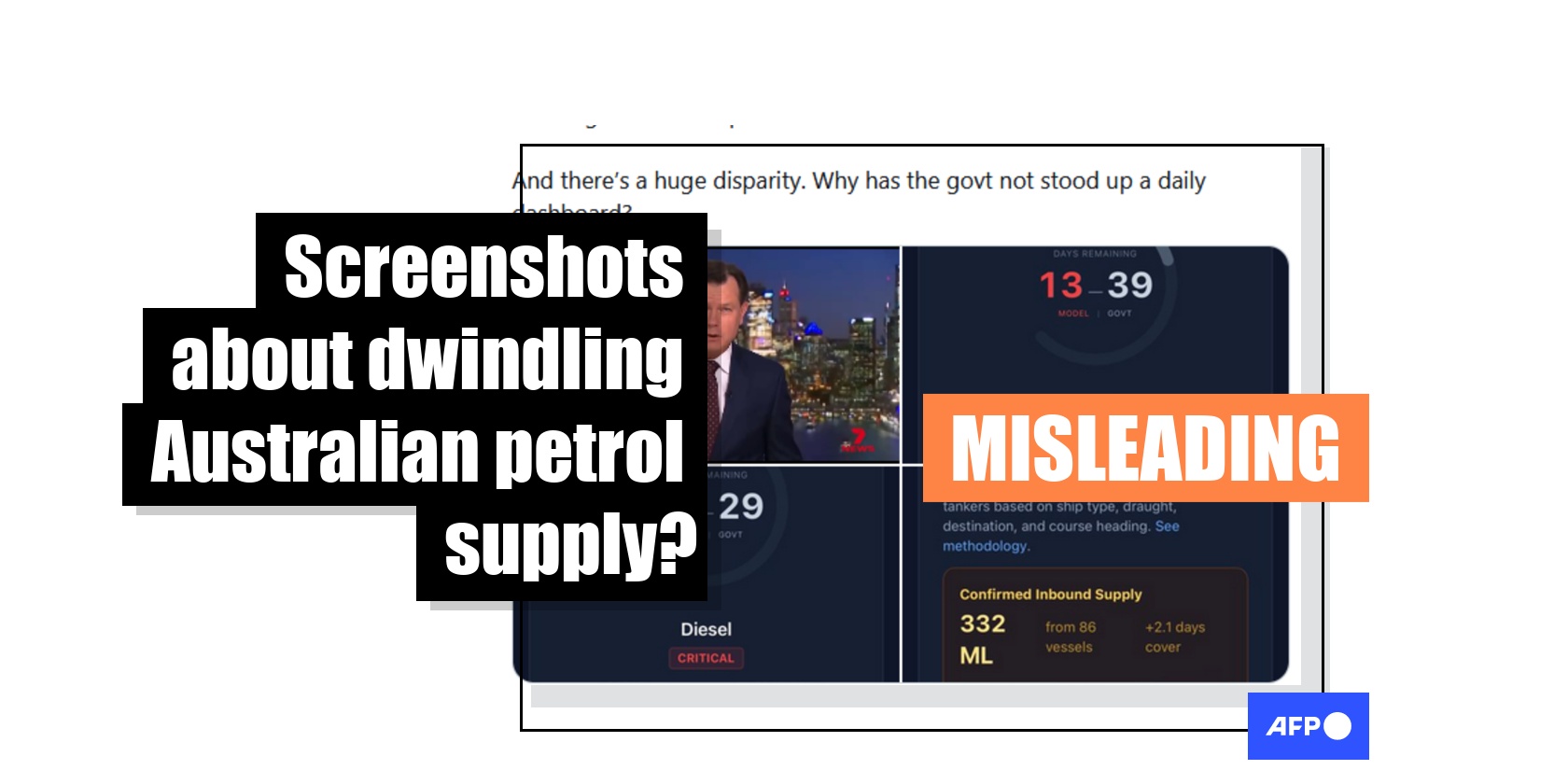
"Apps like Fuel Security are highlighting the difference between what the government is claiming vs actual ships on the water or committed. And there's a huge disparity," reads an April 7, 2026 X post featuring screenshots from a website displaying a purported fuel stock countdown clock.
One screenshot displays a "model" 13-day figure for remaining petrol stocks in red, compared to the government's 39-day figure in grey. A label beneath the counter shows a "critical" warning.

Global fuel markets have been roiled by a war in the Middle East triggered by joint US and Israeli strikes on Iran on February 28, with Tehran retaliating by effectively closing off the vital Strait of Hormuz (archived link).
Around a fifth of global crude oil and liquefied natural gas passes through the waterway in peacetime.
A first round of peace talks between the United States and Iran fell apart on April 12, after which President Donald Trump announced a US naval blockade of the strait, further shaking up markets (archived link).
With a fragile ceasefire set to expire, Trump has ordered US negotiators to travel to Pakistan for another round of talks, but Iranian state broadcaster IRIB reported on April 19 Tehran currently has "no plans to participate" in the next round of talks (archived link).
Australia is heavily reliant on imports for fuel and the government has urged the public to take measures to conserve petrol, while Prime Minister Anthony Albanese has travelled to Singapore, Brunei and Malaysia to shore up supplies (archived here and here).
Similar claims about the Australian government's fuel stocks figure being inaccurate have spread elsewhere on X and Facebook, with some linking to the FuelSecurity site displaying drastically lower numbers of petrol stocks at the time the posts were shared.
'Undue alarm'
But the FuelSecurity site's owner Bradley Hughes told AFP in emails on April 14 and 15 the drastically low modelled numbers were caused by a power outage that disrupted his home server, and that he has since corrected the figures.
"I take responsibility for the lapse," he said, adding that he has also implemented safeguards to prevent a repeat of the issue. Hughes also documented his corrections and published them on his site (archived link).
Ahead of the correction, a spokesperson for Energy Minister Chris Bowen said on April 14 that the FuelSecurity site was "not accurate or a reliable source of information" (archived link).
"Misleading and alarmist information should be avoided and is irresponsible," they said.
Australia's official figures showed that there were 38 days' worth of petrol, 28 days' worth of kerosene, and 31 days' worth of diesel in stock on April 7 (archived link).

Refreshing the FuelSecurity page on April 15 showed that the model estimated 31 days of petrol stocks, 24 days for diesel, and 24 days for jet fuel -- still slightly lower than the government's official figures reported on April 7.

The government has since updated its data, and it reported on April 14 that Australia's stock could meet petrol demand for 46 days and kerosene for 30 days, while diesel stocks remained largely unchanged.
Hughes acknowledged that screenshots of his site could "cause undue alarm".
But he emphasised that his site explicitly states on every page that it is a scenario modelling tool that combines government data with live vessel tracking, retail fuel prices and station outage data to show how Australia's fuel stocks are affected by the war in the Middle East.
Hughes' site also acknowledges "known limitations", such as his use of shipping data that does not say what cargo the vessels carry.

'Not a literal countdown'
Lurion de Mello, an expert in energy economics and behavioural finance with Sydney's Macquarie University, told AFP on April 10 the site "should be interpreted as a signal of stress, not a literal countdown to empty tanks" (archived link).
He said that the site's method of including shipping data that does not show the actual cargo could inflate or distort the estimate.

De Mello also said the site's display showing official figures in grey, while the model's numbers were in red, appeared to imply "the government is wrong and they're correct".
"Some people in the public might take the website's word for it over the government. That can create panic."
Hussein Dia of Swinburne University, who studies transport and logistics, said on April 10 the model does not take into account supply dynamics in its calculations -- it appears to be asking "what would happen if imports stayed low and demand stayed elevated" (archived link).
"Under those assumptions, you can generate much lower 'days remaining' figures," Dia told AFP.
Dia said fuel systems are adaptive in reality, and governments and industry can reprioritise distribution, manage demand and bring in alternative shipments, leading to less linear outcomes than the model suggested.
AFP has previously fact-checked other claims related to Australia's fuel reserves.
Copyright © AFP 2017-2026. Any commercial use of this content requires a subscription. Click here to find out more.
Is there content that you would like AFP to fact-check? Get in touch.
Contact us