Misleading childhood vaccine claims resurface as Trump seeks recommendation overhaul
- Published on August 11, 2026 at 23:10
- 3 min read
- By Marisha GOLDHAMER, AFP USA
Donald Trump made unsupported statements about childhood vaccination in the United States compared with Europe as he signed an executive order, and the White House followed the US president's address by republishing a misleading graphic on the number of injections recommended for children. But prior to the Trump administration's changes, the US Centers for Disease Control and Prevention (CDC) had endorsed pediatric immunizations against 17 diseases, similar to guidance in many European countries.
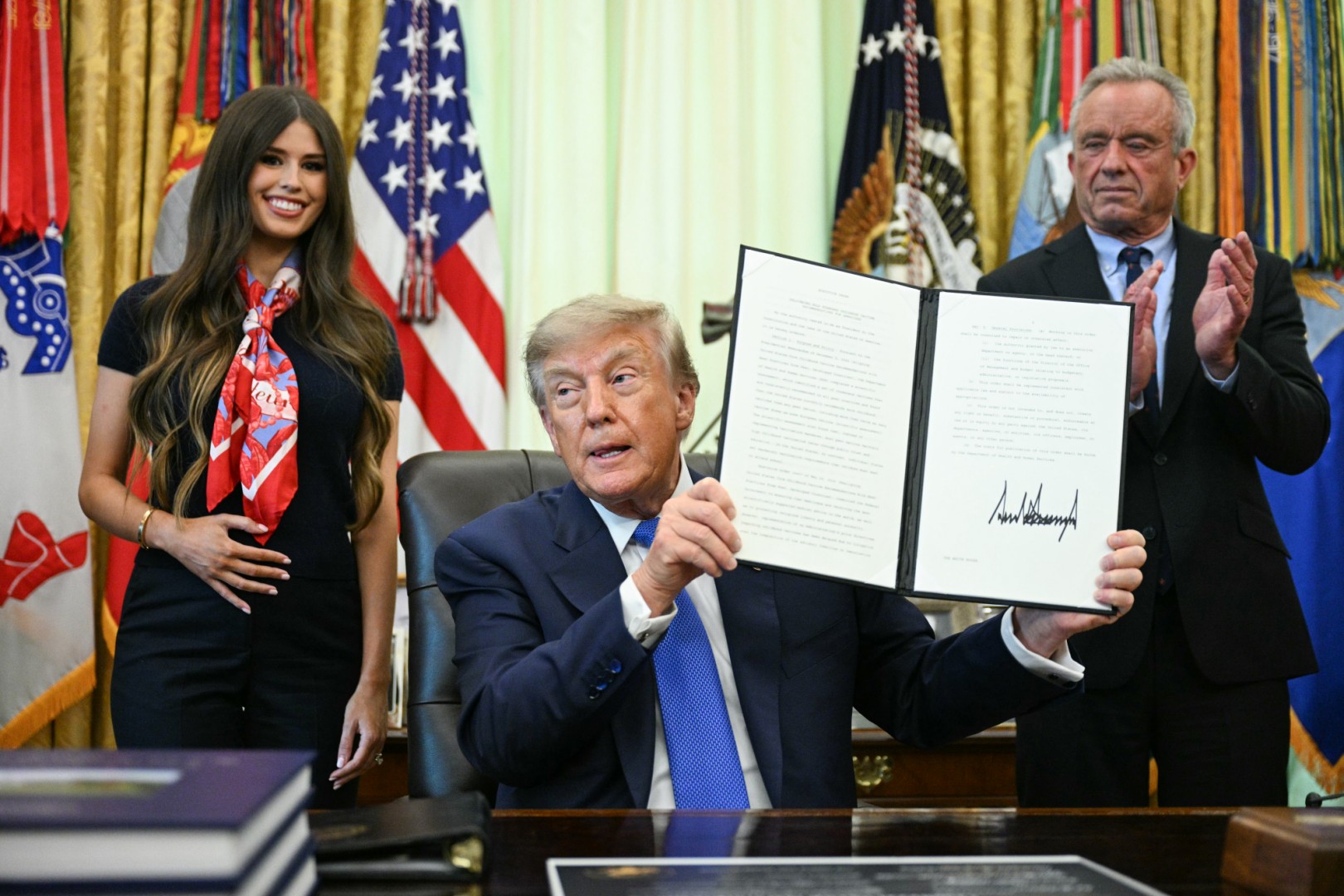
"America's recommended more childhood vaccines than any peer nation," Trump said during the August 10, 2026 Oval Office signing (archived here). "And even twice as many doses as some European countries. And even more than that, in many cases, we were requiring 72 jabs for our beautiful, healthy, lovely, delicate little children."
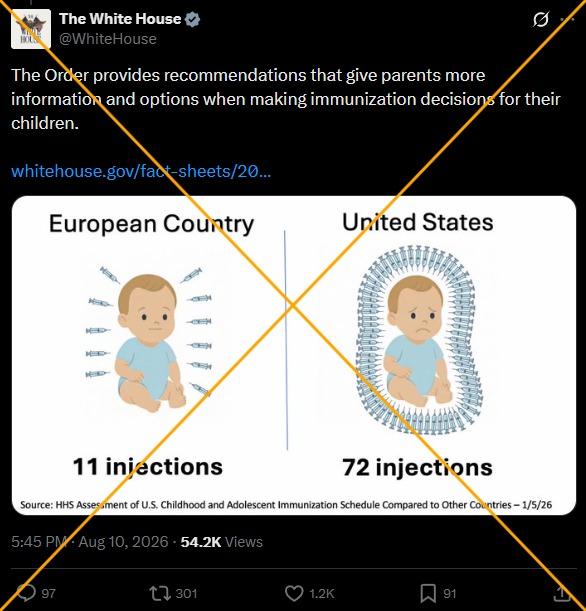
Later the same day, the White House's official X account posted a graphic -- originally shared in January -- that misleadingly claims the United States had before Trump's second term supported "72 injections" for children, compared with 11 in an unspecified European country.
The White House's image spread across platforms, amplified by prominent Trump backers such as Benny Johnson, whom AFP has repeatedly fact-checked for sharing misinformation. Trump's comments in the Oval Office also inspired other posts claiming 72 shots were "required for children."
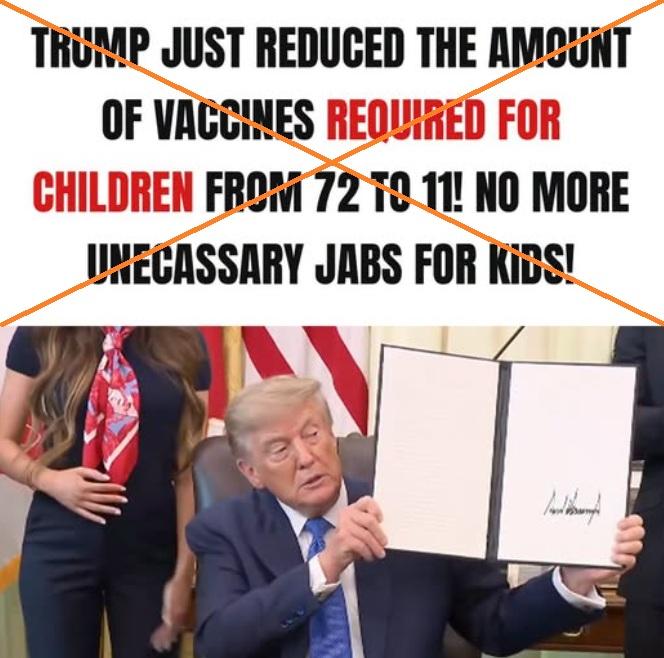
But the CDC recommendations were never federally mandated, as AFP has previously reported.
Individual states set vaccine requirements for entry into public schools and daycares. Those mandates, which Trump's executive order suggests should be reviewed, have exemptions (archived here).
The injections each American child receives vary, but the actual number is generally lower than 72 because some are administered as combination shots or orally, according to the Yale School of Public Health (archived here). A combination shot is a single injection that includes protection against two or more different diseases (archived here).
The graphic's claimed figures are also misleading in that they compare the uppermost number of vaccine doses previously recommended in the United States through age 18 -- a total that includes annual influenza and Covid-19 shots -- with the lowest number given in any European nation (archived here).
The previous US vaccination schedule more closely resembled recommendations in parts of Europe when considering the number of diseases targeted -- 17 -- rather than the dose count.
Trump's executive order now recommends that all children receive immunizations against 11 diseases: "Measles, mumps, rubella, diphtheria, tetanus, pertussis, polio, Haemophilus influenzae type B, pneumococcal disease, human papillomavirus and varicella" (archived here).
For some vaccines including hepatitis B, meningococcal disease and influenza, the order says decisions should be based on "shared clinical decision-making."
The executive order's advice mirrors a prior attempt under Trump to change the federal childhood immunization schedule -- an effort a federal judge struck down in March 2026 (archived here).
American Academy of Pediatrics (AAP) President Andrew Racine called the executive order "dangerous" in an August 11 statement, saying "there is no new evidence to justify significant changes to childhood immunization guidance" (archived here).
The AAP continues to recommend routine vaccination to protect against 18 diseases in its 2026 immunization schedule (archived here).
The American Medical Association similarly criticized Trump's order, saying in an August 10 X post (archived here): "Altering a proven vaccination schedule without credible evidence risks weakening public confidence and putting children's health at risk."
MMR vaccine
Trump also called to split up the measles, mumps and rubella vaccine into separate shots, reasserting the false claim that the combination shot is dangerous.
"Together there could be a possibility they're quite lethal, and separately it looks like they are not at all lethal but just very effective," he said.
Years of scientific evidence support the safety of the combined MMR vaccine, however (archived here and here).
Public health experts have long advised that the combined shot offers children more protection faster and also decreases the logistical hurdles for parents who may struggle to make multiple appointments (archived here).
In an August 10 call with reporters, Aaron Milstone, a member of the AAP Committee on Infectious Diseases, said the group is "advising that you continue to give children a vaccine that has decades of safety data" (archived here).
Longstanding misinformation, amplified by Trump and Health Secretary Robert F. Kennedy Jr, has also falsely linked the MMR vaccine to autism.
But a landmark study including more than 2.5 million children in the United States found "no association between MMR vaccination before 24 months and childhood autism" (archived here).
Senator Bill Cassidy, a doctor whose deciding vote confirmed Kennedy's controversial appointment as health chief, posted on X that the president's initiative would "increase hesitancy and make children less safe" (archived here).
"This executive order is wrong," Cassidy said in the August 10 message. "The President does not have the expertise to make these changes. Vaccines are overwhelmingly safe. Vaccines are effective. Vaccines DO NOT cause autism."
The order arrives as the United States is suffering its worst measles outbreak in 35 years (archived here).
Read more of AFP's reporting on vaccine misinformation here.
Copyright © AFP 2017-2026. Any commercial use of this content requires a subscription. Click here to find out more.
Is there content that you would like AFP to fact-check? Get in touch.
Contact us