White House misleads on vaccine schedule as CDC changes US recommendations
- Published on January 9, 2026 at 23:59
- 4 min read
- By Marisha GOLDHAMER, AFP USA
The Trump administration overhauled the US pediatric vaccine schedule on January 5, 2026, upending years of scientifically backed recommendations that reduced disease with routine shots. At the end of 2024, the US Centers for Disease Control and Prevention (CDC) was recommending 17 pediatric immunizations for all individuals. Now that number is 11.
The decision follows President Donald Trump's December 2025 directive that health officials review and adopt best practices from "peer, developed countries" (archived here). The CDC put a noticeable focus on Denmark, which has a minimalist schedule compared to other European nations.
As the dramatic shift was announced on January 5, 2026 the White House shared a graphic on X alongside a screenshot of a Truth Social post from Trump that falsely claimed the United States previously required "72 jabs" for children in contrast to just 11 in Europe.
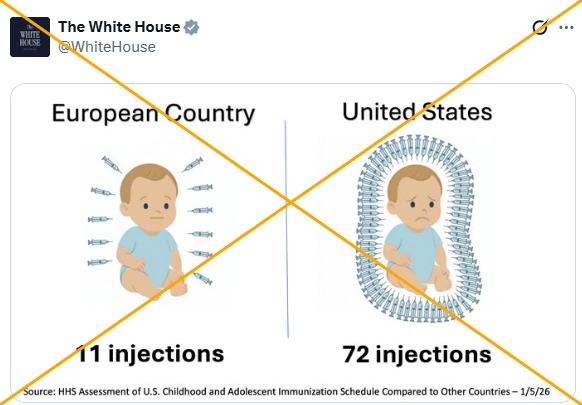
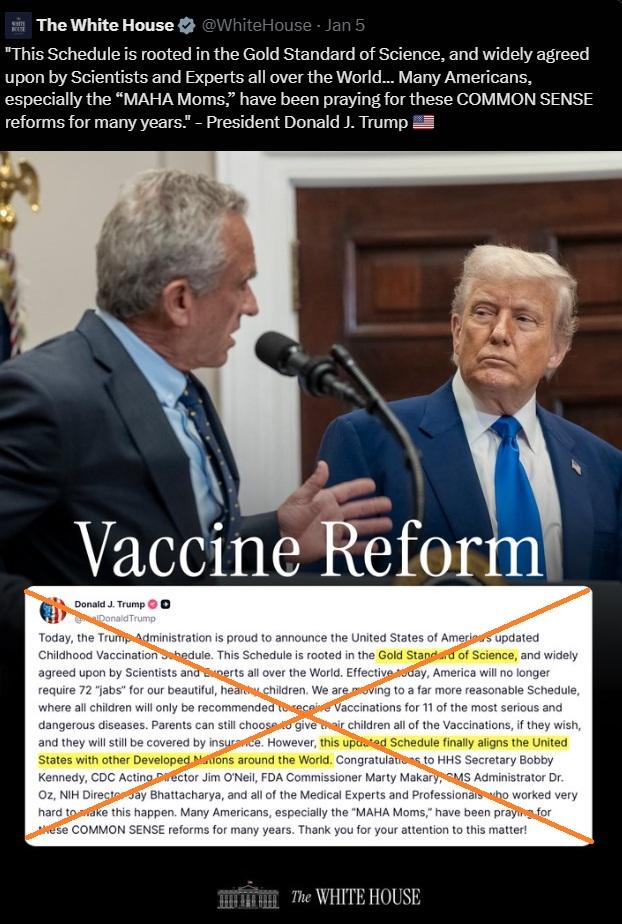
But the CDC recommendations were never a federal mandate, as AFP has previously explained. States set vaccine requirements for entry into public schools and daycares and these mandates, which are often guided by CDC advice, have exemptions (archived here).
Additionally, the graphic misleads by implying a child will receive 72 injections in infancy. The number of shots varies, but according to the Yale School of Public Health the actual number is generally lower as combination and oral vaccines are administered (archived here).
The figures also misleadingly compare the uppermost number of vaccine doses previously recommended in the United States through age 18 to the lowest number given in any European nation (archived here).
The American Academy of Pediatrics (AAP) said the changes to the vaccine schedule are "dangerous and unnecessary" (archived here).
Sean O'Leary, chair of the AAP's Committee on Infectious Diseases (archived here), told a press call on January 5: "The US child vaccine schedule is one of the most thoroughly researched tools we have to protect children from serious, sometimes deadly diseases."
He said his organization will continue to issue "evidence-based recommendations" it says are "based in science and not in a political agenda."
Denmark in focus
Trump's claim seemed to call back to a presentation given by Acting Director of the Food and Drug Administration's Center for Drug Evaluation and Research Tracy Beth Høeg on December 5, 2025 during a meeting of the CDC's Advisory Committee on Immunization Practices.
It included a slide which said the United States will give 72 total vaccine doses, assuming diphtheria, tetanus, pertussis, haemophilus influenzae type B, polio and hepatitis B are given separately, and compared that to 11 doses in Denmark, 17 in the United Kingdom, 22 in Germany and 28 in Japan.
Høeg said her total also counts annual influenza vaccines from infancy, but Germany and Denmark only recommend the vaccine to patients in particular risk groups.
This comparison misses the context of the broader trends favoring annual flu protection for young children in Europe where six countries have a universal recommendation starting at 6 months of age and 13 others have age specific guidance (archived here).
Ahead of the CDC announcement, experts at the Vaccine Integrity Project, an initiative out of the University of Minnesota, warned against the use of Denmark as a yardstick for comparison to the United States.
"Denmark's schedule reflects a set of choices made in a small, highly homogeneous country with a centralized health care system that guarantees universal access to care, low baseline disease prevalence, and strong social infrastructure," the group wrote on December 22, 2025 (archived here).
"Those conditions do not apply to the United States, not even close."
One change by the CDC, to have teens receive just one dose of the HPV vaccine, rather than the prior two dose schedule, aligns with research published in 2024 and World Health Organization confirmation that a single shot of several vaccine products can protect girls from cervical cancer (archived here, here and here).
'10 steps backwards'
The previous US vaccination schedule was more similar to recommendations in parts of Europe when considering the number of diseases targeted, rather than the dose count.
The CDC says it will continue to recommend vaccination against 10 diseases "for which there is international consensus" -- diphtheria, tetanus, whooping cough, Haemophilus influenzae type b, Pneumococcal conjugate, polio, measles, mumps, rubella, and human papillomavirus (HPV) -- as well as chickenpox (archived here).
AFP previously examined false claims from Health Secretary Robert F. Kennedy Jr. that Europe rejects the chickenpox vaccine, instead finding it is recommended in 13 countries, in addition to Hungary, Italy and Latvia currently making it mandatory (archived here).
Beyond the recommended immunizations, the CDC designated certain vaccines for high-risk populations, saying protection against rotavirus, COVID-19, influenza, meningococcal disease, hepatitis A, and hepatitis B can be given to most children "based on shared clinical decision-making."
The AAP continues to recommend that children be immunized against these diseases (archived here).
Alicia Stillman, co-executive director of the American Society for Meningitis Prevention (archived here), told AFP on January 6 an issue she has observed with vaccines that are not given recommended status is that they are "looked at as optional."
Studies suggest recommendation status impacts vaccination rate, Stillman said, pointing to more people receiving the previously recommended MenACWY vaccine than the MenB vaccine which was offered under "shared clinical decision-making" (archived here and here).
"I feel like we just took 10 steps backwards," she said.
US cases of meningococcal disease have increased sharply since 2021 (archived here). The bacteria "kills in a matter of hours. And the only way to protect against this is by vaccination," Stillman said.
"These are preventable deaths."
Read more of AFP's reporting on vaccine misinformation here.
Copyright © AFP 2017-2026. Any commercial use of this content requires a subscription. Click here to find out more.
Is there content that you would like AFP to fact-check? Get in touch.
Contact us