Catching measles does not protect against cancer
- Published on December 18, 2025 at 22:17
- 4 min read
- By Gwen Roley, AFP Canada
Canada lost its measles elimination status in 2025 and outbreaks persist across North America, but social media users are arguing against vaccinating for the disease by claiming research from a decade ago proves contracting it can prevent cancer. Medical experts said this misinterprets a case study that used engineered virus cells -- distinct from wild-type measles -- for cancer-treatment therapy, and that widespread vaccination is recommended to protect immunocompromised cancer patients.
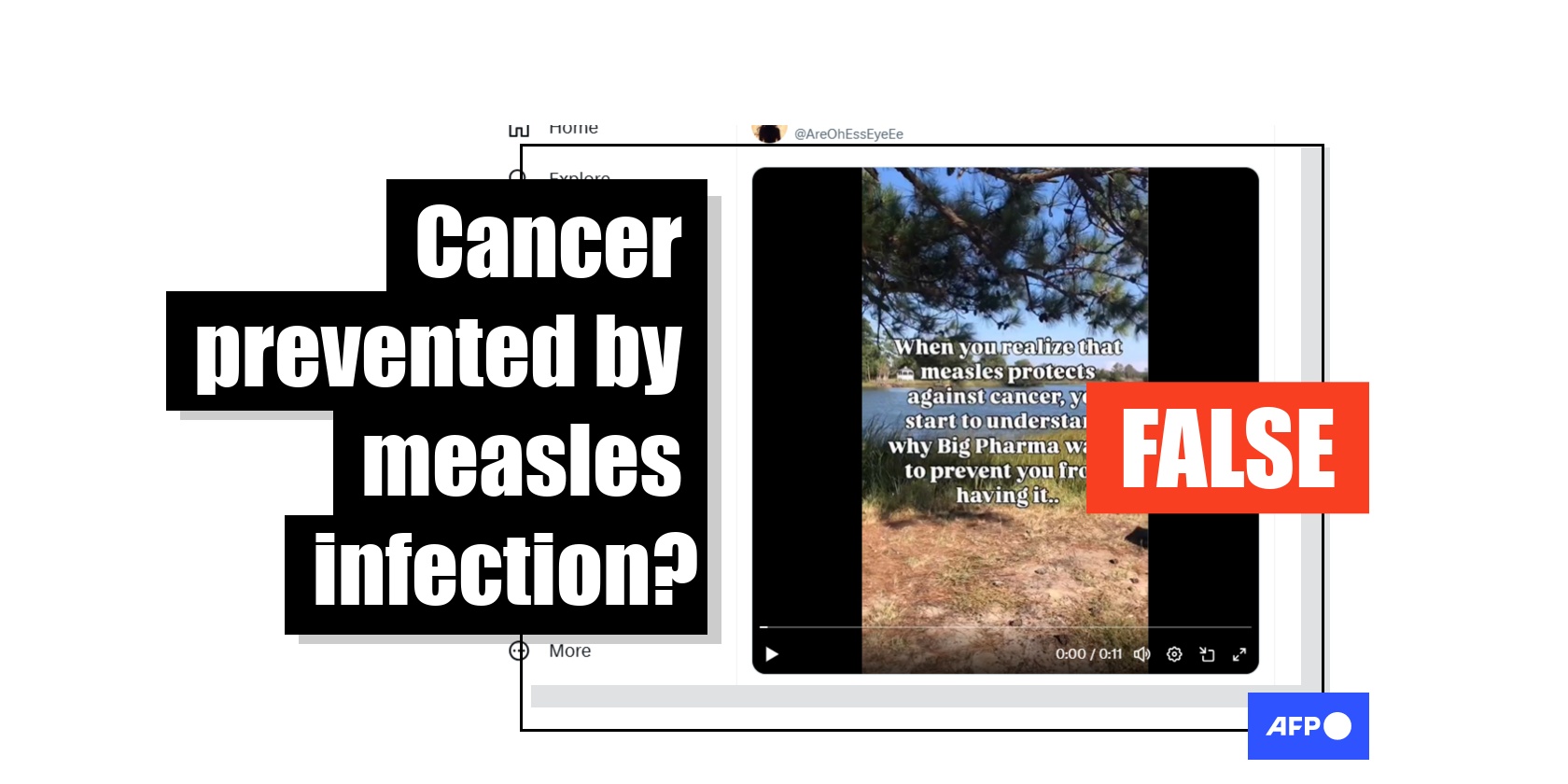
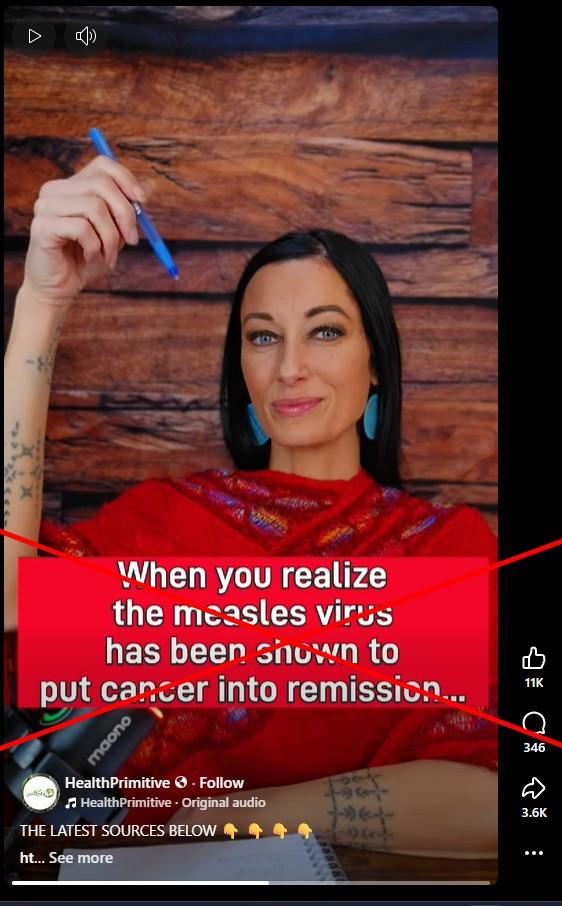
"When you realize the measles virus has been known to put cancer into remission... and they spent the last 50 years convincing you it's one of the deadliest threats to humanity," says text over a December 13, 2025 Facebook video.
The clip, viewed more than 200,000 times, goes on to claim that a 2014 Mayo Clinic paper proved "high-dose measles virus" leads to "blood cancer remission."
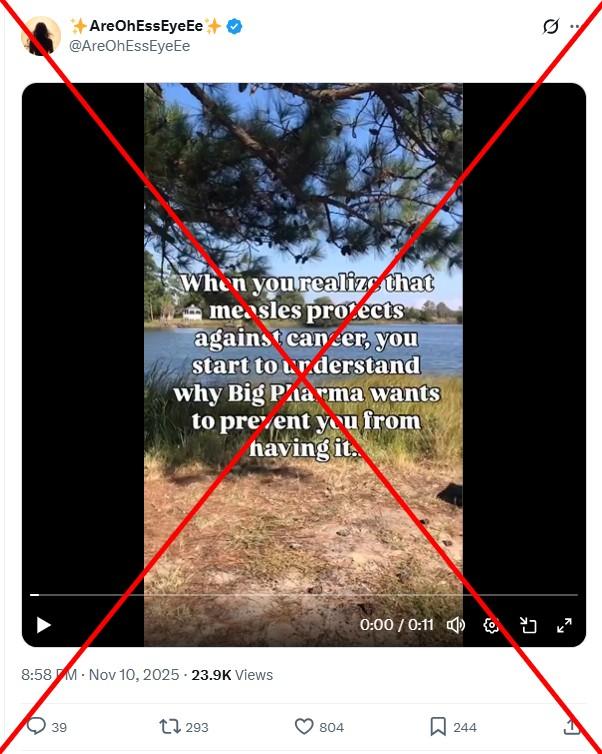
Several other posts shared throughout 2025 on X, Instagram, Facebook and TikTok spread similar claims alleging that Mayo Clinic proved measles guards against cancer, and that the research shows "why Big Pharma wants to prevent you from having it."
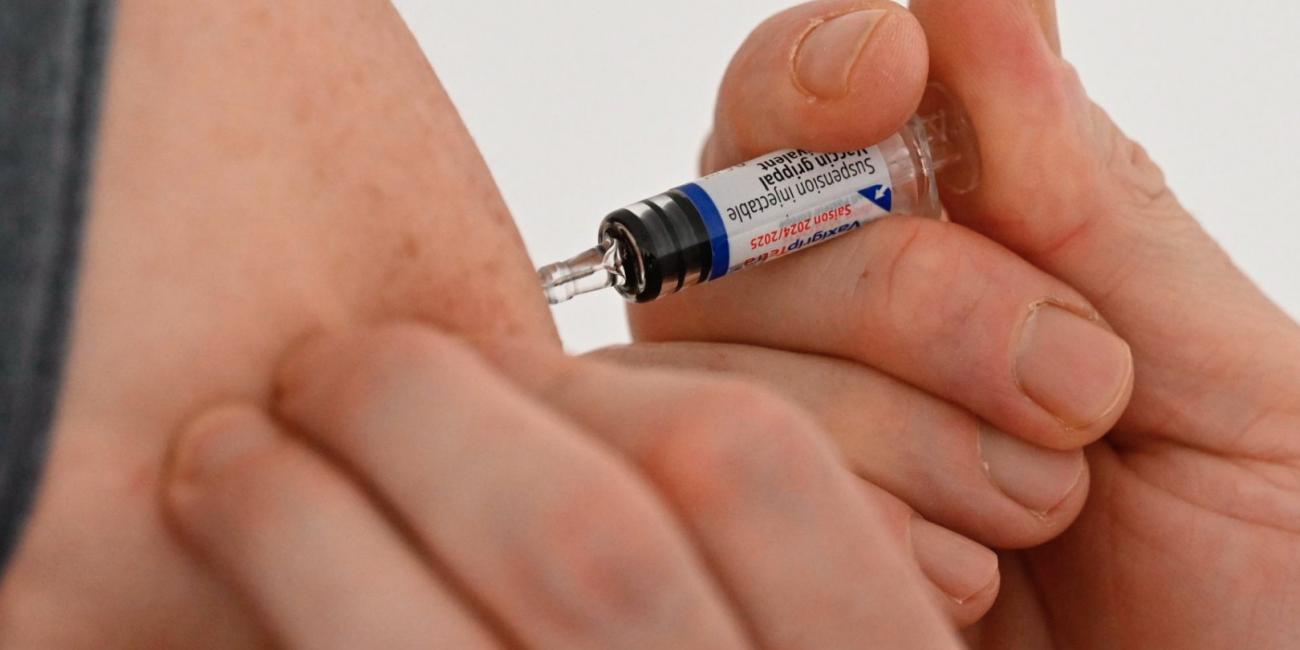
Measles is a highly contagious virus that causes respiratory symptoms and can lead to encephalitis and death (archived here). Vaccination campaigns in North America beginning in the 20th century dramatically decreased the rate of infection, but several outbreaks starting in 2024 caused a jump in cases in the United States, Mexico and Canada.
The World Health Organization set out to eliminate measles worldwide by 2030 through campaigns to offer vaccination to children, but it admitted in November 2025 the goal "remains a distant one," particularly with immunization rates falling in high-income countries (archived here).
Canada lost its measles elimination status in November 2025.
AFP has debunked several misleading claims on the virus and the measles, mumps and rubella vaccine, which immunizes against the disease. The posts claiming measles protects against cancer are similarly misleading.
Mayo Clinic did publish research in 2014 on a case in which an engineered version of the measles virus was used to kill myeloma plasma cells and saw the patient enter remission (archived here and here). But this infusion was not the same as contracting measles.
In response to anti-vaccine claims that sprung from the research, Mayo Clinic put out a position statement in 2019 saying "measles is not protective against cancer" and that prior vaccination would boost any "potential utility as a cancer therapy" (archived here).
"There is no evidence that measles can prevent the development of cancer," added Stephen Russell, a professor of molecular medicine at Mayo Clinic and one of the paper's authors, in a video published in tandem with the statement (archived here and here).
Russell said the patient in this case was previously vaccinated against measles, which contributed to her positive response.
Oncolytic virotherapy
The 2014 Mayo Clinic case used a class of cancer treatments known as oncolytic virotherapy, which deploys derivations of viruses -- such as measles -- that are engineered to attack cancer cells (archived here).
"But that's totally a therapeutic application of viruses, completely different than what happens with natural infections," said John Bell, a senior scientist at the Ottawa Hospital Research Institute, in a December 15, 2025 interview (archived here).
Bell, who carries out oncolytic virotherapy research, explained that the treatment the patient received in the Mayo Clinic case was actually a derivation from the measles vaccine, as opposed to the wild-type virus contracted via infection (archived here).
In addition to the patient's vaccination status, Bell said the immunosuppression from her cancer allowed the engineered version of the measles virus to target cancer cells while ignoring normal tissue.
Bell clarified that while the case in 2014 successfully sent the patient into remission, the use-case for this type of measles virotherapy is still "very much in development."
Engineered versions of another virus, herpes, have been approved to treat some cases of melanoma in the United States and glioblastoma in Japan (archived here and here).
Cancer patients and immunity
Most cancer patients are both immunocompromised and highly at risk of adverse reactions if they contract a disease like measles, Bell said (archived here). This is why he encouraged vaccination for the general population: to protect people with weaker immune systems from infection.
Pierre-Philippe Piché-Renaud, a pediatric infectious diseases physician at the Hospital for Sick Children in Toronto, also emphasized the importance of vaccination against measles (archived here).
"If people have these misconceptions that it could protect against cancer and protect against infection, they will be very disappointed because these infections -- the measles infection -- does quite the opposite," he said in a December 11, 2025 interview.
"People who are infected with measles are actually more likely to get other kind of infections."
Piché-Renaud attributed the resurgence of measles in Canada to vaccine complacency resulting from a lack of reliable information on vaccination, as well as limited access to the shots in certain places.
He recommended consulting trusted sources and physicians to learn how vaccination can prevent measles infections.
Read more of AFP's reporting on misinformation in Canada here.
Copyright © AFP 2017-2026. Any commercial use of this content requires a subscription. Click here to find out more.
Is there content that you would like AFP to fact-check? Get in touch.
Contact us