Study does not prove vaccines increase dementia risk
- Published on July 24, 2026 at 21:25
- 3 min read
- By Chloé RABS, AFP France
- Translation and adaptation Marisha GOLDHAMER, AFP Canada
Research on dementia prevention has pointed to possible benefits from adult vaccination, but on social media, one study that failed to reaffirm those findings is being misrepresented to claim shots against influenza and pneumonia dramatically increase the risk of Alzheimer's disease. The paper's lead author told AFP that despite its unexpected results, the study in no way proved a causal link between vaccination and the onset of neurodegenerative diseases.
"Adult vaccination is associated with a 50% HIGHER risk of ALZHEIMER'S and a 38% HIGHER risk of DEMENTIA, according to the LARGEST vaccine-dementia study ever conducted," begins the caption of a July 18, 2026 X post from Nicolas Hulscher. The epidemiologist has repeatedly been fact-checked for spreading disinformation, particularly about Covid-19 vaccines.
"What was most concerning was the more doses that they got, the higher the risk of dementia and Alzheimer's became" he claimed in a video clipped from a nearly two-hour-long program hosted on the Canadian video streaming platform Rumble.
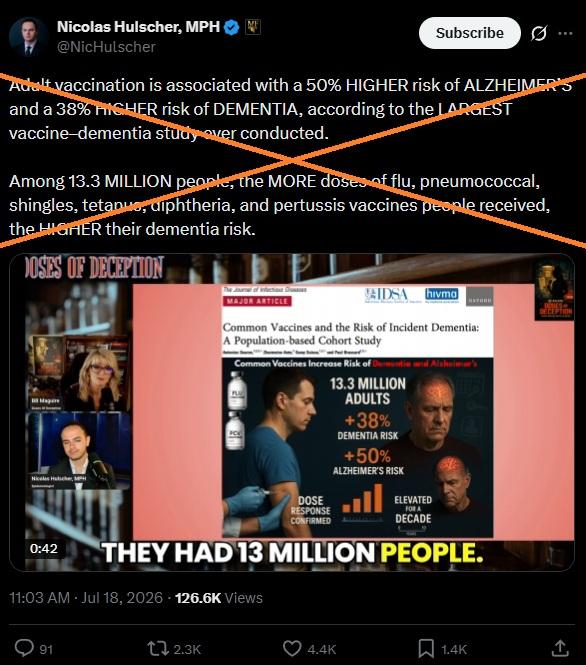
Similar videos in English and French spread across Facebook, Instagram, Threads, Bluesky and TikTok.
In the clips, Hulscher references a May 2023 paper published in the Journal of Infectious Diseases titled: "Common Vaccines and the Risk of Incident Dementia: A Population-based Cohort Study" (archived here).
But the study's lead author, Antonios Douros, an expert in pharmacoepidemiology (archived here), told AFP his paper's findings were being misrepresented.
He said the takeaway from the research is not that getting vaccinated increases dementia risk, but unlike in previous research, they did not find immunization helped prevent neurodegenerative disease.
'Infectious disease hypothesis'
Dementia is a condition impacting millions of people worldwide that affects memory and the ability to perform daily activities (archived here).
The World Health Organization reports it as "the seventh leading cause of death and one of the major causes of disability and dependency among older people globally (archived here).
There are several known risk factors for dementia including smoking, alcohol consumption, high cholesterol and diabetes (archived here). Dementia can also be caused by damage to the brain such as a stroke or head injury (archived here).
Several studies have led researchers to theorize that development of dementia is linked to a wide range of infectious pathogens (archived here and here).
Guillaume Dorothée, head of neuroimmunology, inflammation and therapeutics at the Saint-Antoine Research Center in Paris (archived here), told AFP that experimental data shows that infections can increase the severity of certain degenerative diseases or accelerate their progression.
"This makes biological sense because we know there are immune components in the brain that contribute to the emergence of these diseases and can be amplified by infections," he said.
Similarly, Douros and his co-authors said in their paper that the "infectious disease hypothesis" was seemingly supported by observational studies and experiments that found "different vaccines are associated with strongly decreased risks of dementia," (archived here, here and here).
So, they also sought to examine whether vaccinating people could "reduce inflammatory factors that contribute to the emergence of dementia."
From the United Kingdom-based study cohort, the researchers examined the association between a list of vaccines and the onset of dementia.
The paper reported "common vaccines were associated with an increased risk of dementia" but concluded that the observed increased risk likely stemmed from "unmeasured confounding and detection bias."
Douros said Hulscher's interpretation of findings from the study were "problematic and misleading" since the association was statistical and did not account for all the factors needed to establish a causal relationship between vaccination and dementia.
Study limitations
Douros said it is important to acknowledge "potential limitations due to the complexity of the study question." This includes confounding differences in characteristics between vaccinated and unvaccinated individuals that were not measured in the available data, such as frailty.
Detection bias also comes into play since vaccinated individuals may be more likely to be diagnosed with dementia "just because they are seen more regularly by physicians," he said.
The paper noted "the increase in risk was driven by regularly recurring vaccinations (influenza and pneumococcus for those at higher risk) -- that is, vaccinations leading to more frequent physician visits and potentially to elevated chances of disease detection -- and not by vaccinations more likely to be administered in a one-off fashion."
Dorothée agreed that the authors were "very clear and cautious, concluding only that they did not succeed in revalidating a beneficial effect of vaccination."
Read more of AFP's reporting on vaccine misinformation here.
Copyright © AFP 2017-2026. Any commercial use of this content requires a subscription. Click here to find out more.
Is there content that you would like AFP to fact-check? Get in touch.
Contact us