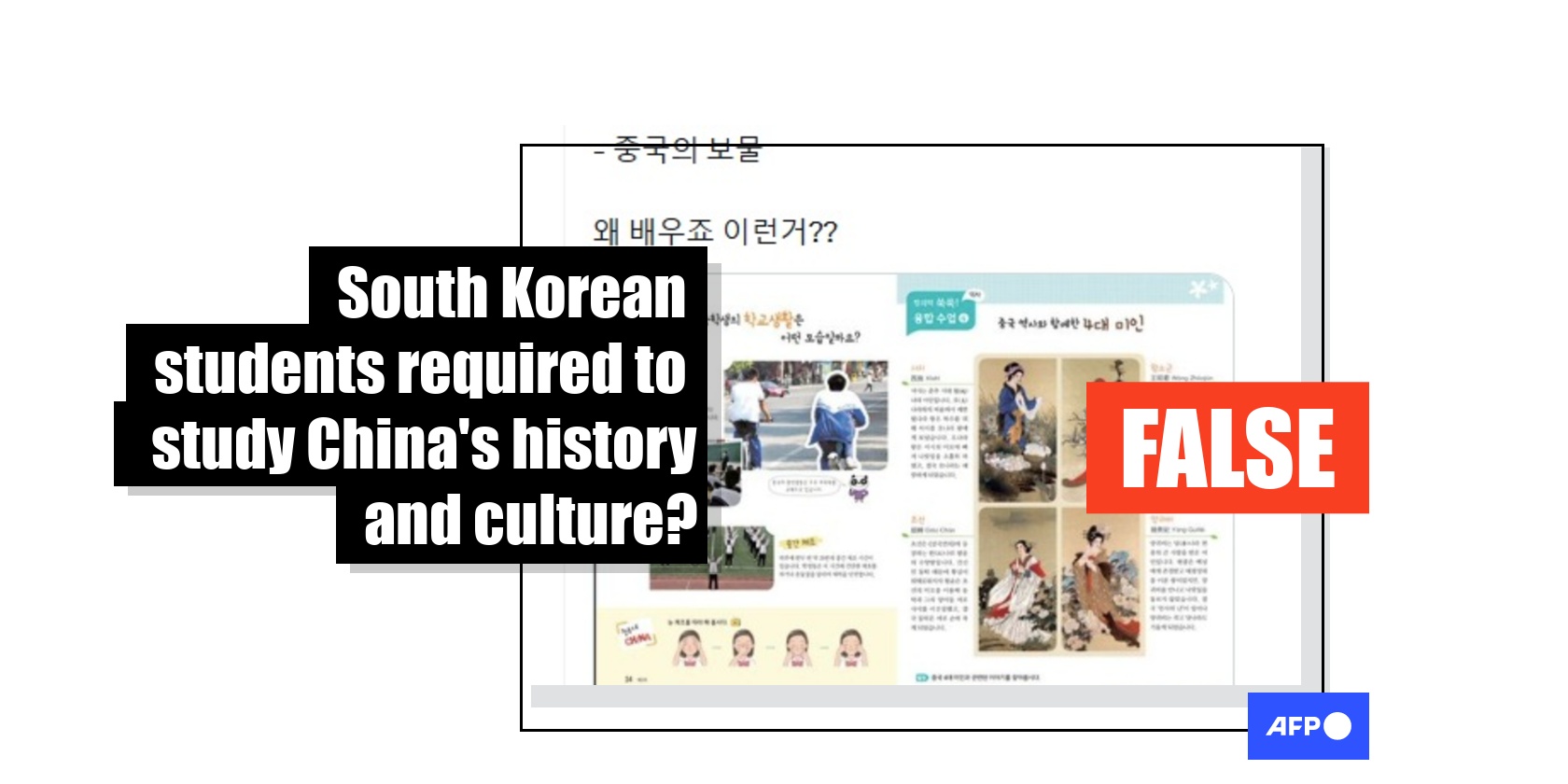
Posts falsely claim all South Korean students required to learn Chinese history, culture
- Published on July 16, 2026 at 10:23
- 3 min read
- By Hawon Jung, AFP South Korea
Pages about China's history and culture, taken from a textbook for an elective language course used by a relatively small number of South Korean middle schoolers, are circulating in posts falsely claiming they show what all students are now required to learn. Anti-Chinese narratives such as this have long been amplified by South Korea's far-right. One teacher told AFP there was nothing unusual about the textbook, and it was concerning that such content had been politicised.
"This is what the final term for middle school students these days covers -- the daily lives of Chinese school children, the four beauties of China, China's key national anniversaries, Chinese currency, China's national treasures. Why do they learn stuff like this?" says a Korean-language X post shared on June 19, 2026.
The post shares what appears to be screenshots from a school textbook depicting the daily lives of Chinese middle school students, the "four beauties" of ancient Chinese history, major traditional holidays in China and special foods associated with those celebrations.
"This is aimed at China-fying South Korea!" reads a comment on the post, while another says "Parents: they are brainwashing our innocent children!"

The screenshots were also shared in similar Threads, YouTube and X posts, as well as on far-right website Ilbe.
Comments on these posts similarly raise the alarm about supposed Chinese infiltration.
"Red communists are behind our school textbooks... this is really concerning" says one comment. Another reads: "They are dreaming of taking over Korea."
But the claim is false and appears to be another example of the anti-Chinese narratives that commonly spread among South Korea's far-right.
Such claims often surface around elections, baselessly tying Chinese nationals to electoral and visa fraud. Widely debunked claims of Chinese meddling or Beijing-engineered election fraud were also shared ahead of the June 6 regional elections.
Ballot paper shortages reported at many polling stations on election day sparked weeks-long protests in Seoul, with many protestors also accusing South Korean police officers and journalists at demonstration sites of being Chinese (archived link).
Elective course
A reverse image search on Google led to a Chinese-language textbook that contained the same pages shown in the falsely shared screenshots (archived link).
The textbook is for middle school students who choose to learn Chinese as a second foreign language.
South Korean requires all middle and high school students to take English as a foreign language. They can also take an elective second foreign language course -- choosing from eight options including Chinese, Japanese, French, German and Arabic, although not all eight languages are available at all schools (archived link).
The percentage of students studying Chinese as a second foreign language is relatively small compared to the total number of school children in South Korea, especially after such courses became elective in the late 2000s (archived link).
Nearly 20 percent of high schools in South Korea reportedly do not offer second foreign language course as a growing number of universities dropped the subject from college application requirements (archived link).
Among some 554,174 high school seniors and graduates who took the national college entrance exam in 2025, only 13,654 applicants -- around 2.5 percent -- took the elective test for Chinese language, according to education ministry figures (archived link).
'Hateful and exclusionary worldview'
The Chinese language textbook's foreword says it aims to help students "learn basic Chinese grammar and expressions in ways that are fun and efficient" and "understand different cultures".
It teaches grammar, idioms and everyday expressions, with each chapter featuring brief facts about Chinese society and culture.
"To spark children's interest in a language, it is essential to nurture their curiosity about the broader culture and society of the country. There's nothing unusual about it," Hyun Kyung-hee, a Korean literature teacher with three decades of experience, told AFP on July 15.
Hyun, who is a spokeswoman for the Korean Teachers and Education Workers Union, added the kind of information shared on social media has been featured in foreign language textbooks for decades without a problem until anti-Chinese narratives were recently politicised by the far-right.
"It is deeply concerning that even content of an ordinary foreign language school textbook has become a target of such hateful and exclusionary worldview," she said.
AFP has previously debunked other false anti-Chinese narratives that circulated in South Korea.
Copyright © AFP 2017-2026. Any commercial use of this content requires a subscription. Click here to find out more.
Is there content that you would like AFP to fact-check? Get in touch.
Contact us