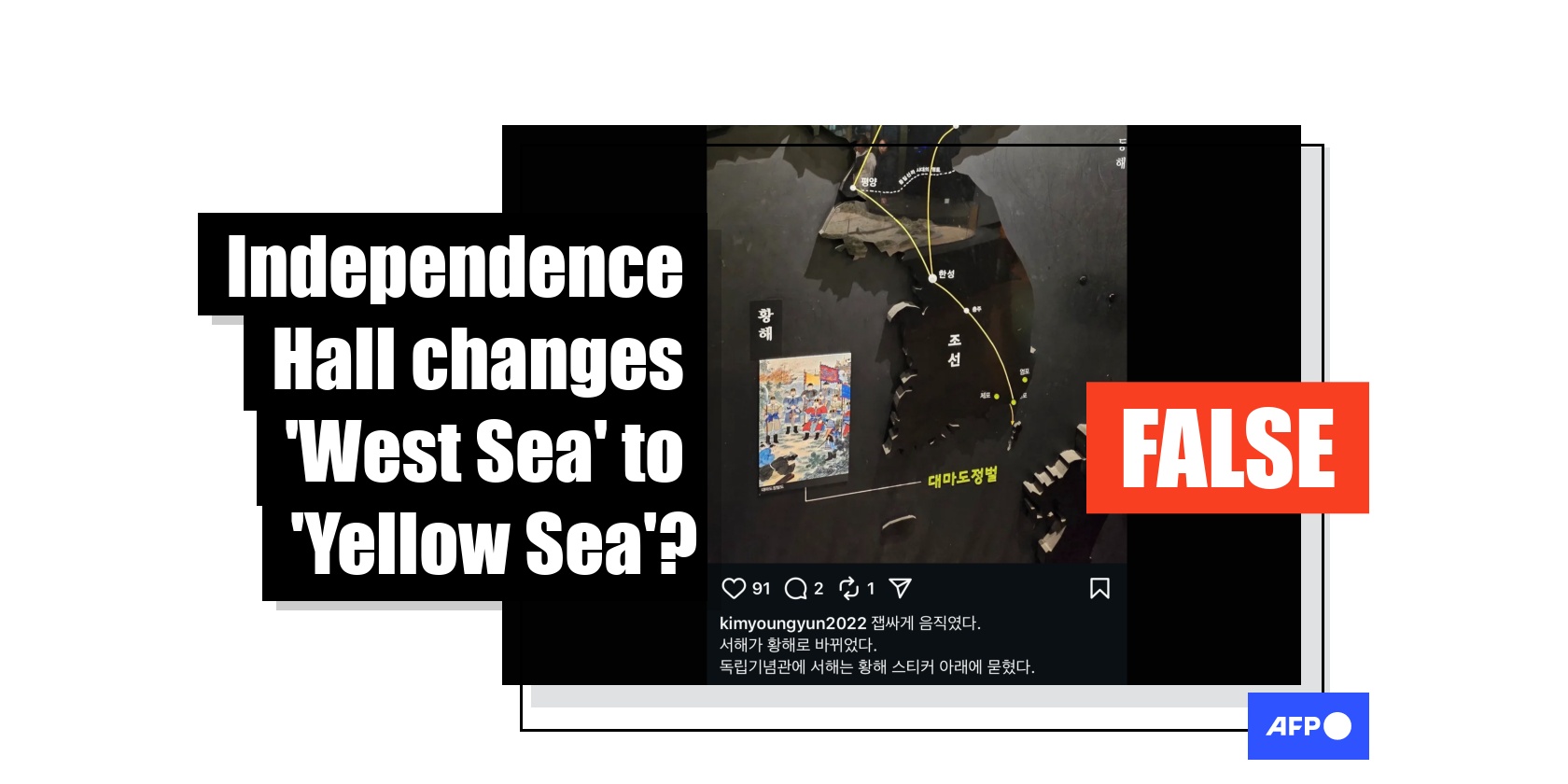
False posts about S. Korean exhibit push China capitulation narrative
- Published on January 16, 2026 at 09:28
- 3 min read
- By Hailey JO, AFP South Korea
After South Korean President Lee Jae Myung met Chinese leader Xi Jinping in January 2026, a photo of a museum exhibit was shared in posts falsely claiming it had been modified to align with Lee "selling the country out" to Beijing. The posts claim the exhibit was altered to rename the sea separating South Korea and China from the "West Sea" to the "Yellow Sea". But a museum spokesperson told AFP the body of water has always been labelled that way, and a sticker over the name was because of maintenance rather than a change of wording.
"At the Independence Hall, a sticker reading Yellow Sea has covered up the term West Sea," reads part of the Korean-language caption of an Instagram photo shared on January 10, 2026.
"They are selling the country out. To cling to power, they've taken a nation that prospered through the South Korea-United States alliance and shoved it straight into China's mouth," adds the caption, which includes a hashtag of a derogatory nickname for South Korean President Lee Jae Myung.
The photo shows a map of the Korean peninsula, which is displayed in the Independence Hall museum as part of an exhibit about Joseon-era foreign policy.
The museum was founded in 1987 and is dedicated to collecting, preserving and showcasing materials related to the country's history and resistance efforts to regain independence from Japanese colonial rule (archived link).
The body of water to the west of the peninsula is labelled in Korean as the "Yellow Sea", with the label appearing to have been stuck onto the exhibit.
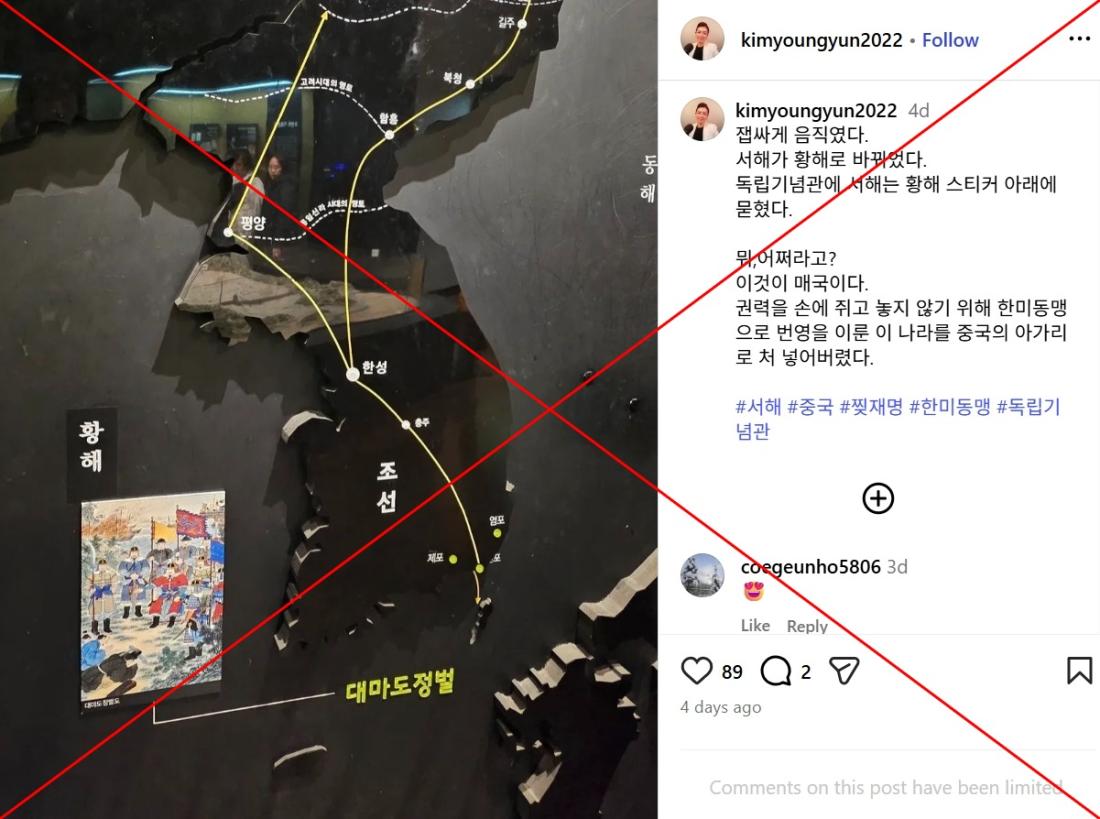
The West Sea, officially known as the Yellow Sea, lies between the Korean peninsula and China.
While "West Sea" is commonly used in South Korea, "Yellow Sea" is the official name used by the South Korean government and international bodies such as the United Nations (archived here and here).
The sea is too narrow for either country to fully claim in its entirety as an exclusive economic zone (EEZ) which the UN Convention on the Law of the Sea defines as being within 200 nautical miles from the country's coast (archived link).
Seoul has long pushed for an equidistance line approach -- a position also taken by the conservative Park Geun-hye administration -- in line with the country's EEZ law that sets "the median line" as the default boundary unless another agreement is reached with relevant states (archived here and here).
Beijing has argued for a boundary that reflects coastline length and other factors and gives it a larger share of the sea than a median line would allow (archived link).
A provisional agreement took effect in 2001 allowing only fishing and navigation in overlapping EEZ waters, but no official boundary has been demarcated leading to disputes (archived here and here).
Following reports that Lee proposed a median line during a four-day state visit to China in January where he met Chinese leader Xi Jinping, the same photo circulated across platforms including Facebook, Threads and X (archived here and here).
The posts tapped into a narrative among conservatives that casts Lee and other liberal politicians as sympathetic to, or even controlled by Beijing.
The circulating photo, however, does not show an exhibit that was recently changed.
'Never been changed'
A spokesperson from the Independence Hall told AFP the term "Yellow Sea" was selected following a "comprehensive review" of official geographical naming standards and school curricula when the exhibit was created in 2010, and "has never been changed".
The Yellow Sea label was placed over the exhibit's original lettering that had been "damaged and peeled off due to ageing" as part of maintenance, she said on January 15.
A reverse image search on Google led to multiple blog posts from as early as 2016 that shared photos of the same exhibit at the Independence Hall seen in the false posts (archived here, here and here).
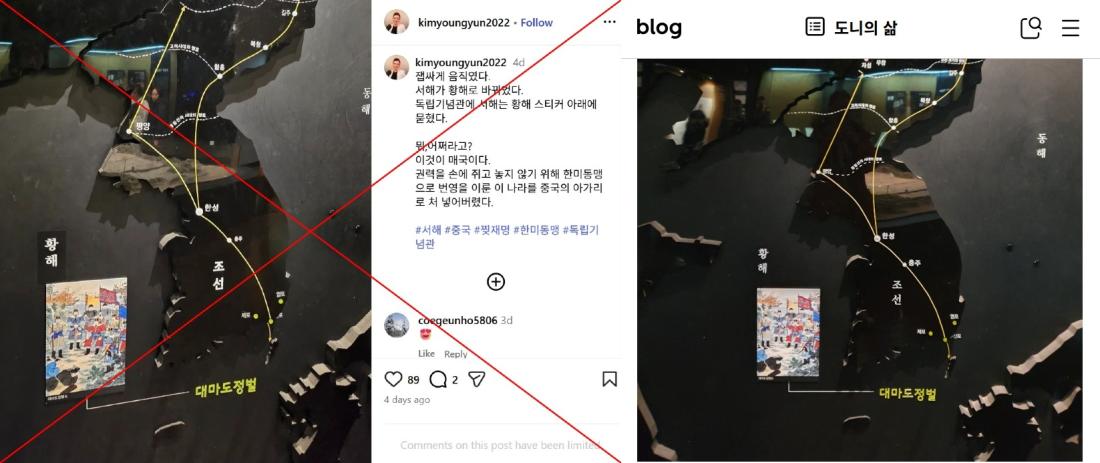
The earlier posts show the body of water was labelled the Yellow Sea, contrary to claims the wording had been recently altered from "West Sea".
The claim is the latest example of misinformation falsely casting developments in South Korea as evidence of purported Chinese influence. AFP has previously debunked similar false claims.
Copyright © AFP 2017-2026. Any commercial use of this content requires a subscription. Click here to find out more.
Is there content that you would like AFP to fact-check? Get in touch.
Contact us