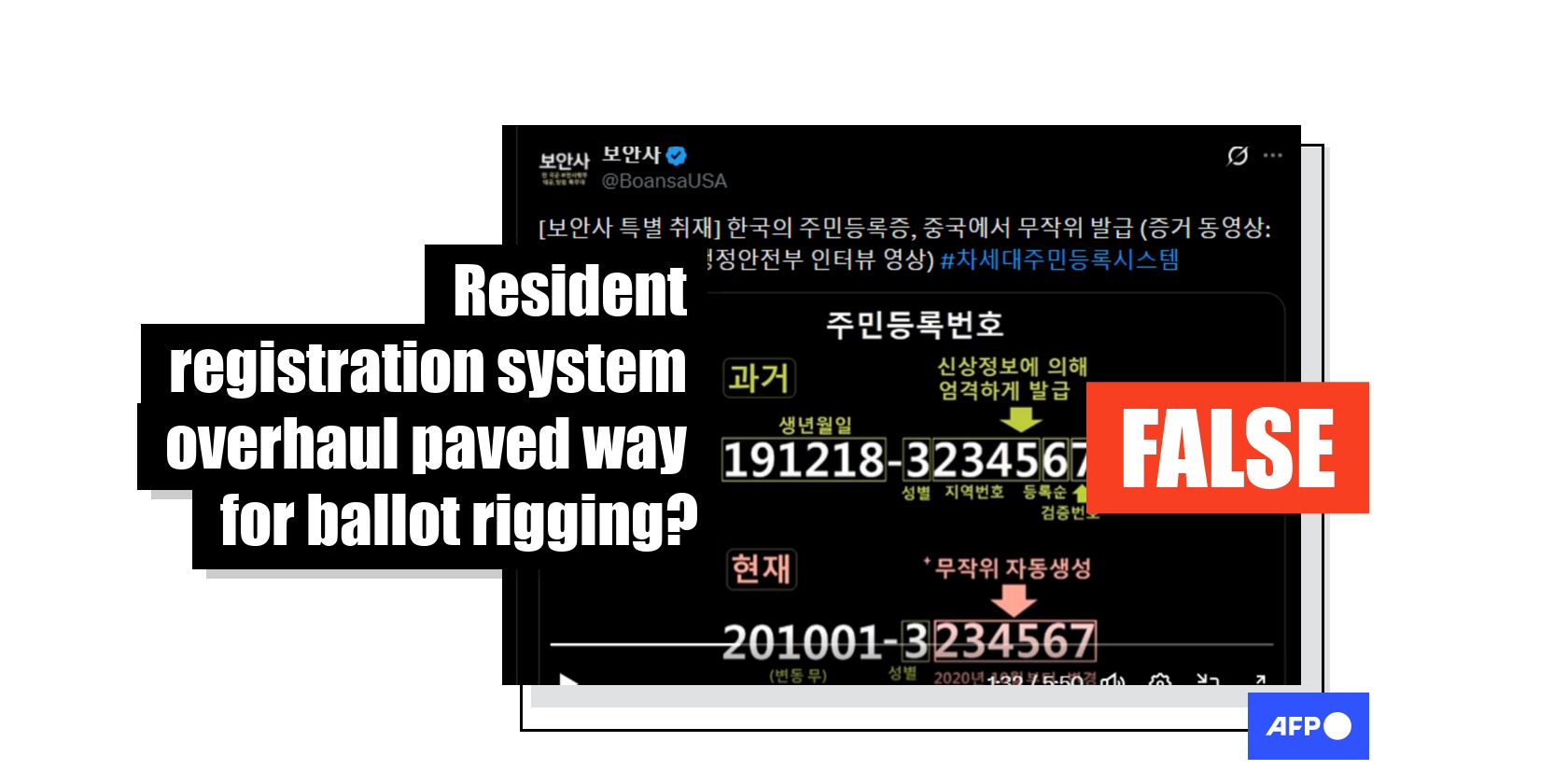
S. Korean posts linking ID changes to voter fraud 'entirely false': interior ministry
- Published on March 23, 2026 at 09:57
- 3 min read
- By Grace MOON, AFP South Korea
Anti-China sentiment and vote rigging allegations have long intertwined in South Korea's far-right communities, with the latest example circulating on social media falsely claiming changes to the resident registration system in 2020 enabled Chinese nationals to commit fraud. The interior ministry dismissed as "entirely false" the assertions made in the posts, which also misrepresented an informational video as an exposé of the supposed cheating scheme.
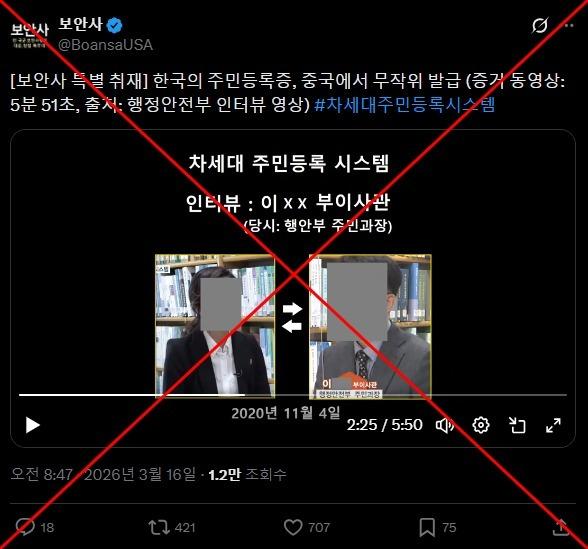
"South Korean resident registration cards being randomly issued in China," says the Korean-language caption of an X video shared on March 16, 2026.
It says the system by which resident registration numbers are assigned, revised in 2020, serves to ensure that "fraudulent election operations in South Korea involving the mobilisation of Chinese nationals can continue indefinitely".
The video also shows a screenshot from an interview purportedly conducted with an anonymous interior ministry official on November 4, 2020. The official explains the ministry's plans to create a new centralised system for managing resident registration cards by 2023.
"Until now, resident registration numbers were assigned based on region," the official says in the video, "But now it will be possible to assign resident registration numbers arbitrarily nationwide, regardless of region."
Similar claims about Chinese nationals being issued resident registration cards were also shared elsewhere on X, resurrecting a claim that previously circulated in 2024 and 2025.
South Korean citizens are assigned a 13-digit resident registration number, typically at birth or upon naturalisation, which serves as a key tool for authentication and identity verification (archived link). Prior to the 2020 revisions, four of the 13 digits revealed the holder's place of birth, narrowed down to the specific province and county or village.
The government overhauled the system in 2020, replacing these regional codes with randomised numbers following a series of data leaks, growing calls to strengthen personal data privacy, and concerns about workplace discrimination (archived here, here and here).
'Cannot be forged'
An interior ministry spokesperson said the changes did not make it easier for nationals from other countries to obtain resident registration cards. The circulating posts are "entirely false", they told AFP on March 18.
According to the ministry, foreigners can only obtain resident registration cards after they are naturalised (archived link). Those who wish to naturalise must meet requirements stipulated under the Nationality Act, such as owning a residence in the country for at least five years and meeting language qualifications (archived link).
Foreigners who intend to reside in South Korea for more than 90 days may apply for foreign resident registration (archived link). Approved applicants can then receive a residence card for foreigners, which are issued at immigration offices.
The registration does not give them the right to vote, but foreign residents aged 18 or older who have held permanent residency status for at least three years are allowed to vote in local elections (archived link).
The interior ministry spokesperson added that resident registration cards are produced by "a specialised security institution, and therefore cannot be forged by individuals".
Jung June-hee, a media scholar and journalism professor at Hanyang University, labelled the circulating claims as "conspiracy theories" (archived link).
"It is clear that the underlying intention is to spread negative emotions and perceptions about groups they are targeting with hate," Jung told AFP on March 23.
Informational video
Moreover, a keyword search found the screenshot of the obscured figures shared in the false posts was taken from an informational video posted by state-run broadcaster KTV News on November 4, 2020 (archived link).
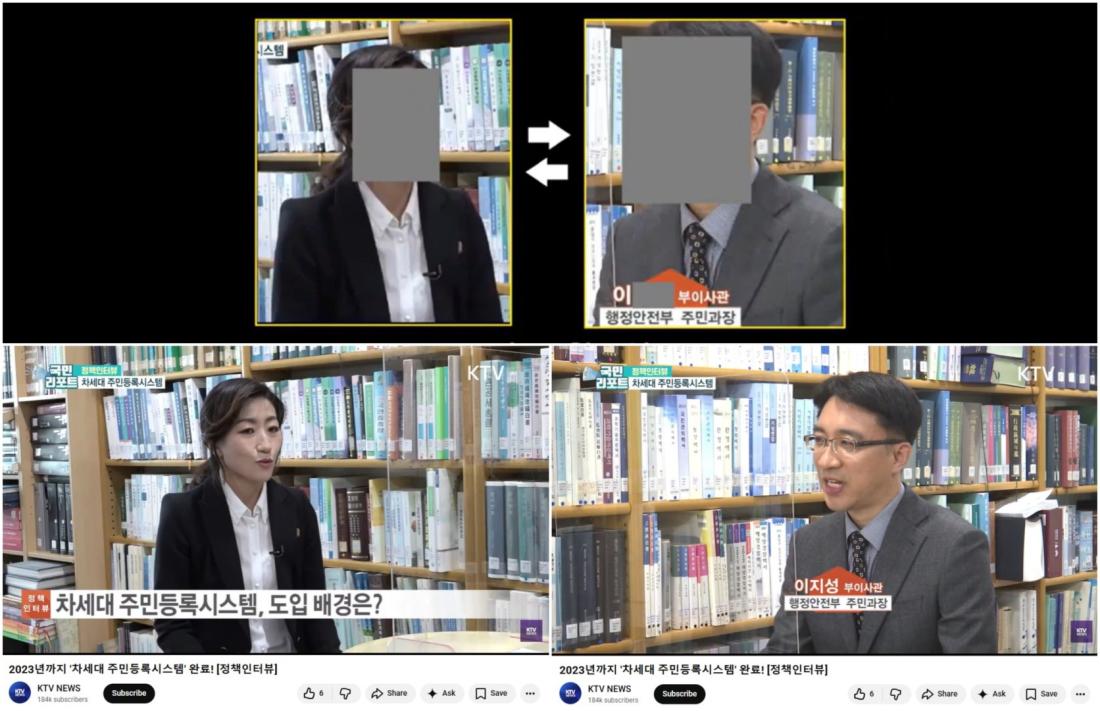
The video is titled, "'Next-generation resident registration system' to be completed by 2023!", and the figures are identified as KTV journalist Jang Ji-na and Lee Ji-seong, who worked at the interior ministry's resident registration division at the time, ministry documents show.
In the video, Lee explains the changes to the resident registration system and makes no mention of Chinese nationals or efforts to manipulate elections.
AFP has previously debunked other false claims linking Chinese nationals to election fraud in South Korea, including how such narratives took shape after former president Yoon Suk Yeol's failed bid to impose martial law in December 2024.
Copyright © AFP 2017-2026. Any commercial use of this content requires a subscription. Click here to find out more.
Is there content that you would like AFP to fact-check? Get in touch.
Contact us