Conspiracy theories targeting S.Korean election integrity resurface ahead of local polls
- Published on June 2, 2026 at 10:59
- 5 min read
- By Grace MOON, Hawon Jung, AFP South Korea
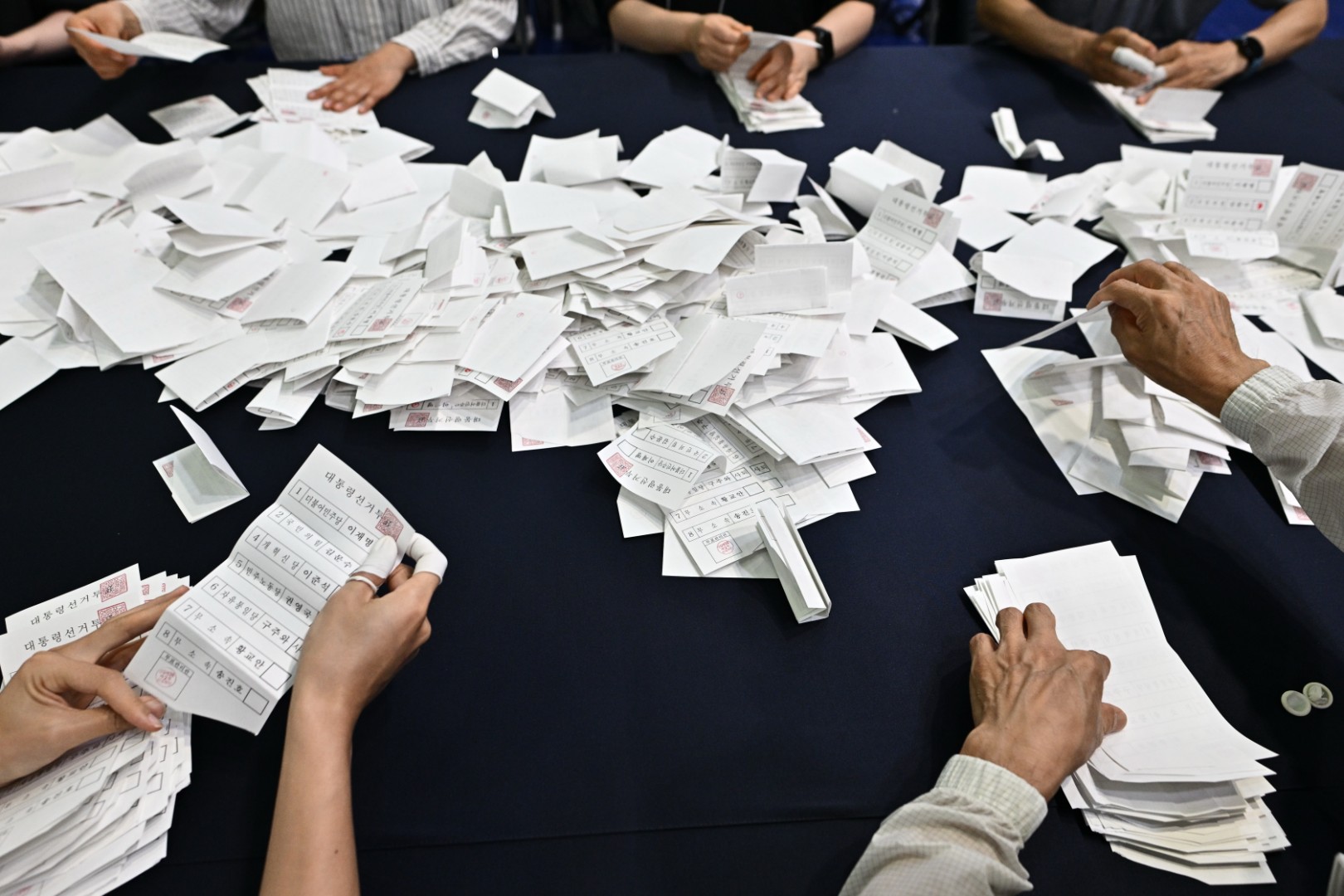
As South Koreans cast early ballots for new governors, mayors and other representatives in key regional polls, social media was flooded with previously debunked conspiracy theories casting doubt on the integrity of local elections. The well-worn claims about hacking, illegal ballots and vote-rigging have previously been refuted by the country's election watchdog and debunked by AFP but continue to spread among far-right users and politicians.
Posts claiming South Korea was vulnerable to widespread election fraud surfaced in the lead up to local elections on June 3, 2026, the first nationwide polls since President Lee Jae Myung took office (archived link).
Lee replaced disgraced former leader Yoon Suk Yeol, who was ousted over his failed martial law bid in December 2024, and the polls are widely seen as a referendum on his first year in office (archived link).
But public trust in elections has been dented by the spread of conspiracy theories in recent years, with jailed ex-president Yoon also feeding into the far-right narratives (archived link).
In spite of efforts by the National Election Commission (NEC) to address some of these falsehoods -- by broadcasting live footage of early-voting ballot storage facilities and installing transparent stands for some ballot boxes -- claims challenging the integrity of local elections have persisted (archived link).
Professor Ryu Ji Yoon, who teaches media and cultural studies at Seoul Women's University, told AFP on May 29 that "the structure of these election conspiracy theories remains largely unchanged from past election cycles" (archived link).
Election fraud falsehoods -- like any other conspiracy theory -- often spread through algorithms that "trap users in filter bubbles," she said, adding that the boundary between far-right online communities and mainstream discourse had "effectively collapsed" long ago.
Vote hacking
"Early voting -> Opened to the internet -> Vote-rigging possible. Main-day voting -> Closed to the internet -> Vote-rigging impossible," says a Korean-language X post shared on May 26, days before early voting opened for the June 3 elections.
The claim that the communications network through which voting results are electronically sent to the central election authorities can be hacked by outside forces was shared elsewhere in similar X posts.

The NEC has refuted such claims, saying the internal network used during elections -- whether for early voting or on election day -- is accessible only from a handful of pre-authorised computers inside the NEC that are not connected to the internet (archived here and here).
"It is a closed system based on its own dedicated communication cables and only accessible from pre-authorised computers located inside the election commission offices. Access from unauthorised devices is blocked," an NEC spokesman told AFP on May 29. "So it's not true at all that the system is open to the internet."
South Korea's top court also rejected a complaint by a candidate in the 2020 general election who accused his rival of hacking the NEC servers during early voting to win the race (archived link).
The 2022 ruling said secretly rigging an election in that way would require highly-advanced technological skills, enormous funding, and a huge number of and highly-organised accomplices inside the election authorities -- all of which the complainant failed to prove.
"No expert would say that a certain computer system is 100 percent safe from hacking," Kim Ki-hyung, professor of information and computer engineering at Ajou University and a member of the NEC cybersecurity advisory council, told AFP on June 2, 2026 (archived link).
"But realistically speaking, hacking the NEC's internal system like that to sway election results, and -- more than anything else -- doing so undetected, is extremely unlikely."
He continued: "Even if unauthorised devices access the network, it will be next to impossible to do anything to the system without leaving a trace and alerting the authorities. It just seems very implausible."
Chinese interference
"Did you know the Democratic Party granted visa-free entry to Chinese nationals to win votes?" says a Korean-language X post shared on May 28.
Superimposed text on a graphic attached to the post says: "Foreign voters hit a record high of 150,000; 78% are Chinese nationals."
Similar claims about Chinese nationals illegally casting votes were also shared elsewhere on X.

The claims are a variation of narratives that emerged after former president Yoon's failed bid to impose martial law and his subsequent impeachment.
They intensified after South Korea granted temporary visa-free entry for Chinese tour groups in September 2025, as part of efforts to boost tourism, with online users accusing Chinese visitors of using the policy to skirt immigration requirements and meddle in elections (archived link).
But only foreign residents aged 18 or older who have held permanent residency status for at least three years and are registered with their local government are allowed to vote in local elections (archived link).
The NEC spokesperson told AFP that "very strict" requirements are enforced and that "ordinary tourists certainly do not have voting rights".
South Korea’s visa-free policy applies only to Chinese tourists travelling in groups of three or more through travel agencies that have been pre-approved by the South Korean government (archived link). The policy does not grant tourists any special voting rights.
AFP previously debunked related claims that Chinese tourists were exempt from certain immigration requirements.
Ballot rigging
"Why is the National Election Commission forcibly confiscating personal seals?" says an X post shared on May 6. "Is it planning to duplicate those seals and stamp them onto fake ballots?"
Other users recycled claims that printed seals used by early voting supervisors were facilitating ballot-rigging schemes.

But ballots marked with a voter's personal seal are invalid.
According to Article 159 of the Public Official Election Act, voters in South Korea are required to mark their ballots using the official stamp provided at polling stations (archived link).
An exception applies to absentee voters -- such as individuals with disabilities, military personnel, or workers residing at hospitals, nursing homes or prison facilities -- who file a report in advance (archived here and here).
Furthermore, South Korea's election laws allow officials to use a printed seal impression instead of a manually stamped one for certain early-voting and absentee ballots (archived link).
In December 2025, South Korea’s Constitutional Court ruled that the practice does not infringe voters' rights and serves to help "facilitate early-voting procedures more efficiently" (archived here and here). The NEC has previously explained that the signature and seal of an early voting supervisor serve to verify the authenticity of a ballot.
Similar claims previously circulated around South Korea’s 2025 presidential election.
"Ultimately, factual accuracy is not particularly important to people who believe such conspiracy theories," Professor Ryu said, noting that the "psychological dimension is significant".
Election fraud narratives are "built around the idea that the country is heading in the wrong direction," and as people become increasingly consumed by online echo chambers, "their sense of identity becomes tied to that belief," she said.
Even as South Korean election authorities confront the falsehoods head-on, Ryu said they were unlikely to disappear, predicting that similar conspiracy theories were "likely to resurface in future elections".
Copyright © AFP 2017-2026. Any commercial use of this content requires a subscription. Click here to find out more.
Is there content that you would like AFP to fact-check? Get in touch.
Contact us