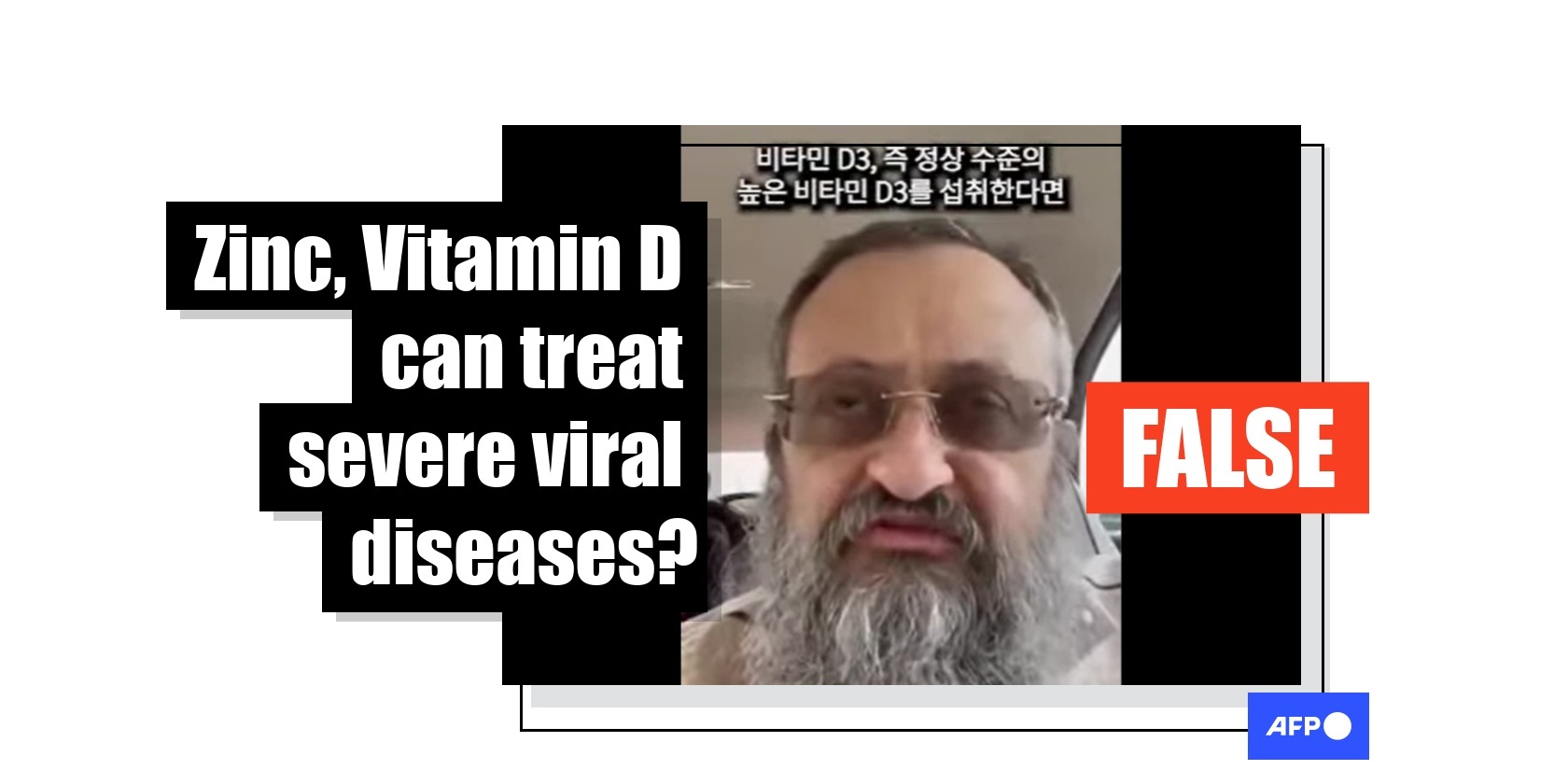
Posts tout unproven treatment for hantavirus, Ebola
- Published on May 26, 2026 at 09:24
- 3 min read
- By Grace MOON, AFP South Korea
Overlapping deadly outbreaks of hantavirus and Ebola have fuelled a resurgence of misinformation on social media, including posts repeating an unproven medical assertion the diseases can be treated by simply taking zinc and Vitamin D. Several experts told AFP there is no scientific evidence to support the claim, which stems from a misunderstanding of how viruses work. The hantavirus and Ebola strains linked to the recent outbreaks currently do not have licensed treatments, with patients requiring medical care.
"A biology lecture from Dr Zelenko: Single-stranded RNA viruses can be prevented by taking enough Vitamin D3 and zinc," says the Korean-language caption of a Facebook video shared on May 13, 2026.
The video, filmed in 2022, shows the late New York doctor Vladimir Zelenko, who touted unproven treatments for Covid-19 and falsely claimed the US Food and Drug Administration (FDA) had approved the research (archived here and here).
In the roughly three-minute video, Zelenko claims that all single-stranded RNA viruses -- including the coronavirus that causes Covid-19, Ebola and hantavirus -- can be treated "with one simple, cheap oral approach".
"If the whole world had enough Vitamin D3, high normal levels of Vitamin D3, and enough intracellular zinc, we would eradicate most of these health risks," he says.

The same video was reshared by thousands of social media users, in multiple languages, as reports emerged of a deadly hantavirus outbreak on an Atlantic cruise ship and the World Health Organization (WHO) declared a public health emergency over Ebola in the Democratic Republic of Congo (DRC) (archived here and here).
The Andes hantavirus strain and the Bundibugyo species of Ebola linked to the outbreaks have relatively high case fatality rates (archived here and here).
However, health authorities have emphasised the outbreaks do not constitute a global pandemic emergency (archived here and here).
There are currently no licensed treatments for both, with patients receiving supportive care, such as rest and hydration. Early, intensive intervention has been shown to increase chances of survival (archived link).
Multiple experts told AFP the claim circulating on social media that zinc and Vitamin D alone could help prevent or treat these diseases is unfounded.
'Misunderstanding of virology'
Professor Thomas A. Russo, chief of infectious diseases at the University at Buffalo, told AFP on May 19 that while "zinc and Vitamin D3 have been shown to have some anti-viral and immunomodulatory properties, there is no evidence that either of those agents are effective treatments for hantavirus or Ebola virus" (archived link).
Molecular virologist Melinda Brindley, who is also an associate professor of infectious diseases and population health at the University of Georgia, told AFP on May 21 that "if something as simple as a multivitamin would eliminate the long list of viral threats he [Zelenko] mentioned, we would know. They simply do not" (archived link). She added that she was unaware of any clinical trials that have tested Zelenko's theory.
Dr Ishmael Aziati, a virologist and instructor in medicine at Washington University in St Louis, said single-stranded RNA viruses "represent a highly diverse group of pathogens with major differences," including in their replication methods and immune evasion mechanisms (archived link).
They "cannot reasonably be reduced to a universal micronutrient-based treatment approach," as suggested by Zelenko, he said.
"The broader claim that a single regimen can effectively treat all single-stranded RNA viruses is not supported by current scientific evidence and reflects a misunderstanding of virology," Aziati told AFP on May 20.
Potentially dangerous
Moreover, experts have highlighted the potential risks of following the circulating advice.
Relying on such unproven protocols as definitive treatments could delay "appropriate medical evaluation, supportive care or evidence-based therapies" and significantly worsen outcomes for severe viral diseases, said Aziati.
Kang Kyeong-yeon, director of the Korean Pharmacists for Democratic Society, a civic advocacy group, told AFP in a phone interview on May 21 that "if someone suspects they have been infected, they should immediately go to a hospital and get tested" (archived link).
Additionally, chronic ingestion of high doses of zinc can cause anaemia and neurological symptoms, while long-term Vitamin D intake may lead to "hypercalcaemia, which can cause a variety of downstream effects including neurologic and cardiac toxicity, renal failure and rarely death," Russo noted.
Hantavirus is normally spread by rodents, with the Andes virus the only known type to spread from close and prolonged human-to-human contact (archived link).
Meanwhile, Bundibugyo virus disease spreads through direct contact with the blood or bodily fluids of an infected person or someone who has died from the disease as well as infected animals, such as bats (archived link).
As of May 22, a total of 12 hantavirus cases have been reported in the cruise ship outbreak, including three deaths (archived link).
On May 25, the WHO confirmed 101 cases of Ebola in the DRC and also estimated nearly 900 suspected cases and 220 suspected deaths, saying the risk is high at a regional level (archived link).
AFP has previously debunked other misleading claims stemming from the recent disease outbreaks.
Copyright © AFP 2017-2026. Any commercial use of this content requires a subscription. Click here to find out more.
Is there content that you would like AFP to fact-check? Get in touch.
Contact us