Posts linking Covid jabs to hantavirus misuse Pfizer, WHO documents
- Published on May 19, 2026 at 05:00
- 3 min read
- By Judith KANTNER, AFP Germany
- Translation and adaptation Sammy HEUNG, AFP Hong Kong
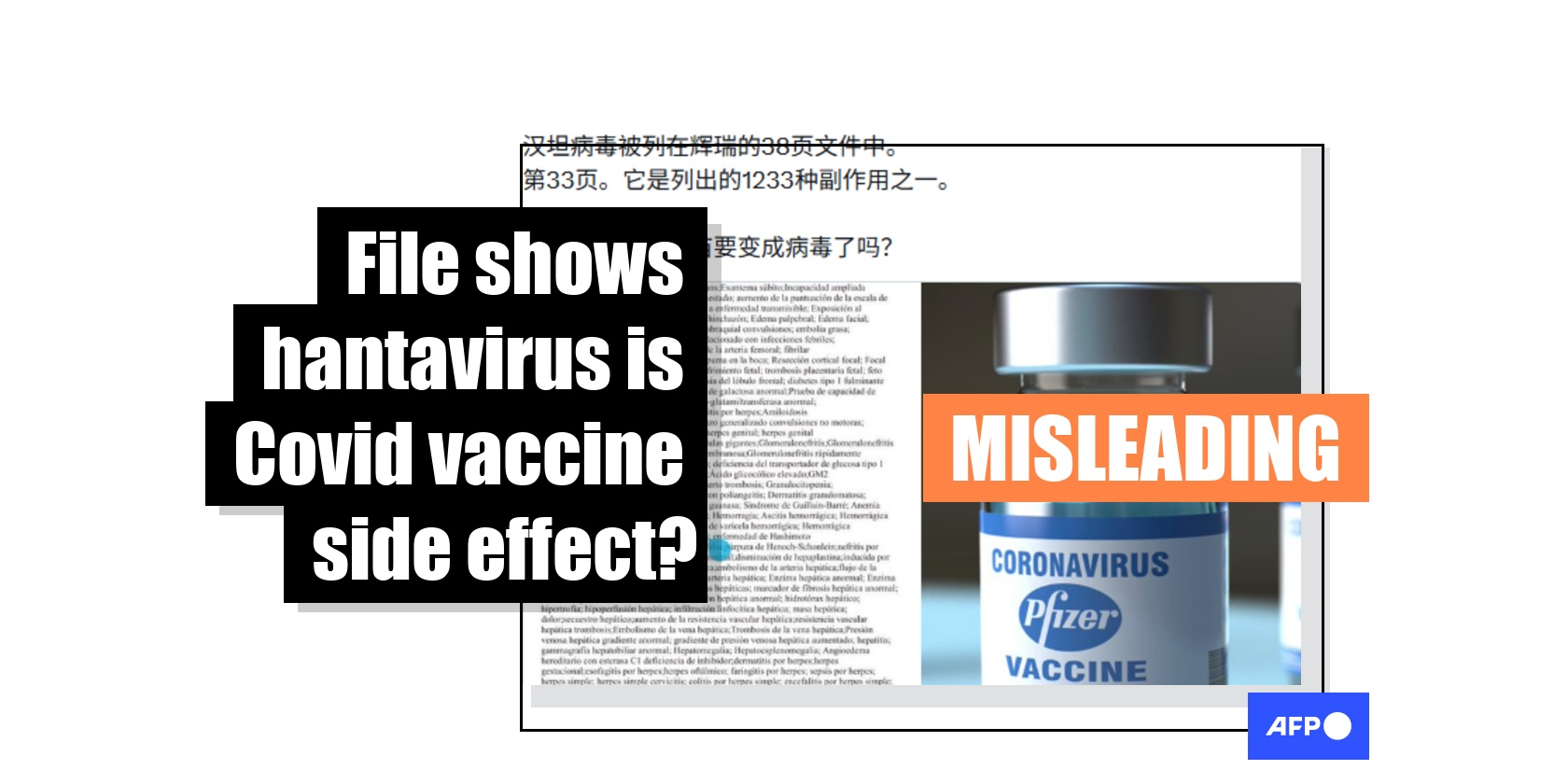
A rare hantavirus outbreak on an Atlantic cruise ship has reignited conspiratorial Covid-era misinformation, with posts sharing files from Pfizer and the World Health Organization (WHO) as supposed proof that the hantavirus is a vaccine "side effect". The former shows a predefined list of medical events that need closer monitoring, while the latter lists conditions reported after vaccination but not proven to be caused by the jab. Pfizer's mRNA Covid-19 vaccine does not contain live viruses and cannot transmit infections such as hantavirus, experts told AFP.
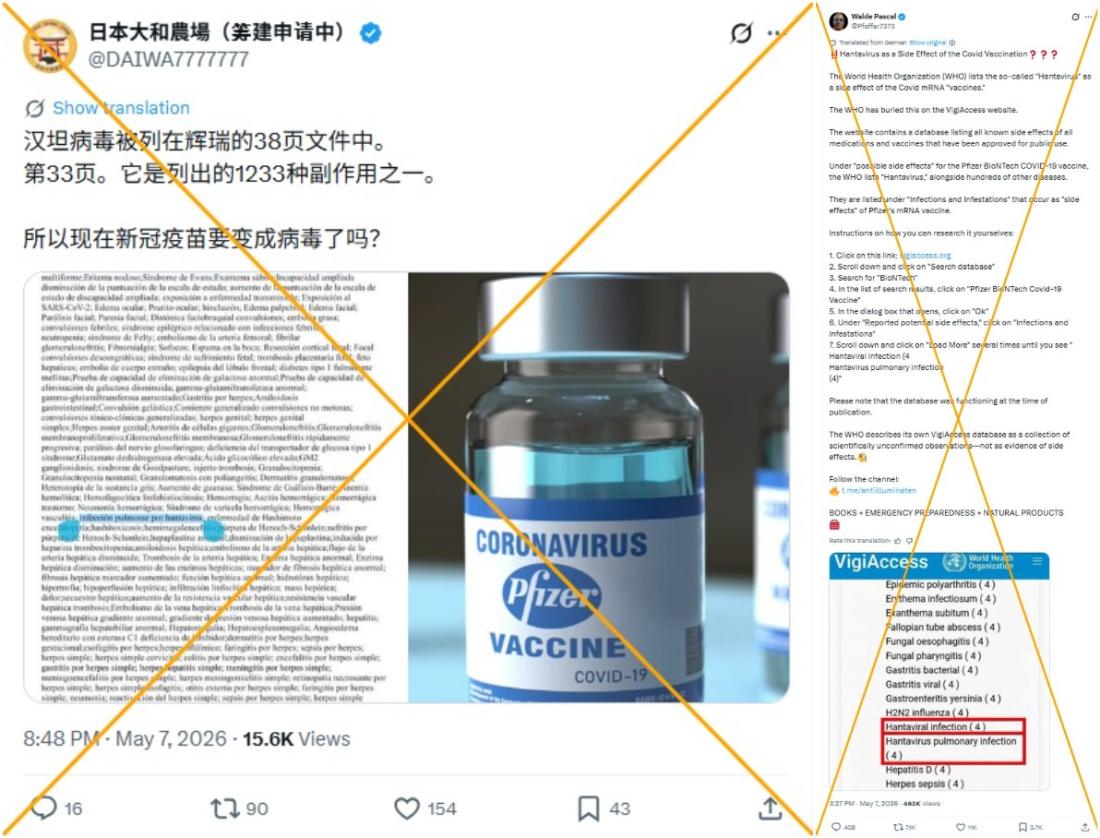
"Hantavirus is listed in Pfizer's 38-page document. On page 33, it is one of the 1,233 side effects listed. So is the Covid-19 vaccine turning into a virus?" says a simplified Chinese X post shared on May 7, 2026.
The post shares an image of a vial of the Pfizer Covid-19 vaccine next to a screenshot of a Spanish-language document with "infeccion pulmonar por hantavirus" -- meaning "hantavirus pulmonary infection" in English -- highlighted.
"The World Health Organization (WHO) lists the so-called 'hantavirus' as a side effect of the Covid-mRNA 'vaccines'", reads another X post, written in German and shared the same day.
It includes a screenshot of the global health agency's VigiAccess database -- with red boxes added around "hantaviral infection" and "hantavirus pulmonary infection".
Similar claims spread in Threads and Facebook posts in various languages -- including English and Spanish -- as reports emerged about a deadly hantavirus outbreak aboard the MV Hondius from Argentina to Cape Verde (archived link).
According to the WHO, including the three people who were killed, a total of 10 cases have been reported as of May 15 (archived link).
All known cases in the current outbreak were people on board the Dutch-flagged vessel, with the WHO saying the risk to the general population is "absolutely low" (archived here and here).
Nevertheless, the outbreak has reignited old conspiracy theories about vaccines that spread widely during the coronavirus pandemic (archived link).
The claim about hantavirus being a side effect of vaccination is similarly misleading.
Hantavirus infection
Pfizer's mRNA jabs for Covid "contain no live or inactivated viruses and therefore cannot transmit any kind of viral infection", Dr Wilson Lam Wai-shun, president of the Hong Kong Society for Infectious Diseases, told AFP on May 14.
Stefan Vieths, president of the Paul Ehrlich Institute separately said on May 11 the German federal medical agency "is not aware of any mechanism by which the approved mRNA vaccines could trigger a hantavirus infection".
"There is no evidence to suggest that Covid-19 vaccinations weaken the immune system or make individuals more susceptible to infections with other viruses."
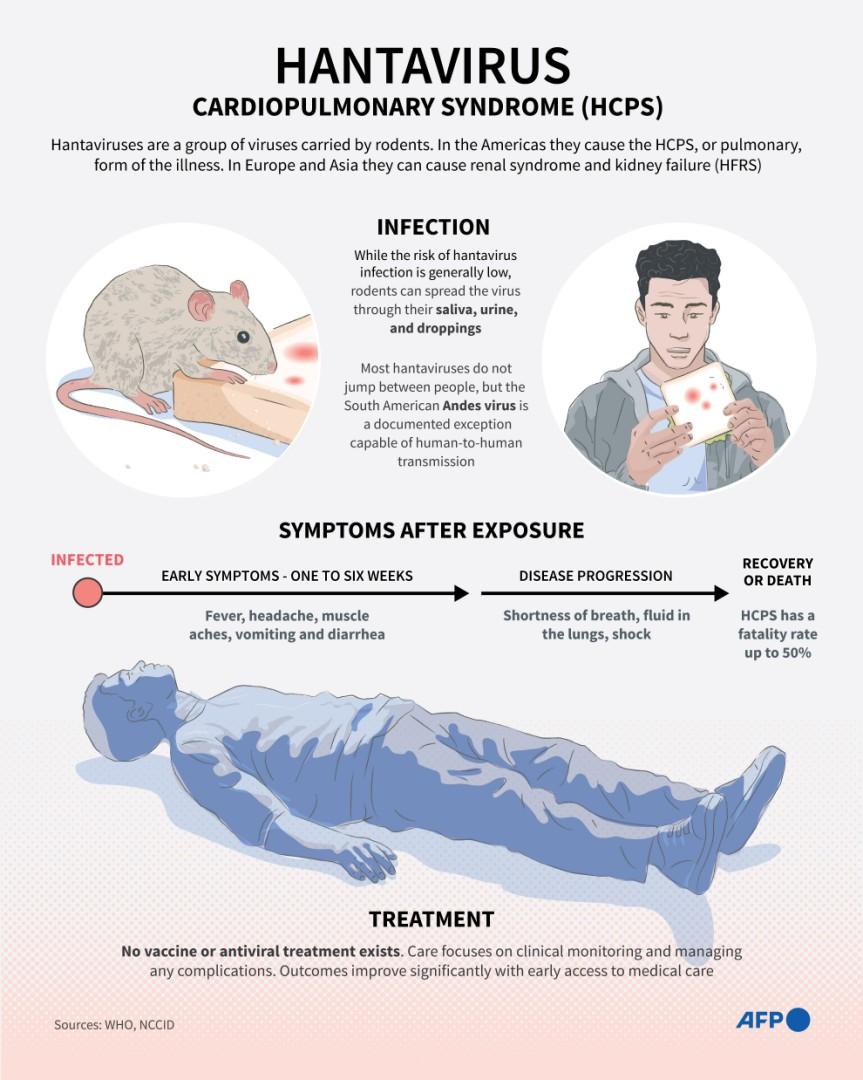
According to the WHO, people usually get infected with hantavirus through contact with infected rodents or their urine, droppings or saliva (archived link).
Eight cases from the MV Hondius outbreak were laboratory-confirmed infections for the Andes virus, the only strain known to cause "limited human-to-human transmission among close and prolonged contacts".
The Andes virus is primarily found in Argentina and Chile, the agency added.
There are currently no vaccines or specific treatments for the disease.
Misrepresented documents
Moreover, a keyword search on Google found the Pfizer report shared online was published on the website of the non-profit group Public Health and Medical Professionals for Transparency (archived link).
The organisation filed a Freedom of Information Act request with the US Food and Drug Administration in 2021 to access data used to approve the Pfizer vaccine (archived link).
"Hantavirus pulmonary infection" is indeed mentioned on page 33 of the document -- alongside hundreds of other diseases -- under "adverse events of special interest".
However, the appendix shows a predefined list of medical events identified by regulatory authorities and expert groups for closer monitoring, according to a Pfizer spokesperson.
A note in the full report, excluded in the circulating online posts, states that the list "does not necessarily indicate" the jab caused the adverse event.
"Rather, the event may be due to an underlying disease or some other factor(s) such as past medical history or concomitant medication."
The Pfizer spokesperson told AFP on May 8 the document is authentic, adding the list of conditions was collected for "completeness and transparency".
Meanwhile, the WHO's VigiAccess database states the information it publishes relates to symptoms "observed following the use of a medicinal product" -- but may or may not be caused by it.
Alongside medical conditions, other items on the list include "animal bite", "near drowning" and "gun shot wound".
Paul Ehrlich Institute's Vieths said the purpose of the reporting system is to "facilitate the early detection of potential signals regarding adverse reactions".
"In the event that a risk signal is identified, further investigations are conducted to determine whether the reported reaction is, in fact, an adverse effect caused by the medication."
Serious reactions to Covid vaccines are "extremely rare", the WHO said, citing data collected from billions of doses administered globally (archived link).
More of AFP's reporting on vaccine misinformation can be found here.
Copyright © AFP 2017-2026. Any commercial use of this content requires a subscription. Click here to find out more.
Is there content that you would like AFP to fact-check? Get in touch.
Contact us