
Old Moderna research triggers false hantavirus claims online
- Published on May 20, 2026 at 04:50
- Updated on May 20, 2026 at 10:55
- 4 min read
- By Grace MOON, AFP South Korea
A hantavirus outbreak aboard an Atlantic cruise ship has revived Covid-era conspiracies, with posts falsely alleging an old Moderna hantavirus research project proves the disease was a "hoax" designed to promote a mass vaccination event. The initiative aimed to address a "long-neglected pathogen" that continues to infect patients since it was documented in the 1950s, Moderna's partner university in South Korea told AFP. While deadly, the virus is unlikely to cause a global pandemic, according to multiple health experts.
"Exposing the hanta 'virus' hoax!!" reads a Korean-language X post shared May 7, 2026.
"Moderna began developing a hantavirus mRNA vaccine in 2024," it says, adding this was the "exact same playbook" the world saw with the Covid-19 pandemic.
"Scaring the public, stoking anxiety and ultimately pushing a new mRNA vaccine -- a classic Deep State tactic."
It quotes a nearly identical post that featured press releases about a collaboration between Covid-19 vaccine maker Moderna and Korea University's College of Medicine on the development of an mRNA-based hantavirus jab.
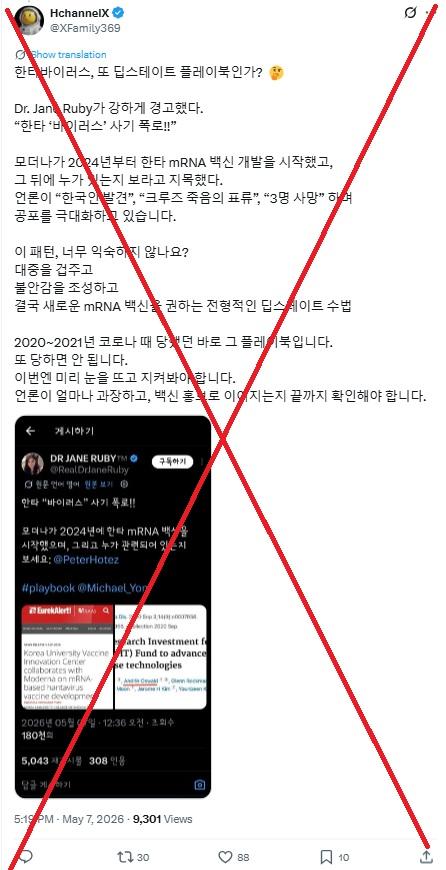
Similar false claims ricocheted in Chinese, Dutch and English posts, with some alleging hantavirus "does not exist" and the deadly outbreak aboard the MV Hondius cruise ship was "pre-planned" (archived link).
The posts echo falsehoods peddled by opponents of coronavirus jabs, including that the Covid-19 pandemic was manufactured to benefit vaccine makers such as Moderna or to serve a so-called "depopulation" agenda.
As with earlier waves of misinformation around Covid-19, the circulating claims about hantavirus are inaccurate.
Misrepresented vaccine research
The vaccine research collaboration was announced in a press release published on the website of the nonprofit American Association for the Advancement of Science on September 5, 2024 (archived link).
It says Korea University's College of Medicine partnered with Moderna to develop a messenger RNA (mRNA) vaccine for hantavirus, which infects hundreds in Korea each year, predominantly young men during military service and residents in high-risk areas.
Kim Woo-joo, chair professor of the university's Vaccine Innovation Center, said the collaboration aimed to address a "long-neglected pathogen" (archived here and here).
Although "relatively uncommon", some hantavirus cases are associated with a high fatality rate, making the disease "a major public health concern", according to the World Health Organization (WHO) (archived link).
"People pay attention when a high-profile death occurs, and then ask why there is no vaccine, but interest quickly fades," Kim told AFP on May 12, adding continued research on a jab is necessary.
Moderna separately told AFP the partnership with Korea University is part of the company's efforts "to develop countermeasures against emerging infectious diseases".
The initiative was widely covered by local media, contradicting some posts that suggest Moderna and Korea University attempted to hide the project (archived here, here and here).
There are currently no approved vaccines for global use or specific treatments for hantavirus.
Inactivated hantavirus vaccines -- which contain weakened or deactivated forms of the pathogen -- have been previously developed in South Korea and China (archived link).
But they "need to be updated to match strains that are circulating today", Kim Won-keun, an associate professor of microbiology at Hallym University, told AFP.
'Low' pandemic risk
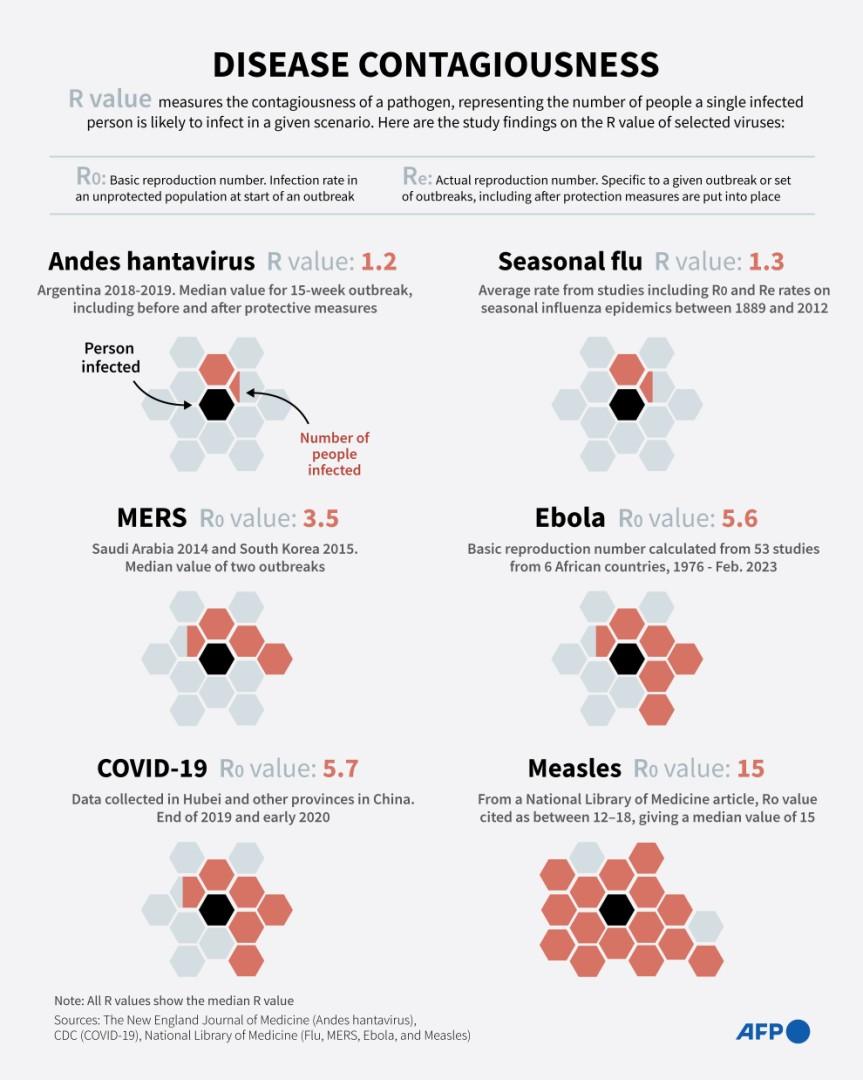
Unlike Covid-19, which killed millions worldwide, the risk that hantavirus poses to the general population is "absolutely low", WHO spokesperson Christian Lindmeier said on May 8 (archived link).
Hantavirus is "a dangerous virus, but only to the person who is really infected," Lindmeier said.
Kim, the microbiology professor, said that given the hantavirus's limited mode of transmission, it is highly unlikely that it could cause a global pandemic.
Not all hantaviruses can cause human infections, but the strains that do are transmitted through inhalation of aerosols contaminated by the saliva, droppings or urine of infected rodents (archived link).
A total of 10 cases have been reported in the cruise ship outbreak, including three deaths as of May 15, with eight cases confirmed for Andes virus infection -- the only strain transmitted between humans and predominantly found in South America (archived here and here).
All known cases in the current outbreak were people on board the Dutch-flagged vessel travelling from Argentina to Cape Verde.
The first person to die had spent 48 hours in the picturesque city of Ushuaia with his wife -- who died two weeks later -- before embarking on the cruise, raising suspicions that they had contracted the virus in Argentina (archived link).
Provincial officials deny this hypothesis, with local scientists believing it is more likely that the infections aboard the cruise ship occurred in another region.
Old pathogen
Furthermore, unlike Covid-19 -- which is caused by a virus previously unknown until its detection in late 2019 -- hantavirus has long been identified.
Hantaviruses are split into two groups: the so-called old world viruses found in Europe, Asia and Africa; and new world ones in North, Central and South America (archived link).
Two major outbreaks have led to the discovery of the distinct groups, according to a 2010 study in the peer-reviewed journal Clinical Microbiology Reviews (archived link).
The first sickened more than 3,000 United Nations troops fighting in the 1950-53 Korean War, which also led to the virus being named after the Hantan River in South Korea (archived link).
The second occurred in the southwestern United States in 1993, where the disease was confirmed in 18 patients.
Hantavirus infection has been a nationally notifiable disease in the United States since 1995 (archived link).
In South Korea, it became a reportable disease requiring continuous surveillance in 1976, according to the Korea Disease Control and Prevention Agency (archived link).
AFP has previously debunked other false claims about the hantavirus.
Updated story to add more information on the Moderna research press release, and to mention the Andes virus strain is predominantly found in South AmericaMay 20, 2026 Updated story to add more information on the Moderna research press release, and to mention the Andes virus strain is predominantly found in South America
Copyright © AFP 2017-2026. Any commercial use of this content requires a subscription. Click here to find out more.
Is there content that you would like AFP to fact-check? Get in touch.
Contact us