Old photo and AI image falsely depicted as Russian troops in Tehran
- Published on April 29, 2026 at 14:40
- 4 min read
- By Tolera FIKRU GEMTA, AFP Ethiopia
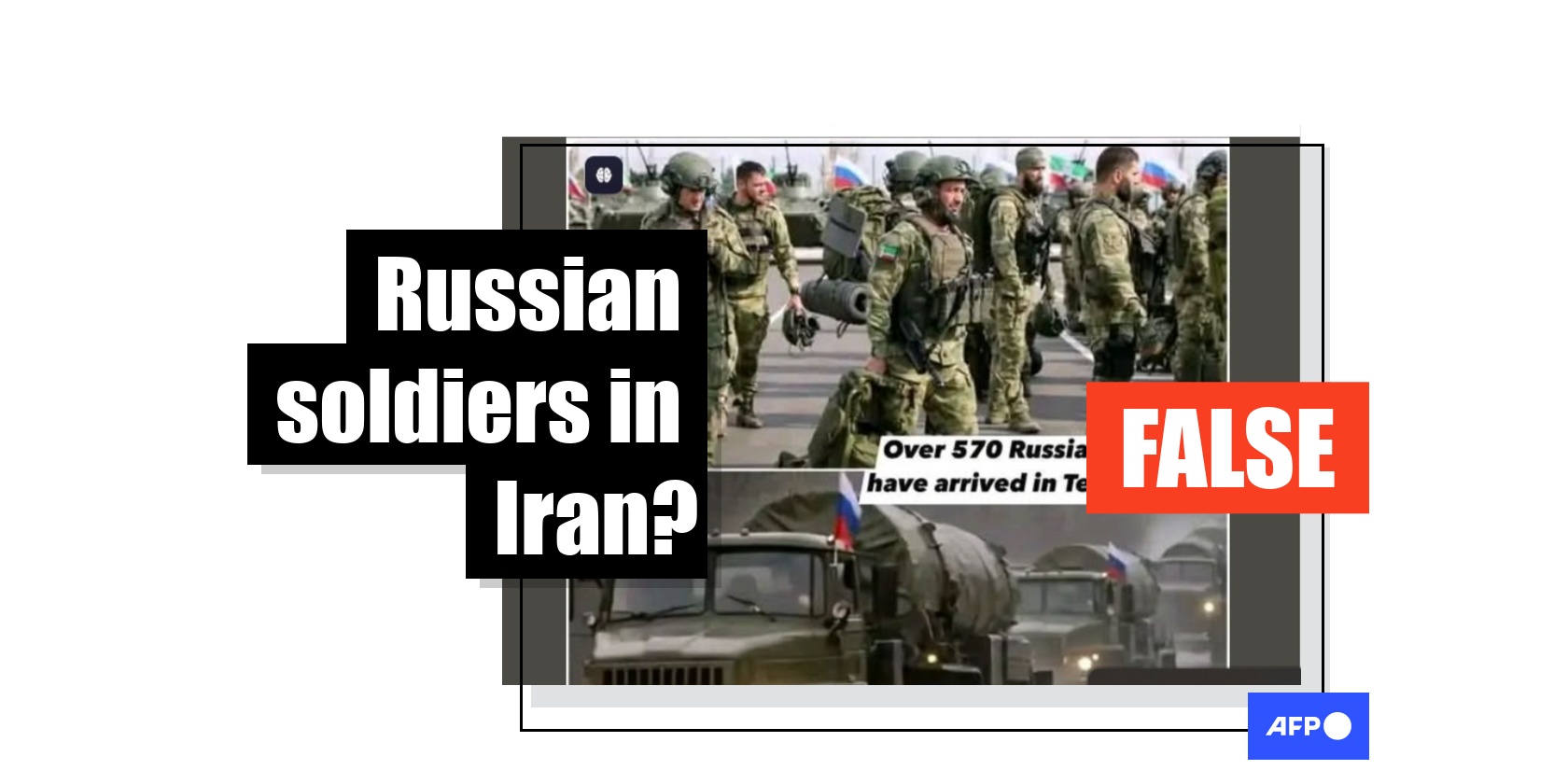
Ahead of a fragile ceasefire in the Middle East war, a post circulated in Ethiopia claiming to show Russian troops sent to Tehran to support Iran’s ground operations. However, this is false: one of the photos is AI-generated, and the other was taken in 2022 in Chechnya.
The post was published on April 5, 2026, in Afaan Oromoo, one of Ethiopia’s major languages. “Russian soldiers, numbering 570, have arrived in Tehran. If American ground forces advance into Iran, they will face a tragic battle,” reads the caption.
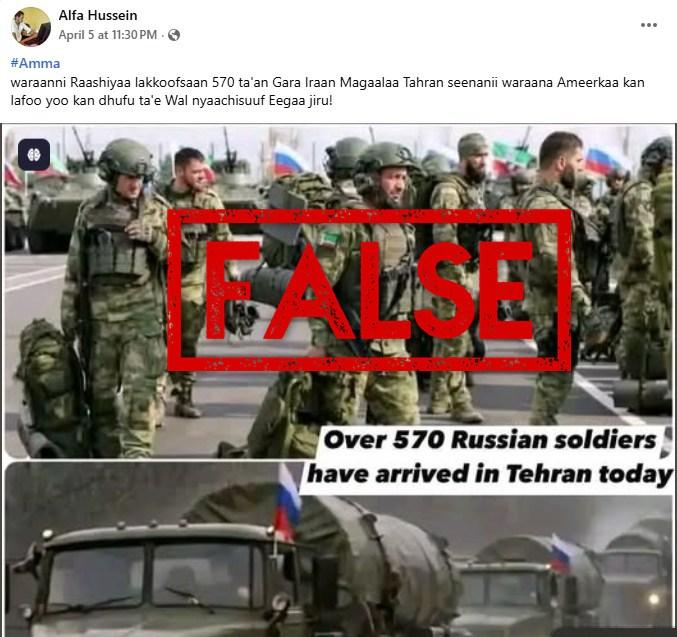
An English text overlay on the photos reads: “Over 570 Russian Soldiers have arrived in Tehran today.”
The post features two images, one showing soldiers carrying military gear, with the flags of the Russian Federation and the Chechen Republic visible in the background. The other shows a military convoy, also displaying Russian flags.
Some users appeared to believe the claim was genuine.
“This is fantastic news. Putin will resolve this effectively,” one user commented. “Alhamdulillah the victory will continue,” added another.
The post was also shared in English on Facebook here.
The claim was published days before a two-week conditional ceasefire was signed following nearly six weeks of escalating strikes between Iran, the United States, and Israel (archived here).
Pakistan-mediated talks between Washington and Tehran have so far failed to produce a breakthrough, with a first round yielding no agreement and the second stalling (archived here and here).
In between, tensions flared in the Strait of Hormuz after US actions to restrict maritime access further strained the situation, leaving prospects for de-escalation uncertain (archived here).
However, the images shared online are unrelated to the Middle East war.
Khankala military settlement
AFP Fact Check conducted reverse image searches and found a Russian news site that published the first image of soldiers carrying their equipment in December 2023, together with an article about Chechen mobilisation in the Ukraine war (archived here).
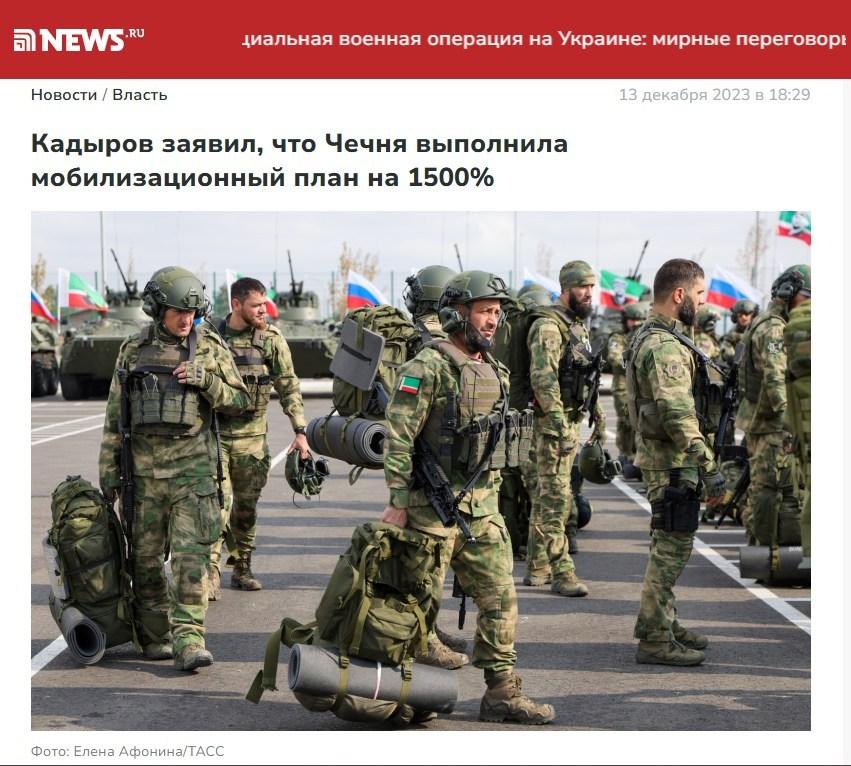
A credit attached to the photo shows it was taken by the Russian news agency TASS.
Searching the agency’s website using keywords from the 2023 article led to the original version of the picture, published a year earlier on October 15, 2022 (archived here).
“Servicemen are seen in the Khankala military settlement before being sent to the special military operation zone,” the caption reads. “The Russian Armed Forces are carrying out a special military operation in Ukraine in response to requests from the leaders of the Donetsk People’s Republic and Lugansk People’s Republic for help.”
Attributed to photographer Yelena Afonina, the photo was taken in Grozny, the capital of Russia's tightly controlled Chechen Republic, which has supported Russia’s war in Ukraine by providing thousands of soldiers (archived here).
AI-generated image
AFP Fact Check conducted a reverse image search on the second photo, which failed to produce an exact match, indicating the picture may have been created with AI, similar to those on stock content provider Freepik.
Several visual clues support this analysis.
Firstly, the flagpoles on the trucks do not have visible mounting brackets. They appear to grow directly out of the canvas or hover behind the cabin.
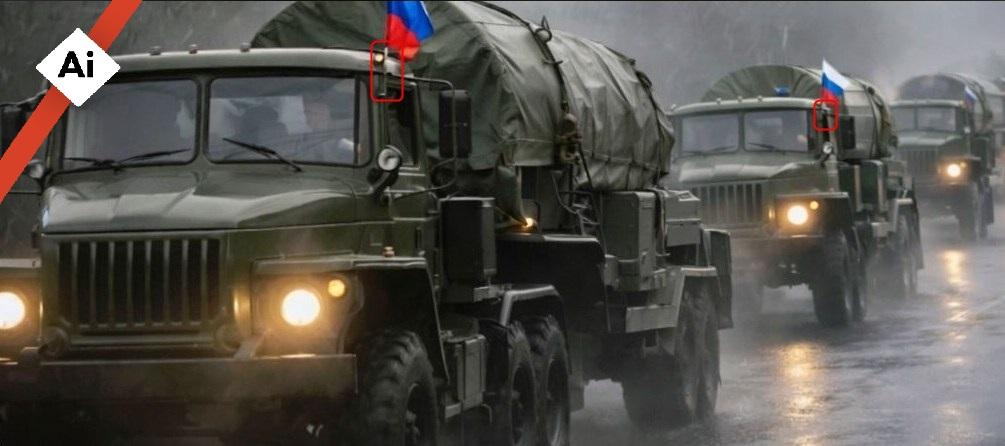
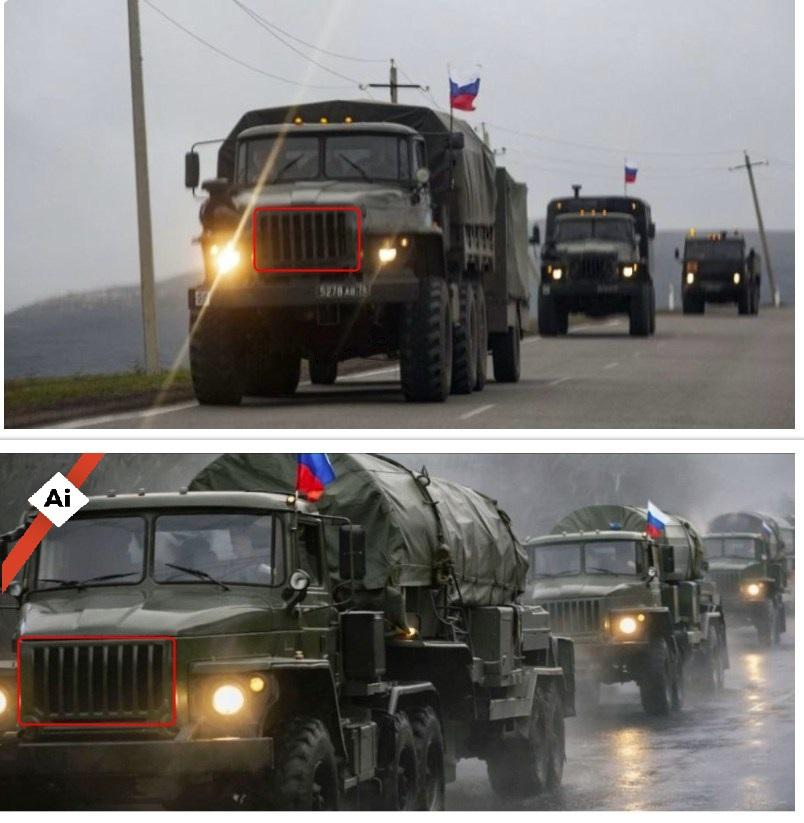
Secondly, there are inconsistencies between similar objects. The lead truck has a wide vertical grille, while the truck behind it features a dense mesh grille -- the type of detail AI often struggles to standardise within the same scene.
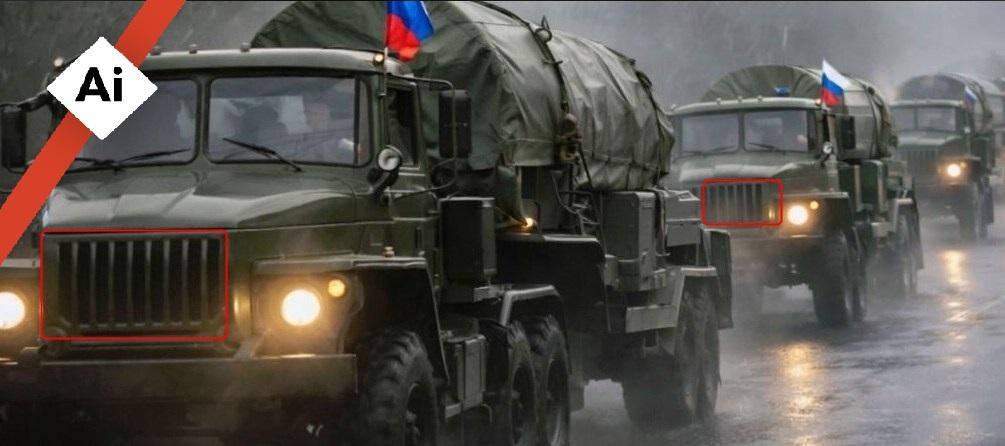
Thirdly, there are visible structural irregularities. The headlights of the lead truck are misaligned, with the left one physically higher than the right one. Their housing shapes are also mismatched.
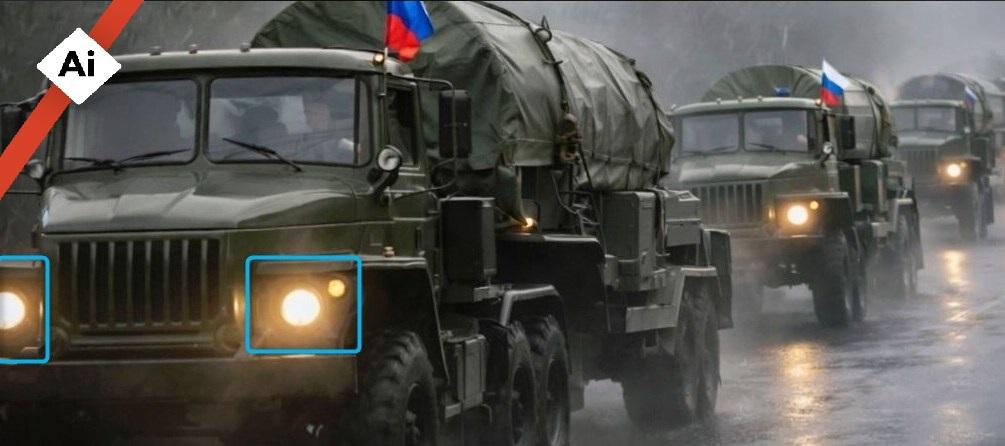
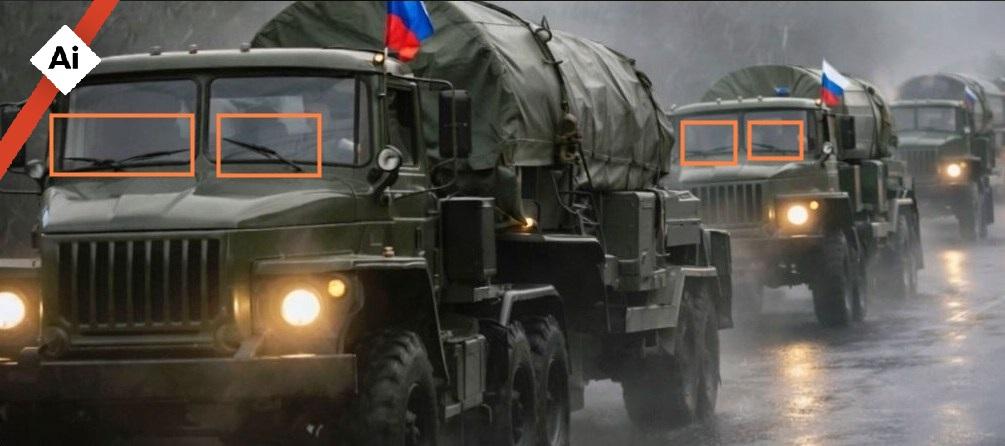
Finally, the windshield wipers appear unnatural and disconnected, lacking a clear pivot point and seemingly floating over the glass, another common anomaly in AI-generated images.
The AI-generated military trucks appear to be modelled on the Russian Ural-4320. A comparison with a genuine photograph of the same model shows clear discrepancies -- the real truck’s grille has eight slats or holes, while the AI-generated version incorrectly shows nine.
Running the image through various AI image detectors proved inconclusive, which is not surprising since these tools are trained to detect specific conditions, such as the human anatomy.
The conclusion that the image is AI-generated is based on observed visual irregularities, the absence of a source image, and the lack of any credible reporting about Russian soldiers arriving in Tehran to bolster Iranian forces.
Read other debunks related to the Middle East war here.
Copyright © AFP 2017-2026. Any commercial use of this content requires a subscription. Click here to find out more.
Is there content that you would like AFP to fact-check? Get in touch.
Contact us