Skeptics inaccurately frame global warming as 'saving' humans from extinction
- Published on May 4, 2026 at 18:31
- Updated on May 4, 2026 at 19:47
- 3 min read
- By Manon JACOB, AFP USA
Shifts in Earth's orbit around the sun influence the start and end of Ice Ages over tens of thousands of years and human carbon emissions have disrupted this, likely delaying the expected start of a cooling cycle. But scientists told AFP that contrary to online posts claiming the warming will prevent "extinction," rapid warming should not be touted as a net positive or a reason to dismiss the threat of climate change to modern ecosystems.
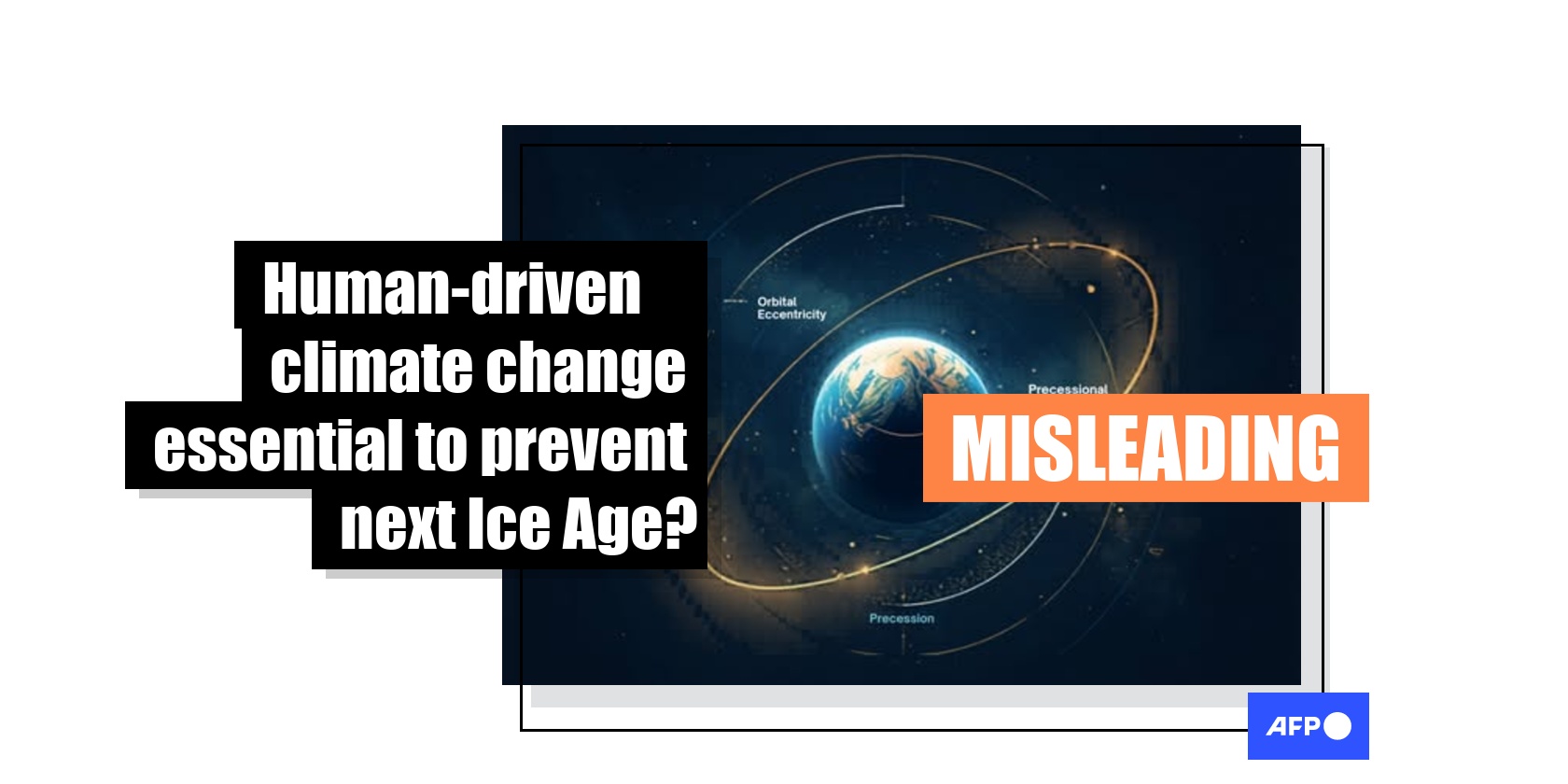
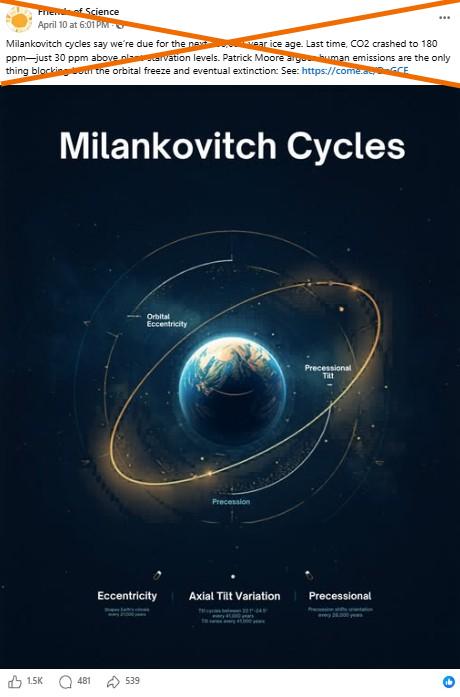
"Human emissions are the only thing blocking both the orbital freeze and eventual extinction," text accompanying a visual shared in a climate-skeptic Facebook group on April 10, 2026 said.
"So, man made climate change is saving us," a commenter remarked underneath the post sharing a graphic of the Earth orbiting.
The claim reverberated on LinkedIn and X in April, often citing a 2015 report by Patrick Moore -- a climate contrarian AFP has repeatedly debunked -- as evidence.
Moore often touts affiliation with environmental organization Greenpeace to add credibility to his claims, but in 2010 the independent group said his ties to the institution were "long-gone" (archived here).
And scientists told AFP his assertions about the positive outcomes of increased CO2 -- supposed to prevent "extinction" -- misrepresent the effects human emissions have already had on ecosystems since the Industrial Revolution, just short of two centuries ago (archived here).
Natural cycles disrupted
Milankovitch cycles are changes in Earth's orbit which lead to fluctuations in the amount of sunlight it receives (archived here).
"The small changes set in motion by Milankovitch cycles operate separately and together to influence Earth's climate over very long timespans, leading to larger changes in our climate over tens of thousands to hundreds of thousands of years," NASA says on its website (archived here).
But experts told AFP, the pace of warming observed today is destabilizing these natural shifts in warming and cooling.
Bethan Davies, a professor of glaciology at Newcastle University in the United Kingdom (archived here), said that temperature changes expected to happen because of Milankovitch cycles have been off their predicted course.
Earth's orbit, for example, should currently favor "cooler summers in the northern hemisphere," she said in April 2026 for a previous story.
But she said human-induced "carbon dioxide emissions are now heating the planet substantially, and very rapidly, far faster than at any point" in the last 11,700 years, known as the Holocene period which started at the end of the last Ice Age (archived here).
Steven Soter, astrophysics resident research associate at the American Museum of Natural History in New York, concurred (archived here).
On a timescale of mere decades -- a blip in Earth's 4.5 billion-year history -- "we have injected carbon into the atmosphere that required tens of millions of years to accumulate in the sediments," he said (archived here).
Carbon dioxide is the principal climate-regulating element of the atmosphere and humans have increased its levels more than 50 percent above pre-industrial times so far, he said (archived here and here).
"That represents a terrific shock to the delicately balanced climate system," he told AFP on April 23, 2026.
He said that despite the posts correctly pointing out that human-led carbon dioxide emissions likely "forestalled the next Ice Age, which might otherwise have begun within the next ten thousand years," the resulting greenhouse warming is "far greater than required to prevent an Ice Age" (archived here).
"We are rapidly forcing the climate in the direction opposite to an Ice Age. In climate terms, we are entering unknown territory," he said.
What is most at stake is not an "extinction" level event -- like some posts describe -- but instead the destabilization of Earth's agriculture system, as well as other essential resources such as drinking water supplies, which are needed to sustain an estimated population of 9.6 billion by 2050 (archived here and here).
As temperatures rise, the collapse of these systems due to human emissions is "a distinct possibility," Soter said.
Soter spoke further about this in an August 2025 episode of StarTalk, Neil deGrasse Tyson's science podcast (archived here and here).
AFP has debunked other visuals pushing misinformation about Earth's natural warmer and colder phases.
This story was refiled to resolve a technical issueMay 4, 2026 This story was refiled to resolve a technical issue
Copyright © AFP 2017-2026. Any commercial use of this content requires a subscription. Click here to find out more.
Is there content that you would like AFP to fact-check? Get in touch.
Contact us