
AI Earth images drive Artemis mission conspiracy theories
- Published on April 9, 2026 at 18:23
- 4 min read
- By AFP Canada, AFP USA
The Artemis II mission has been met with global excitement, but also an uptick in online conspiracy theories about space agencies faking lunar missions -- including posts claiming two images show Earth 54 years apart with suspiciously identical cloud cover over the African continent. But the side-by-side appears to be the product of artificial intelligence, and experts told AFP it does not actually include the photo taken by the Artemis crew.
"This is two pictures 55 years apart. Left is 1972. The right is the new Artemis II picture from 2026. Now, why are the clouds over Africa identical? If this is a true picture, how could this be real then?" says the voiceover in a Facebook reel posted April 5, 2026.
The clip shows two images depicting half the Earth, with the left side described as a picture taken during the 1972 Apollo 17 lunar mission and the right labeled as a photo from the Artemis II crew that shot around the Moon in April 2026.
"Same planet. 54 years apart," the text says.
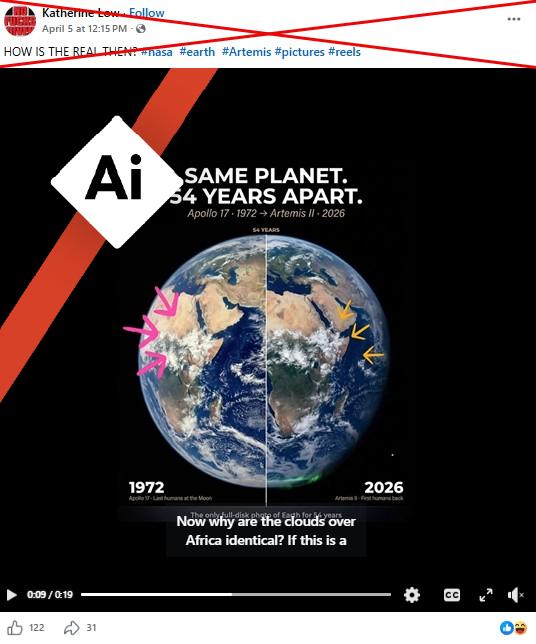
Similar posts comparing the images also circulated on other platforms, including X.
The crew on the Apollo 17 mission in December 1972 -- when humans last walked on the Moon -- took a world-famous picture of Earth titled "Blue Marble" (archived here and here).
The 1972 photo was the only whole-globe, single-shot photograph of Earth taken by a human in space until those released by the Artemis II team, including a picture captured April 2, 2026 by NASA astronaut Reid Wiseman (archived here).
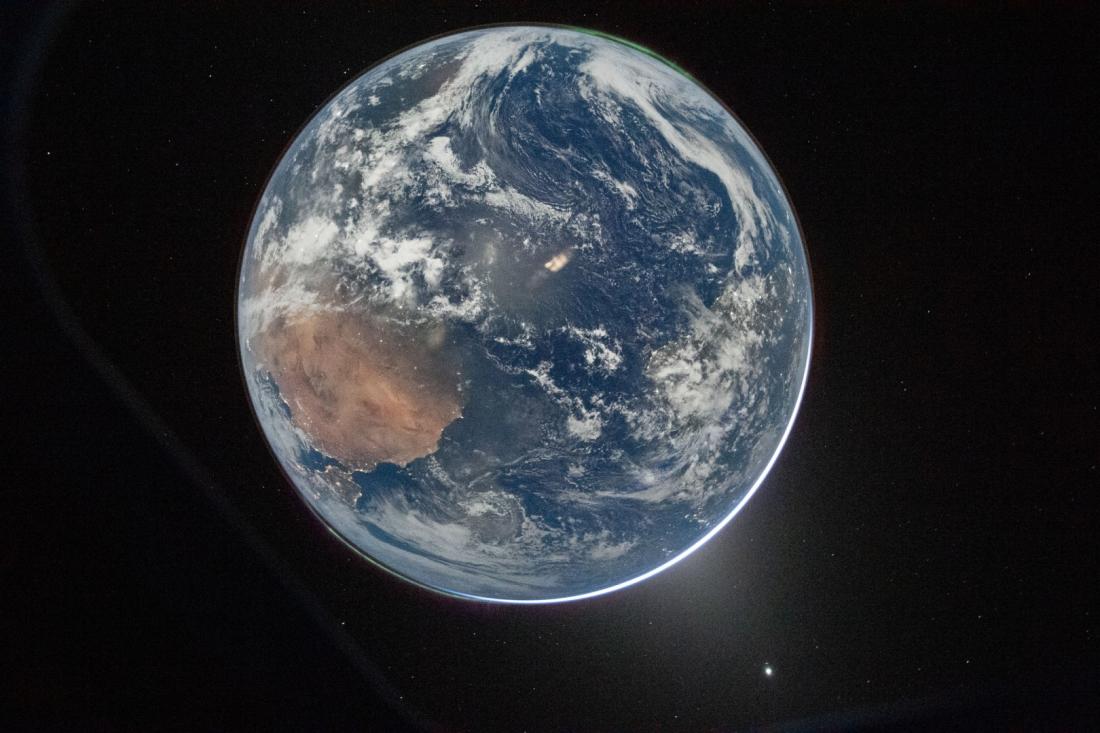
But despite the social media posts claiming to juxtapose two pictures taken by humans 54 years apart, the side-by-side visual does not show Wiseman's 2026 photo -- or the original "Blue Marble" shot from 1972.
AFP could not retrieve any visual matches in the official NASA "Journey to the Moon" gallery (archived here and here).
Google's SynthID detection tool identified a SynthID -- an invisible watermark the company says is attached to AI-generated content created using its programs -- in the image.

Hive Moderation, another tool designed to detect AI imagery, assessed that it "is likely to contain AI-generated or deepfake content," specifically from Google's Gemini AI tool.
Images do not match
Jennifer Levasseur, space history curator at the US National Air and Space Museum, said she doubted the images in the side-by-side spreading on social media were from either the 1972 Apollo 17 mission or Artemis II (archived here and here).
"The split image simply looks like the same image from two angles," she told AFP on April 8.
Jonathan Bamber, a professor of Earth observation and glaciology at the University of Bristol in England, also told AFP he believed the two pictures placed side-by-side to be versions of the same image (archived here).
"At any one time clouds cover about 50 percent of the planet but never in the same place in an identical pattern," he said April 7.
Katie Mack, a theoretical astrophysicist at the Perimeter Institute for Theoretical Physics in Ontario, Canada, agreed that the posts do not show the photo from the Artemis II mission (archived here and here).
Mack said April 7 that the juxtaposed images likely stem from another NASA source -- a recreation inspired by 1972's "Blue Marble" and enhanced by more recent satellite data (archived here).
She said the recreation appears to have been given "some modifications" to make the two sides mirror each other (archived here).
Hundreds of satellites monitor Earth's atmosphere, land and oceans (archived here and here).
AFP contacted NASA for comment, but a response was not forthcoming.
Earth changes
Additional social media comments using the side-by-side to sow doubt about the existence of human-induced climate change are similarly misconstrued.
"Would you look at that, the coast lines are still the same, waters are still blue, skies are clear. I thought we were supposed to have destroyed the planet by now," one Facebook user claimed.
But the University of Bristol's Bamber said changes can "absolutely" be observed from a satellite-distance, including "increased desertification" (archived here).
"Another example would be increased marine heat waves from satellite data and changes in cyclone intensity and number," he said, adding that other instruments measure snow cover extent, which has decreased in the last half century (archived here, here and here).
The Artemis crew has relied heavily on long periods of observation with the naked eye in their mission to the Moon.
After completing their lunar flyby -- in which they also broke the record for distance from Earth -- they were bound for home, with splashdown due in the Pacific off the California coast late on April 10.
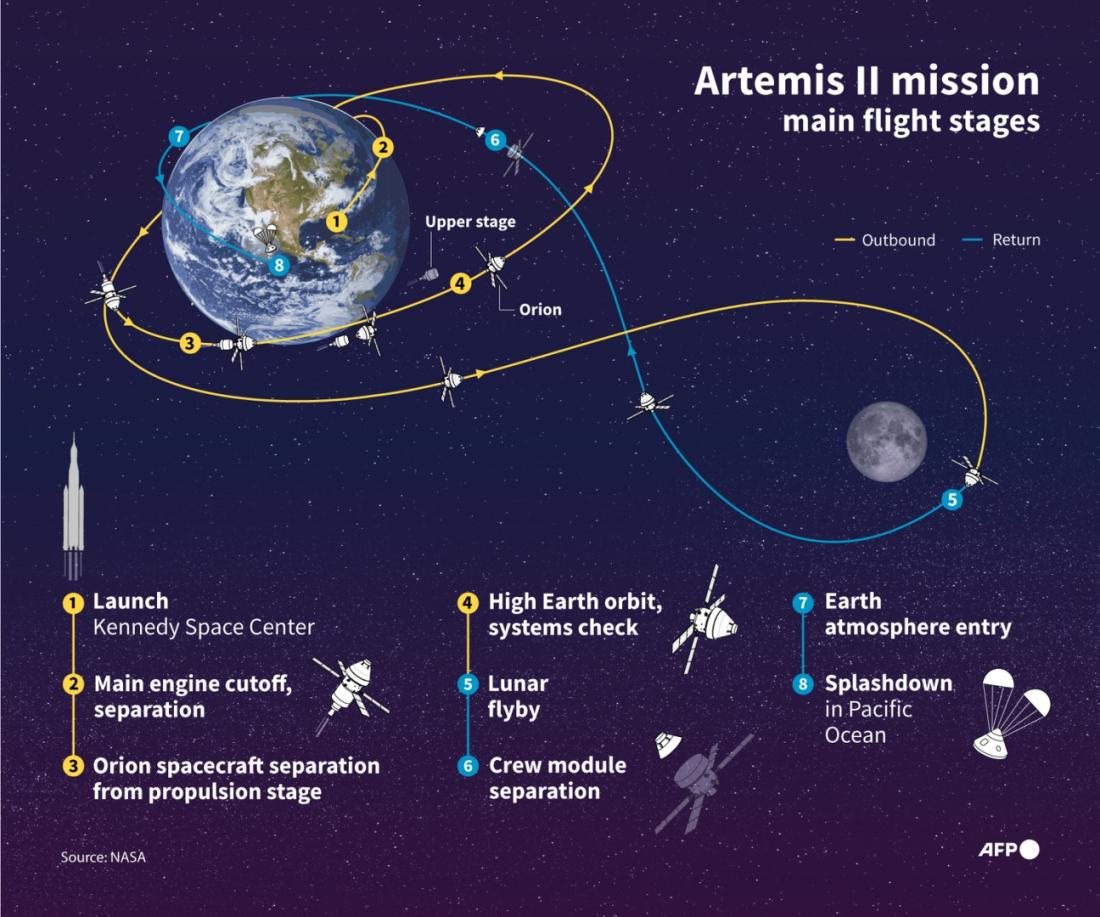
AFP has fact-checked other posts questioning the authenticity of the mission here.
Copyright © AFP 2017-2026. Any commercial use of this content requires a subscription. Click here to find out more.
Is there content that you would like AFP to fact-check? Get in touch.
Contact us