AI-generated video passed off as genuine footage of Iranians protecting power plants
- Published on April 15, 2026 at 08:03
- 2 min read
- By Rasheek MUJIB, AFP Bangladesh
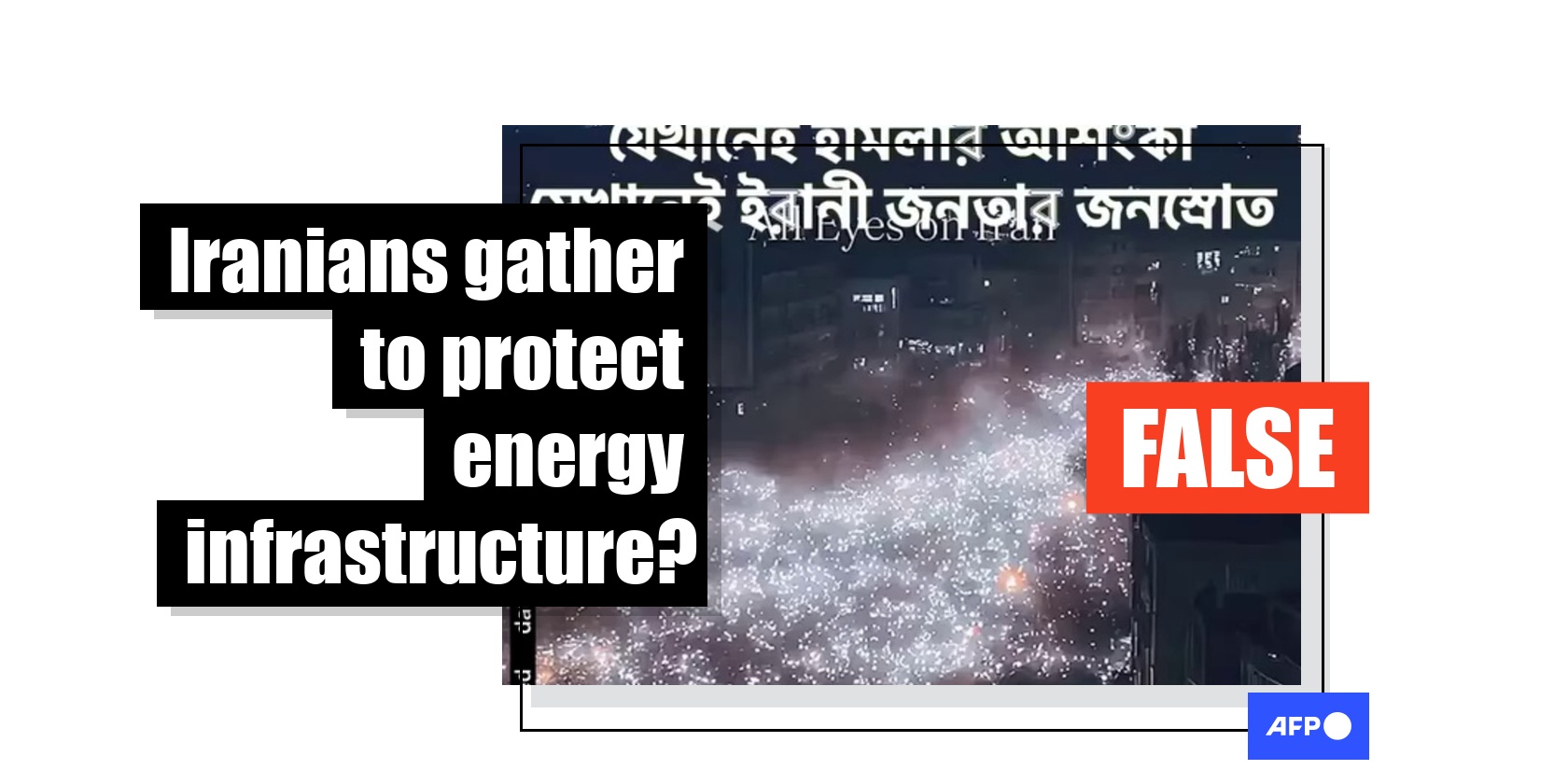
US President Donald Trump threatened to destroy Iran's critical infrastructure ahead of a ceasefire announced on April 7, but video shared online purportedly showing Iranians gathering to protect the Islamic republic's power plants is in fact AI-generated. While Iranian state media reported people forming human chains around power plants, the creator of the footage previously told AFP it was created using AI tools when it first circulated in false posts claiming it showed Iranians protesting the regime in January.
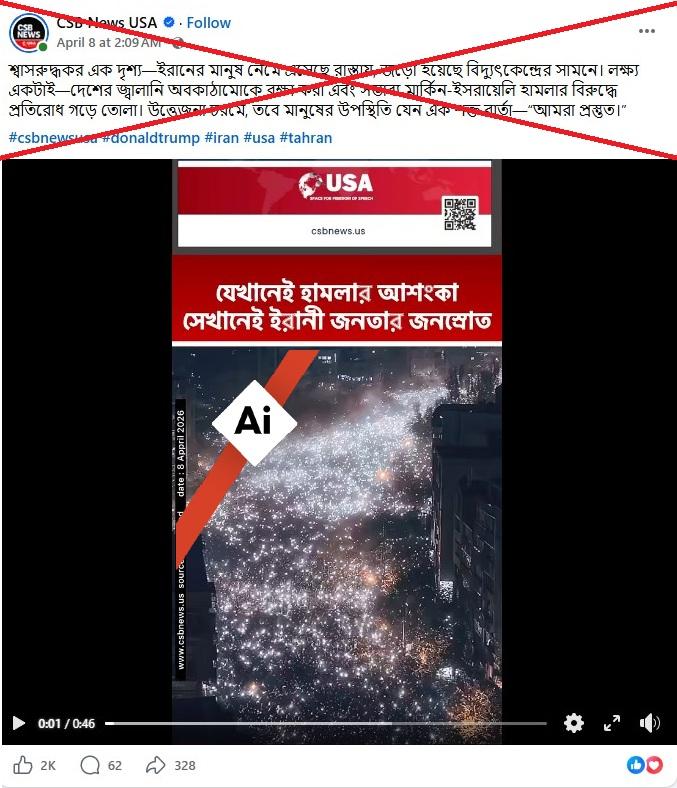
"A breathtaking scene -- the people of Iran have taken to the streets, gathering in front of power plants. The goal is one—to protect the country's energy infrastructure and build resistance against potential US-Israeli attacks," reads a Bengali-language Facebook post on April 8, 2026.
It features a 46-second video of a large crowd marching through a street holding up their phone flashlights.
Bengali text superimposed over the video reads, "Wherever there is a threat of attack, there is a wave of Iranian people."
The video was appeared alongside similar claims on Facebook after Iranian state media reported people forming a human chain "to support power plants" in the southern city of Bushehr, which is home to Iran's nuclear power plant, following Trump's threats to destroy energy facilities in the country (archived link).
Trump agreed to stop bombing Iran for two weeks if Tehran reopened the Strait of Hormuz, which the Islamic republic had effectively sealed off for weeks in retaliation for joint US-Israeli strikes on February 28 that started a region-wide war (archived link).
However, peace talks to end the war on April 12 failed, with US Vice President JD Vance saying Tehran had refused to accept Washington's terms after 21 hours of negotiations (archived link).
Trump then ordered a US naval blockade of the critical Strait of Hormuz and reiterated his earlier threat to destroy Iranian power plants and other civilian infrastructure if no lasting deal is reached.
But the circulating video is in fact synthetic content.
AFP previously debunked the same video when it was shared online as genuine footage of anti-government protests against the Iranian regime that were triggered by widespread economic and political grievances in January (archived links here and here).
Close inspection of the circulating video revealed visual errors indicative of AI-generated content.
Javier Huertas-Tato, a professor at the Polytechnic University of Madrid and a member of the institution's Natural Language Processing and Deep Learning group pointed out the inconsistencies in a January 12 email (archived link).
For example, shadows and hands appear spontaneously and the lights reflected in the windows are poorly rendered.
An analysis of a screenshot from the video using InVID-WeVerify, a tool co-developed by AFP, also found a high chance the video was AI-generated.

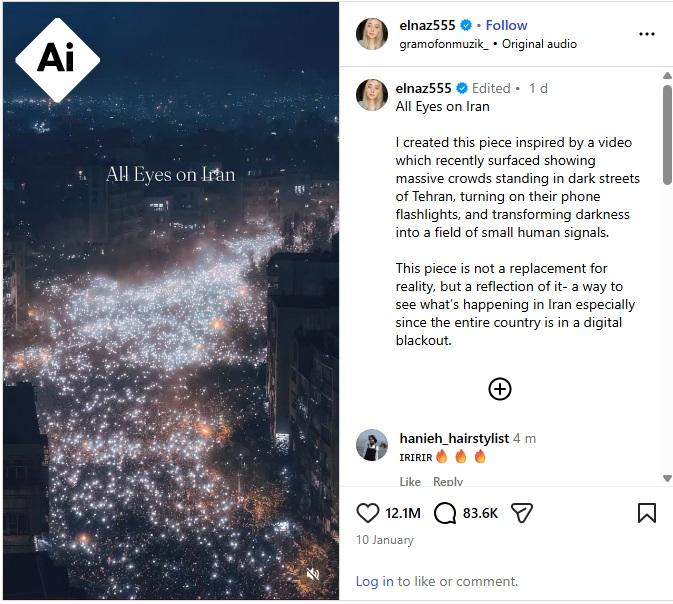
Some versions of the circulating video included a watermark for Instagram user @elnaz555, an artist named Elnaz Mansouri who uses AI in her work (archived links here and here).
Mansouri told AFP on January 13 she created the video with AI.
She also noted the video's creation with artificial intelligence on Instagram and X, explaining it was meant to be a "reflection" of reality following the digital blackout in Iran (archived links here and here).
AFP has debunked other misinformation stemming from the war in the Middle East.
Copyright © AFP 2017-2026. Any commercial use of this content requires a subscription. Click here to find out more.
Is there content that you would like AFP to fact-check? Get in touch.
Contact us