
Deadly Japanese quake revives conspiracy theory about HAARP-induced tremors
- Published on August 7, 2026 at 09:27
- 4 min read
- By Grace MOON, AFP South Korea
After a deadly 7.1-magnitude earthquake struck southern Japan on July 28, posts spreading well-worn conspiracy theories about the natural disaster being triggered by a research facility in the US state of Alaska surfaced online. Authorities say the Japan quake was caused by strike-slip faulting, while experts reiterated to AFP that radio waves transmitted by HAARP cannot initiate earthquakes nor has any causal relationship been established between the facility and induced seismicity.
"After HAARP attacked Busan and Japan two days ago, earthquakes struck both places today,” says part of a Korean-language Threads post shared on July 28, 2026.
It quotes another post featuring images that purportedly show lightning strikes that preceded the 7.1-magnitude earthquake that struck Japan's southern Kumamoto region on July 28 and whose tremors were felt in the South Korean port city of Busan (archived here and here).
The powerful quake killed at least 38 people, and destroyed homes, ruptured bridges and left thousands of households without running water and electricity (archived link).
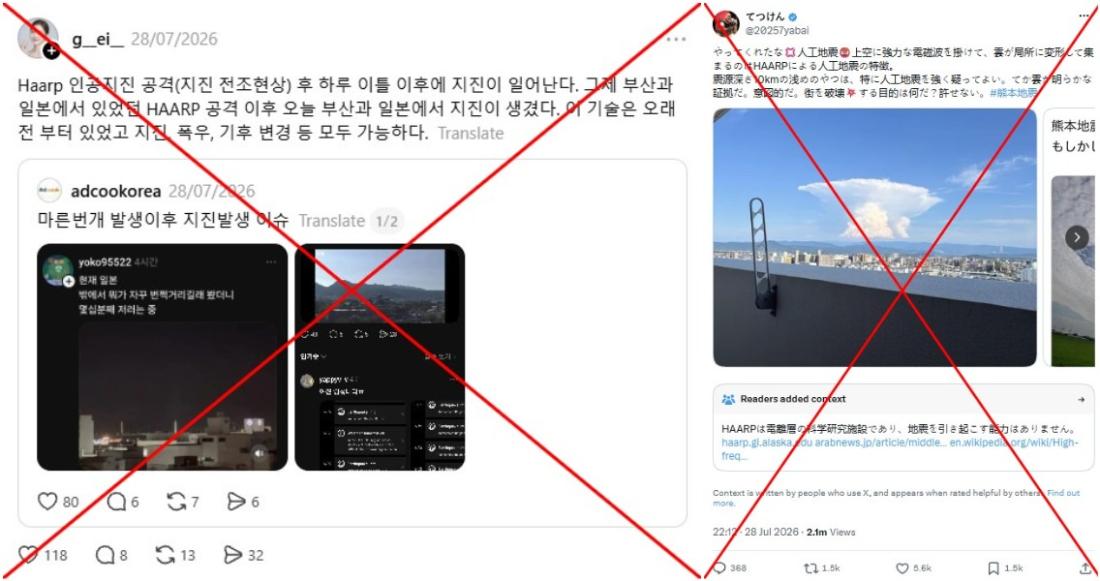
Similar posts circulated in Japanese, with some X users sharing photos of disk-shaped clouds as purported evidence of weather manipulation by HAARP -- a research facility that uses the world's most powerful high-frequency transmitter to study activity in the Earth's ionosphere (archived here and here).
The United States Air Force operated the High-frequency Active Auroral Research Program (HAARP) until 2015, when ownership was transferred to the University of Alaska Fairbanks (archived link).
Multiple experts have told AFP there is no evidence that HAARP radio waves could have induced an earthquake. The facility is a frequent target of false and misleading claims, and AFP has debunked multiple conspiracy theories that it is capable of manipulating weather or causing natural disasters.
After twin earthquakes struck Venezuela in June, HAARP director Jessica Matthews told AFP that radio waves transmitted by its Alaska-based research station reach a frequency that cannot be absorbed by the Earth's atmosphere and that the facility is "simply unable to generate or amplify weather events".
No scientific evidence
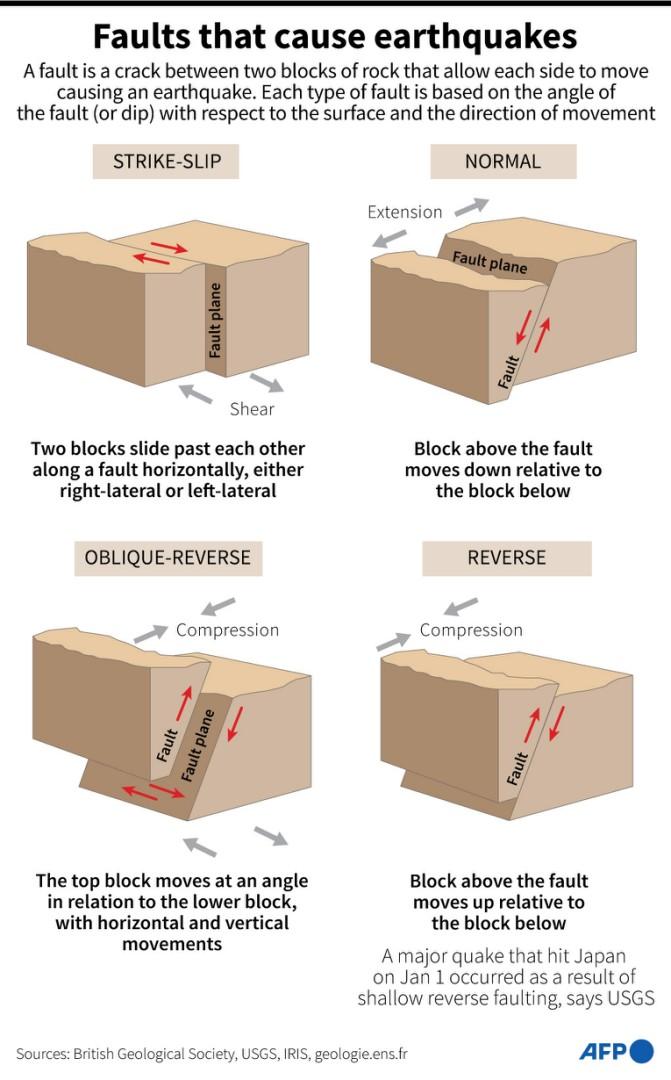
Earthquakes occur when stress accumulates along a fault, or a zone of fractures between blocks of rock in the Earth's crust. The build-up of stress can suddenly cause rocks to slip, resulting in an earthquake.
According to the Japan Meteorological Agency, the earthquake was "characterised by strike-slip faulting", a natural phenomenon in which blocks of rock slip past each other horizontally (archived here and here).
A separate analysis of the quake by the United States Geological Survey (USGS) also supported those findings (archived link).
Japan is one of the world's most seismically active countries, sitting on top of four major tectonic plates along the western edge of the Pacific "Ring of Fire". Kumamoto itself was hit by two devastating earthquakes in 2016, which killed 273 people and injured more than 2,800.
Ryan Schultz, a senior researcher at the Swiss Seismological Service at ETH Zurich who specialises in induced seismicity, told AFP that human activity can cause earthquakes through various sub-surface operations such as mining or the injection of fluids (archived here, here and here).
But contrary to the earthquake conspiracies, "no known causal relationship" between HAARP and induced seismicity has been established, Schultz said on August 4.
"To claim if a sequence of earthquakes was induced by human operations, scientists need to demonstrate a strict set of criteria" showing a correlation between the operation and the location, timing and changes in the rate of seismicity, he added.
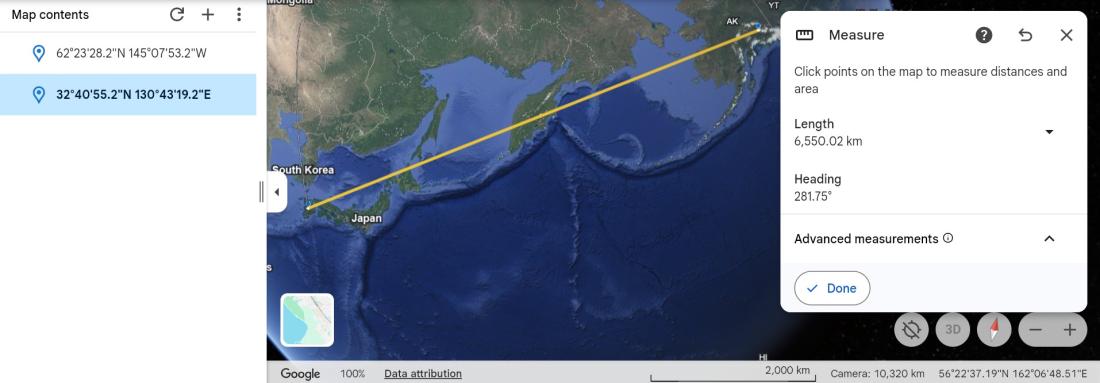
For instance, the distance over which human activity can induce seismicity is often estimated to range from a few kilometres to, at most, tens of kilometres from an operation, according to Schultz.
But that distance falls significantly short of the roughly 6,500 kilometres (4,000 miles) between HAARP and the epicentre of the Kumamoto earthquake (archived link).
Emily Brodsky, a professor of Earth and planetary sciences at the University of California, Santa Cruz, also told AFP in an email on August 6 that "there is no evidence that electromagnetic pulses can be used to deliberately induce earthquakes" (archived link).
"Earthquakes are created by stresses due to the movement of rocks and fluids underground that are not stimulated by electromagnetic pulses," she added.
Dongwoo Lim, a sociology professor at Kansai University who has researched patterns in earthquake misinformation, told AFP that false claims routinely resurface whenever a major earthquake occurs in Japan (archived here and here).
The falsehoods have centred on "HAARP as well as artificial seismic waves, earthquake clouds and government-related conspiracy theories", Lim said in an email to AFP on August 4, adding that "some users are consuming and engaging with these theories as a form of entertainment".
AFP has fact-checked other false claims shared in the aftermath of the earthquake in Japan.
Copyright © AFP 2017-2026. Any commercial use of this content requires a subscription. Click here to find out more.
Is there content that you would like AFP to fact-check? Get in touch.
Contact us