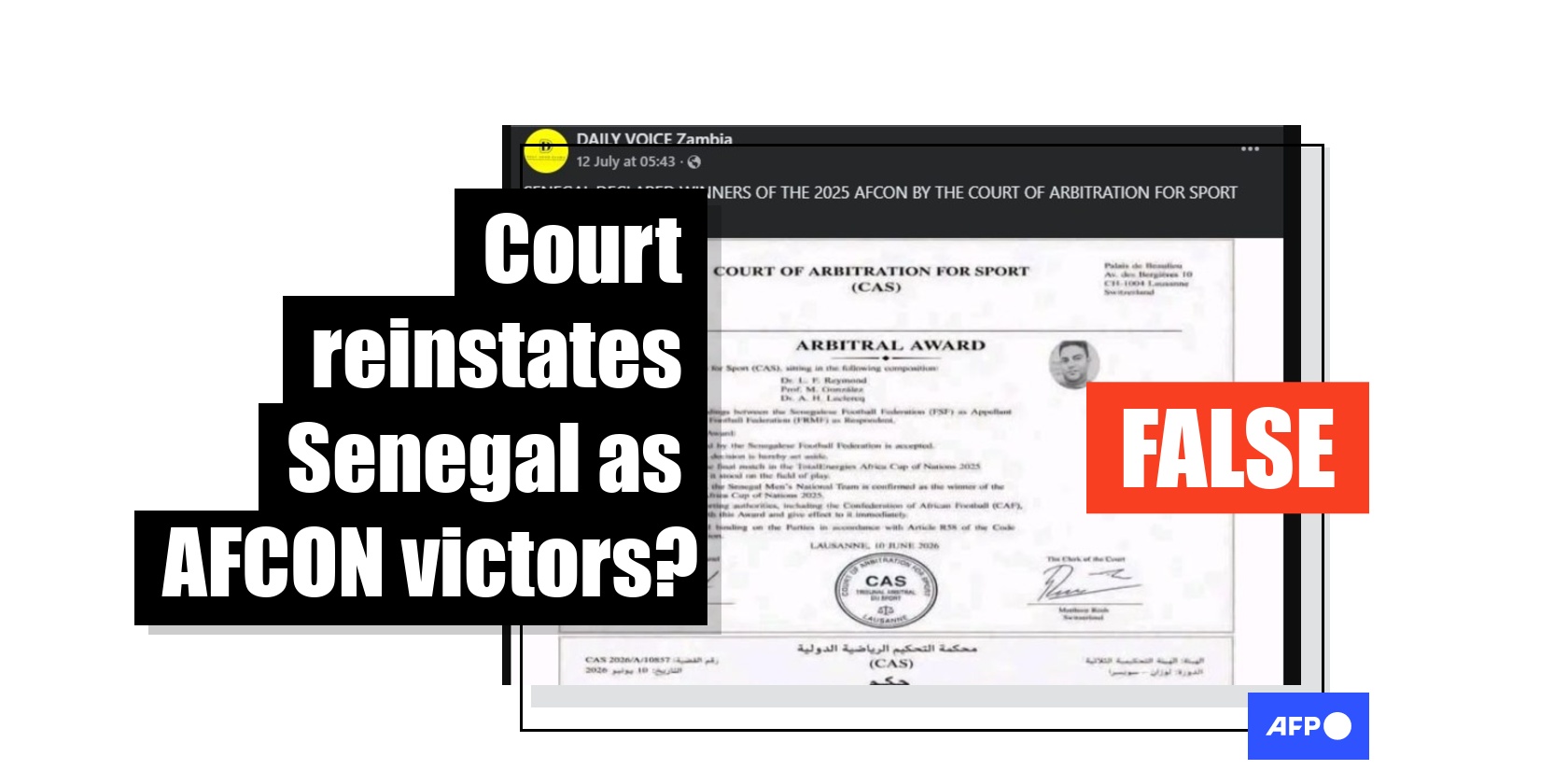
Hoax letter falsely claims Senegal declared AFCON winners by sporting tribunal
- Published on August 7, 2026 at 15:12
- 3 min read
- By Emilie BERAUD, AFP France
- Translation and adaptation Oluseyi AWOJULUGBE, AFP Nigeria
The 2025 African Cup of Nations (AFCON) title was withdrawn from the Senegalese national team and awarded to Morocco after a ruling by the judges of the Confederation of African Football (CAF). Months after the Senegalese Football Federation appealed the decision at the Court of Arbitration for Sport (CAS), social media posts claim a press release from the tribunal reinstates Senegal as the tournament winner. However, this is false; CAS confirmed to AFP Fact Check that the document is fake. The hearing is only scheduled for October.
“SENEGAL DECLARED WINNERS OF THE 2025 AFCON BY THE COURT OF ARBITRATION FOR SPORT,” reads the caption of a post shared on Facebook on July 12, 2026.
The post includes a copy of a letter purportedly signed by the “President of the Panel” for dispute resolutions and legal arbitration at CAS, “Dr L. F. Reymond”.
The document lists five purported resolutions of the court, including one stating that “the result of the final match in the TotalEnergies Africa Cup of Nations 2025 is confirmed as it stood on the field of play”.
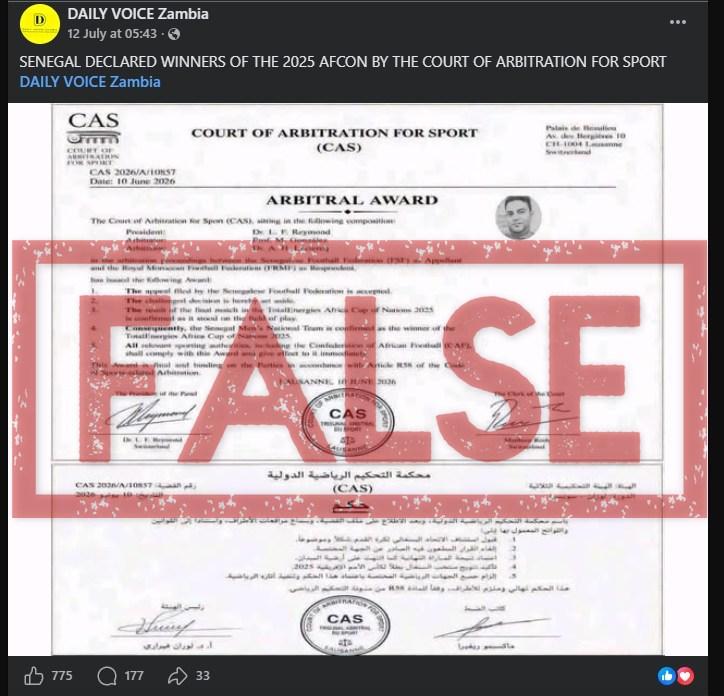
An image of the letter allegedly conveying the court’s decision has also been posted on Instagram and Threads, and shared in other African countries, including Nigeria and Ghana.
Senegal won the AFCON final 1-0 on January 18, 2026, after the match was disrupted by supporters attempting to invade the field over a stoppage-time penalty awarded to Morocco (archived here).
However, on March 17, CAF overturned the result and awarded the title to Morocco. Subsequently, the Senegalese Football Federation (FSF) appealed the decision to the CAS, the independent body that resolves international sports disputes (archived here and here).
Contrary to the claims, the CAS has not yet ruled publicly on the matter.
Decision pending
AFP Fact Check searched the CAS website and found no evidence of the purported ruling (archived here).
The court's press office told AFP Fact Check in an email dated July 16, 2026, that the claim is “false information”.
“No official decision has been made to date and the procedure is still ongoing,” the tribunal said, emphasising that the document in question is a hoax and “includes a fictitious seal and forged signatures”.
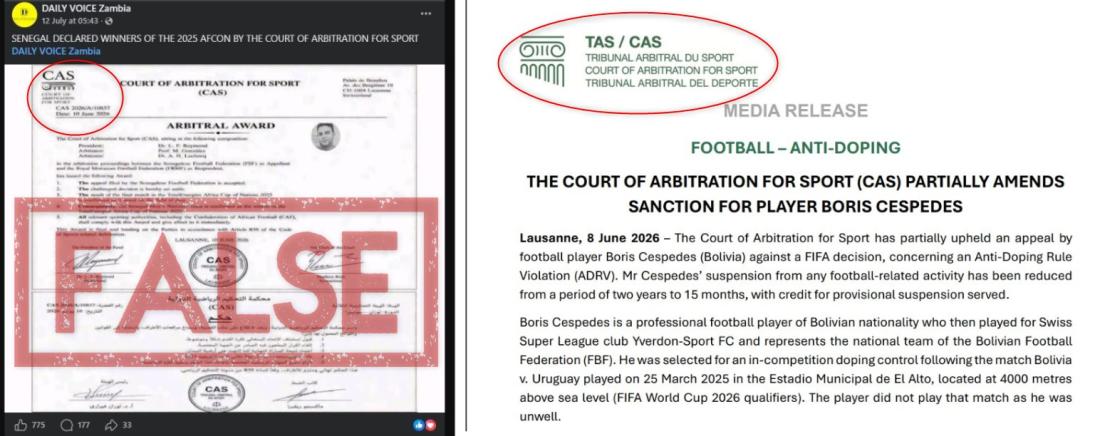
AFP Fact Check compared the fake letter with an official statement published on the CAS website in June 2026 and found several discrepancies, including the logo, font and overall format (archived here).
The fake letter also includes the names of three panellists -- Dr. L. F. Reymond, Prof. M. Gonzalez and Dr. A. H. Leclercq -- none of whom appear as arbitrators on the CAS website (archived here).
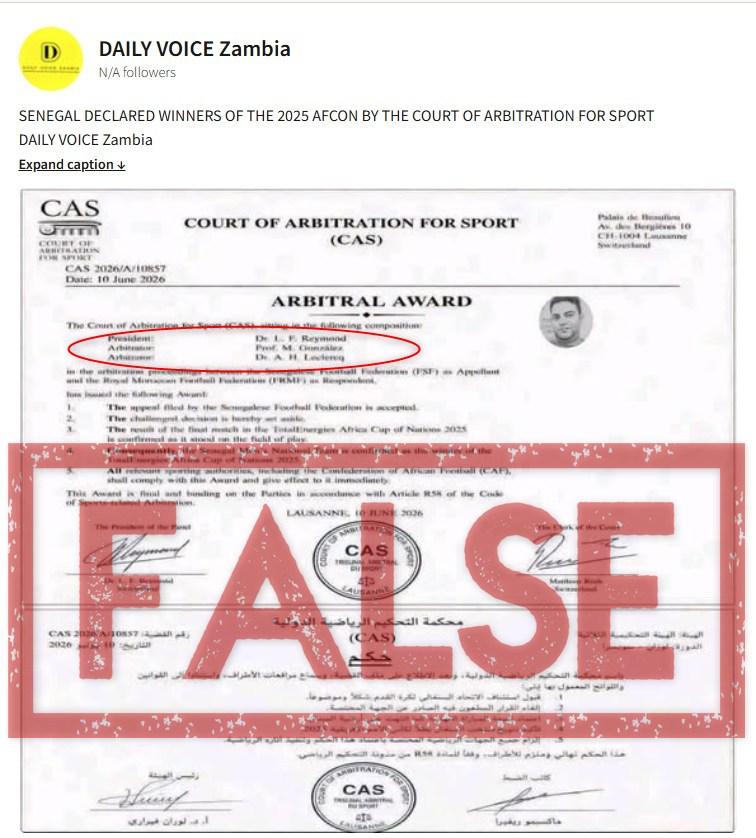
The case number in the top left corner of the document -- CAS 2026/A/10857 -- is also a fabrication.
According to the email from the CAS, the case number assigned to the matter is “2026/A/12295 and will not change”.
Since the CAS was established in 1984, case references have always indicated the year the proceedings were initiated, the type of proceedings, and the individual case number, recorded in the order in which requests for arbitration or appeals are received, the institution’s press office explained to AFP Fact Check.
Lastly, the viral document does not mention all the parties in the case, which is a requirement.
It cites the Senegalese Football Federation as the applicant and the Royal Moroccan Football Federation as a respondent, but does not include CAF, whose decision to overturn the result in the first place led to the appeal.
Unlike the hoax letter, the initial notice published by the CAS includes CAF as a party to the matter (archived here).
According to the CAS, the hearing is scheduled for October 8, 2026 (archived here).
AFP Fact Check originally debunked the claim in French.
Find other claims related to the 2026 World Cup and AFCON here and here.
Copyright © AFP 2017-2026. Any commercial use of this content requires a subscription. Click here to find out more.
Is there content that you would like AFP to fact-check? Get in touch.
Contact us