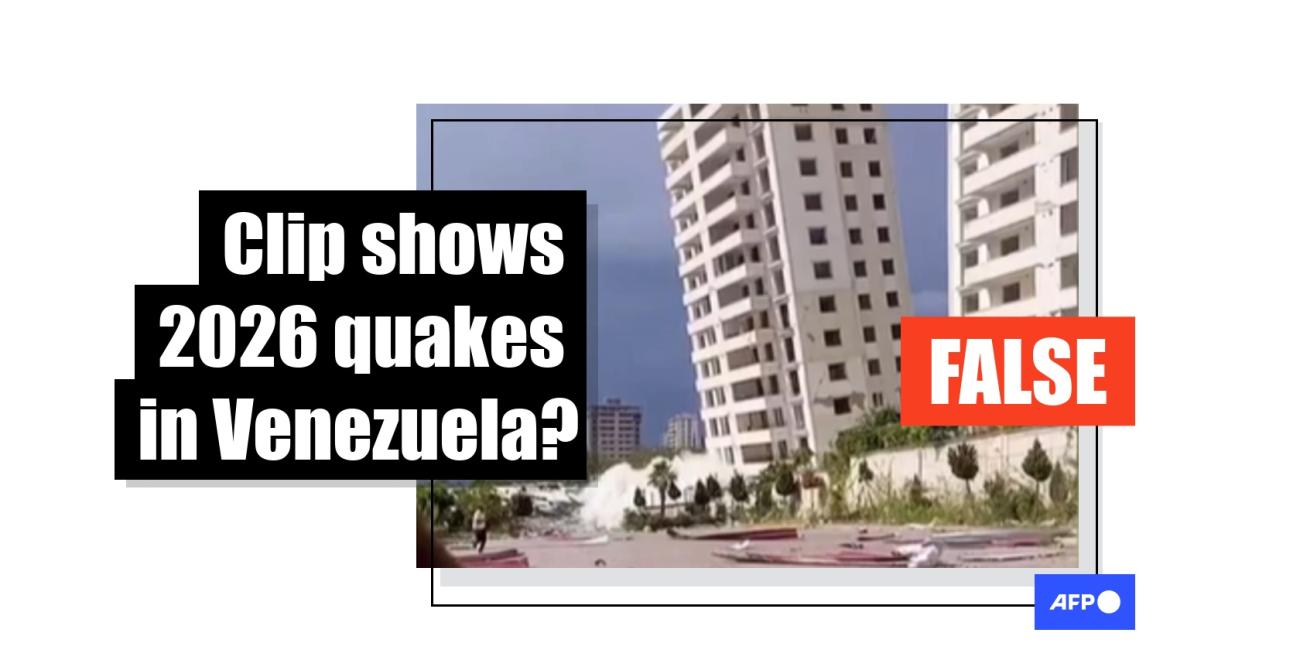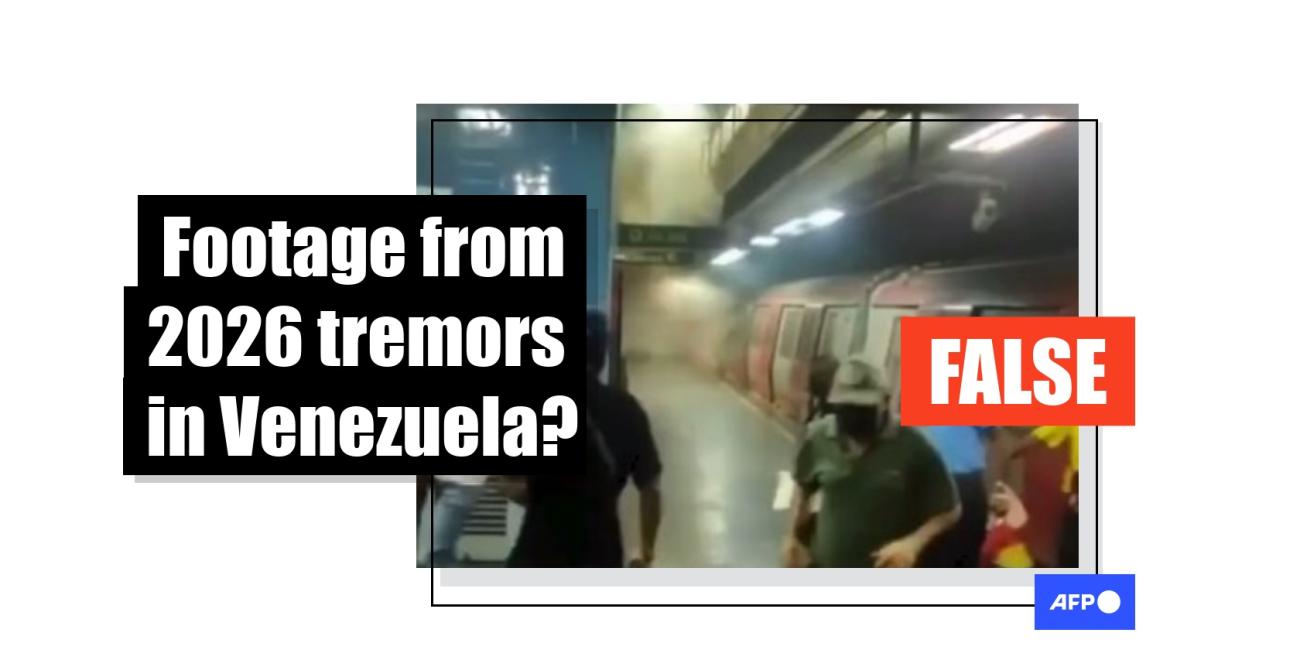
HAARP conspiracy theory falsely tied to deadly Venezuela earthquakes
- Published on July 1, 2026 at 22:28
- 3 min read
- By AFP USA
A humanitarian crisis is developing in Venezuela after twin earthquakes on June 24, 2026 killed and injured thousands of people. Meanwhile, social media posts have falsely pinned the events on the High-frequency Active Auroral Research Program (HAARP) in the US state of Alaska, based in part on an outdated video depicting laser beams that AFP determined is fabricated. Experts also say no laser force could have triggered events of such magnitude.
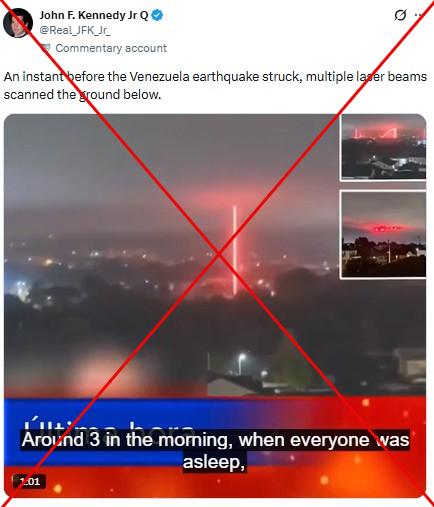
"An instant before the Venezuela earthquake struck, multiple laser beams scanned the ground below," says a June 28 post on X, accompanied by a clip of a cityscape under a night sky dramatically traversed by laser rays.
At the bottom of the screen, a Spanish-language banner reads: "Última Hora."
The clip spread across platforms -- and in multiple languages -- as the country's worst earthquake disaster in over a century shook Venezuela on June 24, pushing residential complexes to collapse and leaving tens of thousands of people unaccounted for amid frantic search-and-rescue operations.
On X, many of the accounts blaming HAARP activities were posing as foreign-affairs authorities and military forces.
HAARP is a research station that uses the world's most powerful high-frequency transmitter to study activity in the highest regions of the atmosphere. The University of Alaska Fairbanks has operated the program since 2015, when it was transferred from the US Air Force (archived here).
AFP has repeatedly debunked online disinformation promoting conspiracy theories about HAARP manipulating the weather or initiating earthquakes, wildfires, hurricanes and other extreme weather events.
But no laser force could create such powerful disasters, scientists say, and the HAARP program is located thousands of miles away from the quakes' epicenter.
"Our facility is simply unable to generate or amplify weather events or initiate or amplify earthquakes," HAARP director Jessica Matthews told AFP on July 1. "Our research equipment transmits radio waves in a frequency that cannot be absorbed by the atmospheric layers responsible for Earth's weather."
Plus, the widespread clip of red lasers was circulating online months prior to the earthquakes and appears entirely fabricated.
Clip precedes quake
Reverse image searches surfaced the same clip falsely tied to HAARP on TikTok, where it was posted March 18, months before the events in Venezuela (archived here and here).
The TikTok account is full of similar red-laser clips published months apart, with no particular geographic context.
A blog linked in the account's bio presents the page as "a living archive" but also notes that "nothing is presented as fact or theory."
David Hysell, an engineering professor in Cornell University's Department of Earth and Atmospheric Sciences (archived here), said HAARP's "effects are pretty subtle and require sensitive instruments to detect."
They "obviously do not include the disco light show depicted in the video you pointed me to which seem to have been augmented by someone with quite an imagination," he told AFP on June 30.
Judith Hubbard, an earthquake scientist and visiting assistant professor at Cornell University, added on June 30 that the videos "show a nighttime scene, but the earthquakes occurred well before sunset" (archived here).
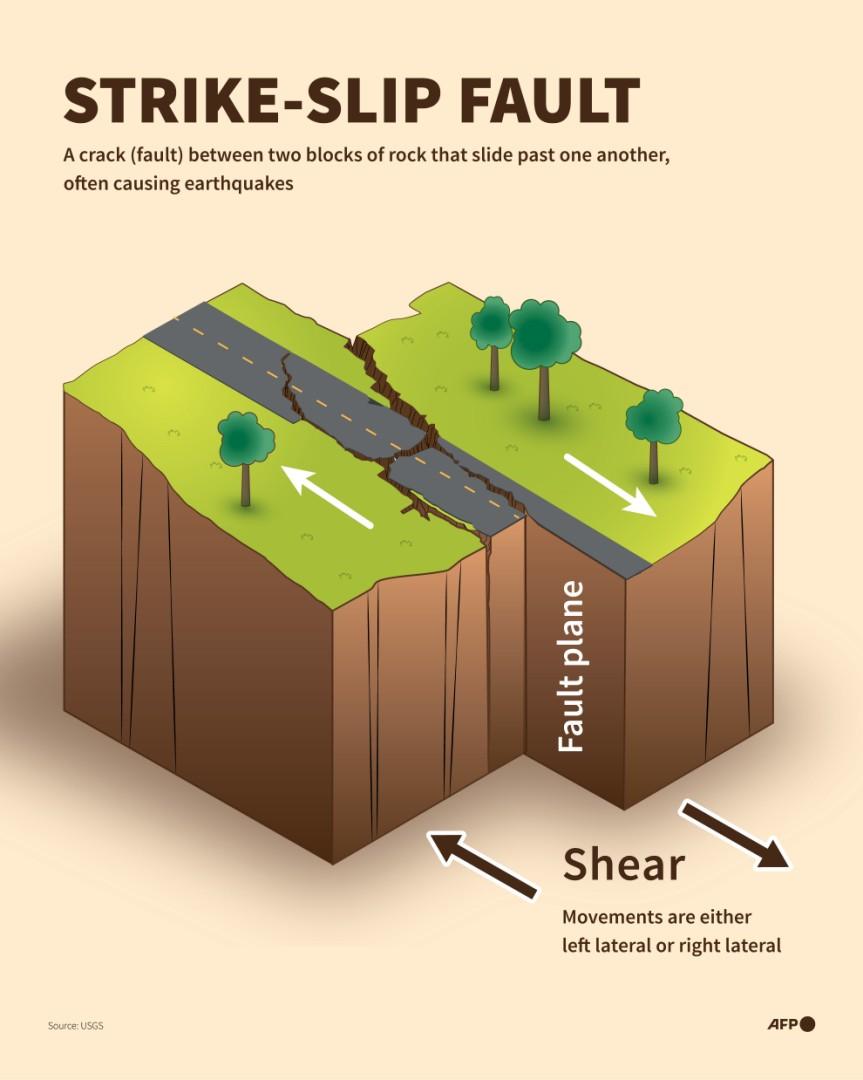
The first earthquake -- of magnitude 7.2 -- struck at 6:04 pm local time (10:04 GMT), southeast of Yumare (archived here). It occurred as a result of shallow strike-slip faulting near the plate boundary between the Caribbean and South American plates, according to the United States Geological Survey (USGS).
A second quake ranking even higher on the Richter scale at 7.5 followed not even a minute later, striking north of the capital Caracas (archived here).
No laser forces
Yihe Huang, an associate professor in geophysics at the University of Michigan (archived here), told AFP on June 30 it was not "physically possible for laser beams to trigger a massive earthquake" given that temblors start deeper in Earth's crust.
"The stress loading from laser beams is too small," Huang said.
Hubbard concurred: "The earthquakes are natural and started at 10 to 20 kilometers (6 to 12 miles) depth, and there is absolutely zero way to trigger earthquakes with lasers."
While earthquake lights -- balls of light and steady glows occasionally reported in association with the tremors -- may happen during a seismic event, they are not as prevalent as people may think, according to scientist and USGS spokesperson Steven Sobieszczyk (archived here and here).
Some reports of the phenomenon have turned out to be associated with arcing power lines.
"Most of the time, earthquake shaking damages power lines or other infrastructure that then flashes, arches, or explodes (similar if you've ever experienced a blown transformer)," Sobieszczyk wrote to AFP on June 30. "Since earthquake damage can be widespread, the distribution of these flashes/explosions can be wide and numerous."
"What the video shows is neither earthquake lights nor blown transformers," he added.
AFP has debunked other claims about the natural disaster in Venezuela.
Copyright © AFP 2017-2026. Any commercial use of this content requires a subscription. Click here to find out more.
Is there content that you would like AFP to fact-check? Get in touch.
Contact us