Climate consensus remains despite revisions to far-end emission scenarios
- Published on May 27, 2026 at 22:43
- 4 min read
- By Manon JACOB, AFP Canada, AFP USA
Recent adjustments to the most extreme scenarios included in key UN climate reports are being misrepresented across social media, including by US President Donald Trump. These updates do not discredit the strong concensus in climate research showing human emissions are behind major environmental shifts and the changes were recommended by independent experts to reflect renewable energy implementation.
"The UN admits that half of our data predicting long-term weather challenges and climate change isn't totally accurate," Tajana Cekic -- a content creator from Canada whom AFP has previously fact-checked for spreading conspiracy theories -- says in a video shared to X and Facebook on May 18, 2026.
"They were paying scientists to get the results that they wanted," she added.
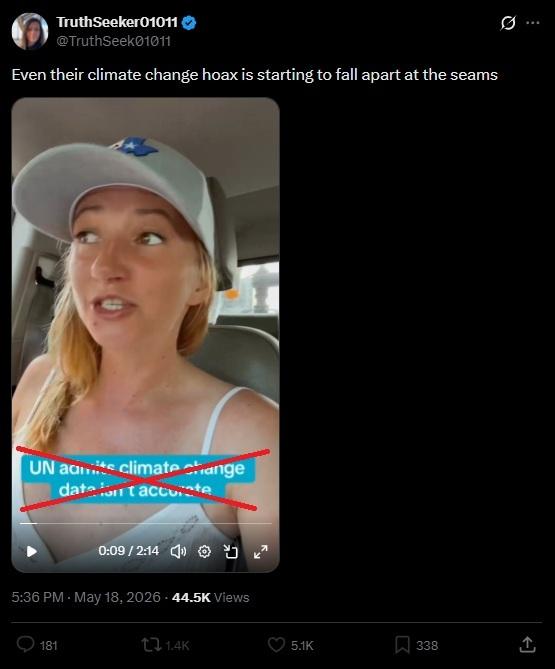
Similar claims circulated in Canada, the United States and were raised on the floor of Germany's parliament following the publication of a paper that recommended the overhaul of scenarios that have been used by researchers and included in the United Nations' major climate reports for years (archived here).
The paper's recommendations come from the Coupled Model Intercomparison Project (CMIP), an international committee of climate modelers, not the UN nor its climate science body the Intergovernmental Panel on Climate Change (IPCC).
Nevertheless, Trump posted May 16 on his Truth Social platform saying: "The United Nations TOP Climate Committee just admitted that its own projections (RCP8.5) were WRONG!" as he criticized "bogus research programs."
RCP8.5 refers to the worst-case scenario adopted for years by the IPCC -- in which humans continue the unabated burning of oil, gas and coal.
The change to retire this, however, does not contradict the climate science presented by the consortium of independent experts and established over decades of research.
Detlef Van Vuuren, the paper's lead author engaged in the CMIP ensemble, and a senior scientist at PBL Netherlands Environmental Assessment Agency (archived here and here), told AFP that Trump's social media post was a "completely incorrect interpretation" of the conclusions.
He reiterated to AFP on May 23: "There is a lot of misinformation regarding the fact that we propose not to use a high-end scenario as high as RCP8.5."
Adjusted extremes
The paper did conclude that the high emissions levels foreseen in the worst-case scenario "have become implausible" but this is a result of renewable energy use, climate policies and recent emission trends.
However, Van Vuuren said that retiring the previous worst-case scenario "doesn't mean at all that we have made a lot of progress with respect to climate change." Under the updated extreme projections, temperatures could still rise by almost 3.5C in 2100 over a preindustrial period defined as 1850-1900.
More importantly, the paper also rethinks the lowest emission projections. The new best-case scenario sees temperatures "overshooting" to at least 1.7C or even 1.8C before returning to 1.5C, Van Vuuren said.
Van Vuuren compared the need to examine a spectrum of climate scenarios to engineers evaluating the sturdiness of a bridge.
They "do not only calculate whether the bridge is strong enough in normal situations -- but also whether it would survive a scenario of a very major storm." Even if the storm never happens, it does not mean the predicted outcome for the bridge was "wrong," he said.
But he said climate scientists now see that "the relevant range has shifted."
'Business as usual' scenario?
Climate scientist Zeke Hausfather said some papers inaccurately described RCP8.5 as "business-as-usual" in the past (archived here).
"Myself and many other researchers pushed back against this over the years, and we've seen progress in terms of researchers using more realistic scenarios given where the world is today," he told AFP on May 21 (archived here).
Similarly, climate scientist Gavin Schmidt said that what was once considered a "business-as-usual scenario" meant what could happen without the implementation of any climate policies. "That is no longer relevant since we enacted many," he told AFP on May 23 (archived here).
Plus, some warming impacts have yet to be fully integrated into current standard climate models, as Schmidt explained in a recent analysis about the retirement of RCP8.5 (archived here).
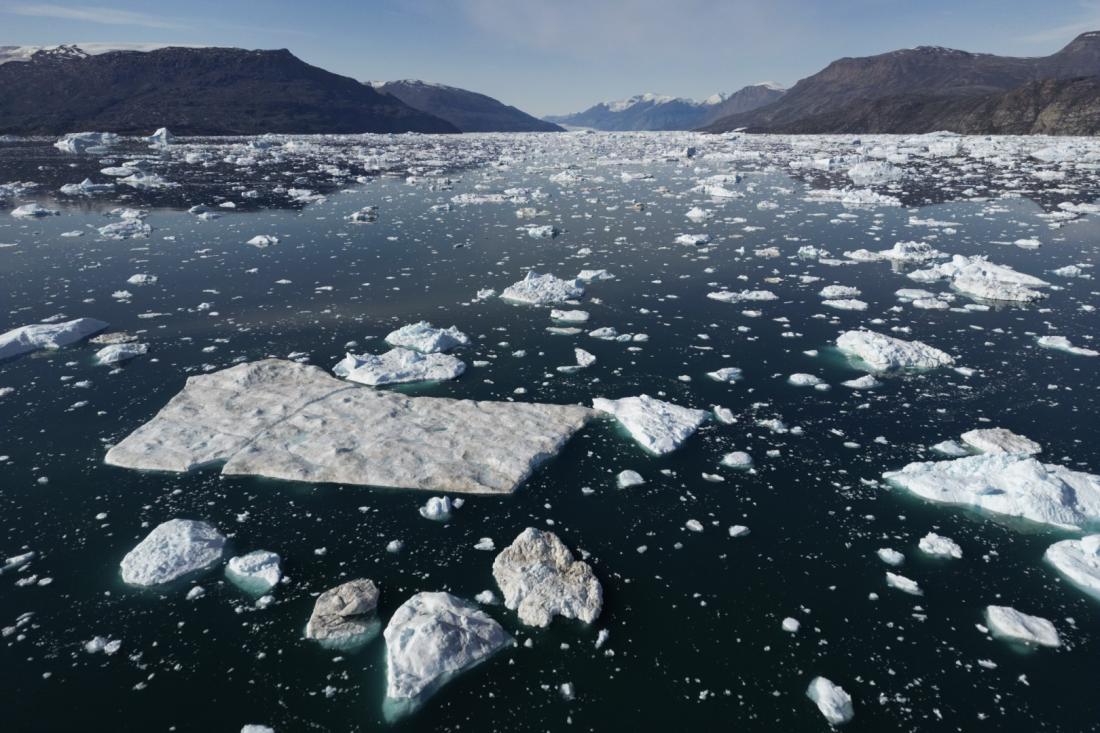
That is the case, for example, with the critical melting of ice sheets with many models yet to catch up with the high melt rates observed in parts of the world including Greenland (archived here).
Additionally, scientific papers that accurately used RCP8.5 still provide important insights into potential impacts, according to Vivek Srikrishnan, environmental engineering assistant professor at Cornell (archived here).
"There is nothing wrong with the previous simulations and studies using RCP8.5, we just think that particular level of emissions is less plausible by 2100," he said.
After 2100, similar concentration levels as projected in RCP8.5 could still be seen.
Scientists also noted the now-retired scenarios will continue to appear in the next IPCC reports, along with the new ones, as they are still cited in research.
Hausfather said: "The world doesn't end in 2100, even though many of our models do."
Paid IPCC scientists?
Experts also told AFP the claim that scientists are paid by the United Nations to promote extreme takes on climate change is false.
The IPCC states on its website that "hundreds of experts in different fields volunteer their time and expertise to produce the reports. Thousands more contribute to the review process and to the literature and other knowledge that are assessed in IPCC reports. These scientists are not paid by the IPCC" (archived here).
Hausfather concurred: "Outside of a small handful of people who are employed by the IPCC's technical support unit, none of us is getting paid for our work on the report."
The paper recommending changes to climate scenarios has also "been incorrectly attributed to the IPCC," the body stated in a May 20 release addressing the misinformation about the updated models (archived here).
"The IPCC does not conduct its own research, run models or make measurements," it said.
The seventh assessment cycle currently involves 664 scientists from 111 countries (archived here and here).
AFP has debunked a series of myths and misconceptions about climate science.
Copyright © AFP 2017-2026. Any commercial use of this content requires a subscription. Click here to find out more.
Is there content that you would like AFP to fact-check? Get in touch.
Contact us