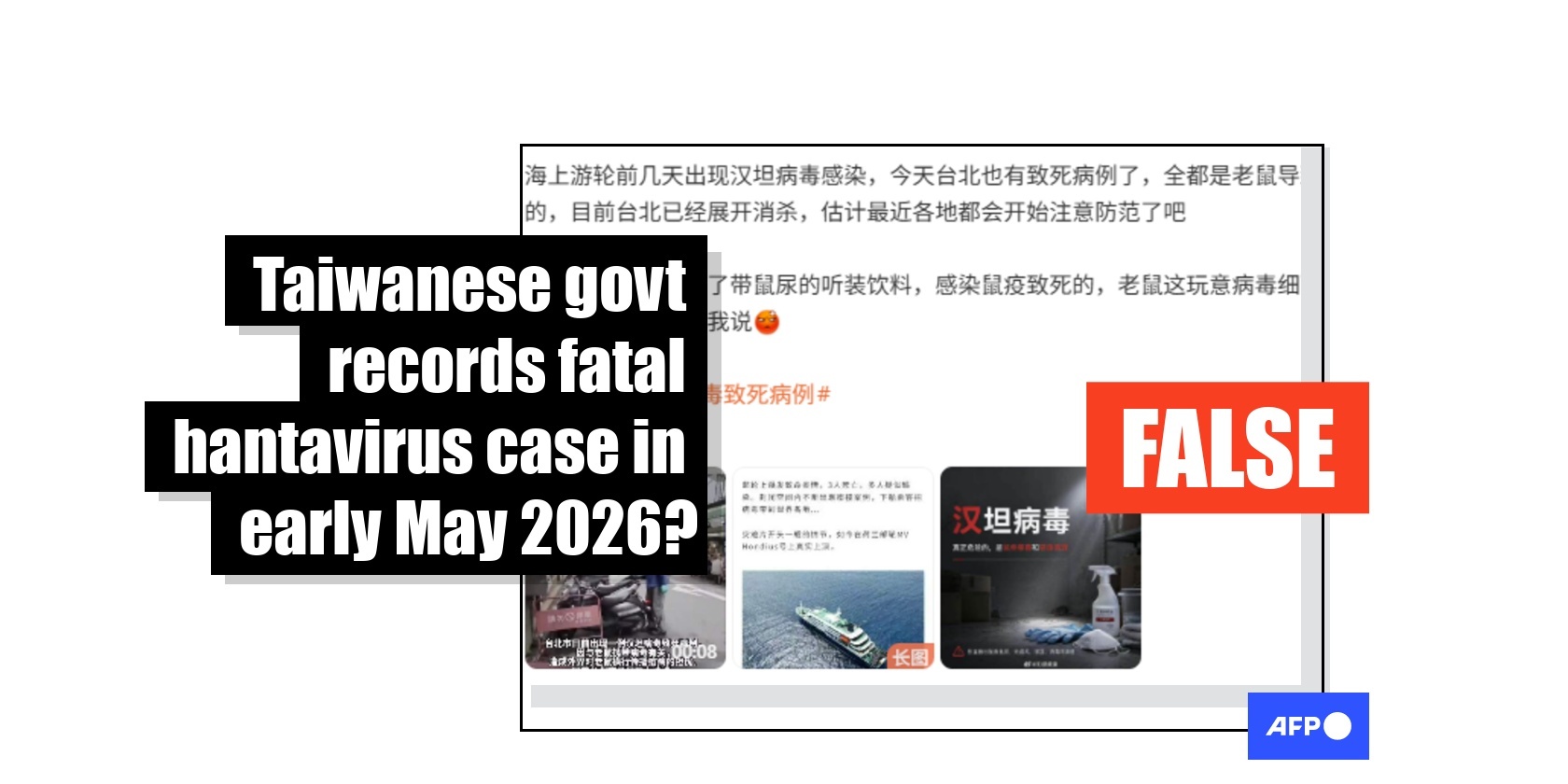
Old Taiwan hantavirus death falsely shared as recent
- Published on May 28, 2026 at 06:41
- 3 min read
- By Sammy HEUNG, AFP Hong Kong
Taiwan had not recorded a death from the rodent-borne hantavirus disease in early May 2026, contrary to false online posts that surfaced shortly after Taipei's mayor announced a pest control drive in the capital. The claim -- which spread as the world reeled from a rare outbreak of the viral illness aboard an Atlantic cruise ship -- was amplified by media reports in China. Taiwan records sporadic hantavirus infections annually, but the latest death was logged in January, with two other reported infections as of May 27.
"There was a hantavirus infection on an ocean cruise ship a few days ago, and now there is a fatal case in Taipei today as well," reads a simplified Chinese Weibo post shared May 8, 2026.
"All of it is caused by rats. Taipei has already started disinfection and extermination operations," adds the post, which has received over 200 likes.
It includes a video of a pest-control activity, with overlaid text stating the death occurred "a few days ago".

Similar claims were shared elsewhere on Weibo and Douyin, with a May 8 post from the Chinese state-owned media CCTV also saying the death happened "a few days ago".
AFP has reached out to CCTV for comment, but a response was not forthcoming.
The posts surfaced after Taipei mayor Chiang Wan-an announced that a cleaning and sanitation drive would be implemented across the capital's 12 administrative districts to combat rat sightings (archived link).
The announcement also came amid a global scare triggered by a deadly hantavirus outbreak aboard the MV Hondius travelling from Argentina to Cape Verde (archived link).
According to the World Health Organization (WHO), including the three people who were killed on the cruise ship, a total of 12 cases have been reported as of May 22 (archived link).
Hantavirus typically spreads from the urine, faeces and saliva of infected rodents. There are currently no vaccines or specific treatments for the disease.
Eight of the cases have been confirmed to be infected with the Andes virus, a strain with a high case fatality rate. It is also the only strain known to transmit between humans through prolonged close exposure, the WHO said (archived link).
All known cases in the current outbreak were people on board the Dutch-flagged vessel, with the global health agency saying the risk to the general population is "absolutely low" (archived here and here).
Claims that Taiwan had recorded a hantavirus death in early May are baseless.
Misrepresented hantavirus death
Reports published by the Taiwan Centers for Disease Control (CDC) indicate three hantavirus cases have so far been recorded on the island.
The only death recorded as of May 27 had been in January, a review of records found. According to a CDC press release published that month, a man in his seventies died of sepsis and multi-organ failure from the disease on January 13 (archived link).
The centre said his family reported rodent activity and traces of rats in their home. Four rats were captured around his residence and places of activity, and two of them tested positive for hantavirus.
Subsequent keyword searches on the CDC website led to another statement published on May 3 about the island's second hantavirus case (archived link).
It involved another elderly man in his seventies who tested positive for hantavirus in March and was discharged on March 30.
The latest case was announced on May 19. The patient, who is in his forties, is receiving treatment at an unnamed hospital (archived link).
The total number of cases is "comparable to the two to three cases reported during the same period over the preceding four years", the CDC said.
Seoul virus
All domestically acquired and imported hantavirus cases reported in Taiwan involved the Seoul virus, which is associated with lower severity and fatality rates than the Andes virus, according to the CDC (archived here and here).
The Seoul virus is a type of hantavirus that is transmitted from rats to humans, according to the WHO (archived link).
A CDC spokesperson said in a press conference on May 19 that there were no cases of human-to-human transmission to date (archived link).
The agency urged the public to keep rats out of their homes, prevent them from entering or staying, and ensure they had no access to food.
Hantavirus is a notifiable disease that requires consistent surveillance in Taiwan, with doctors and forensic pathologists required to report cases within 24 hours (archived link).
More of our reporting on hantavirus misinformation can be found here.
Copyright © AFP 2017-2026. Any commercial use of this content requires a subscription. Click here to find out more.
Is there content that you would like AFP to fact-check? Get in touch.
Contact us