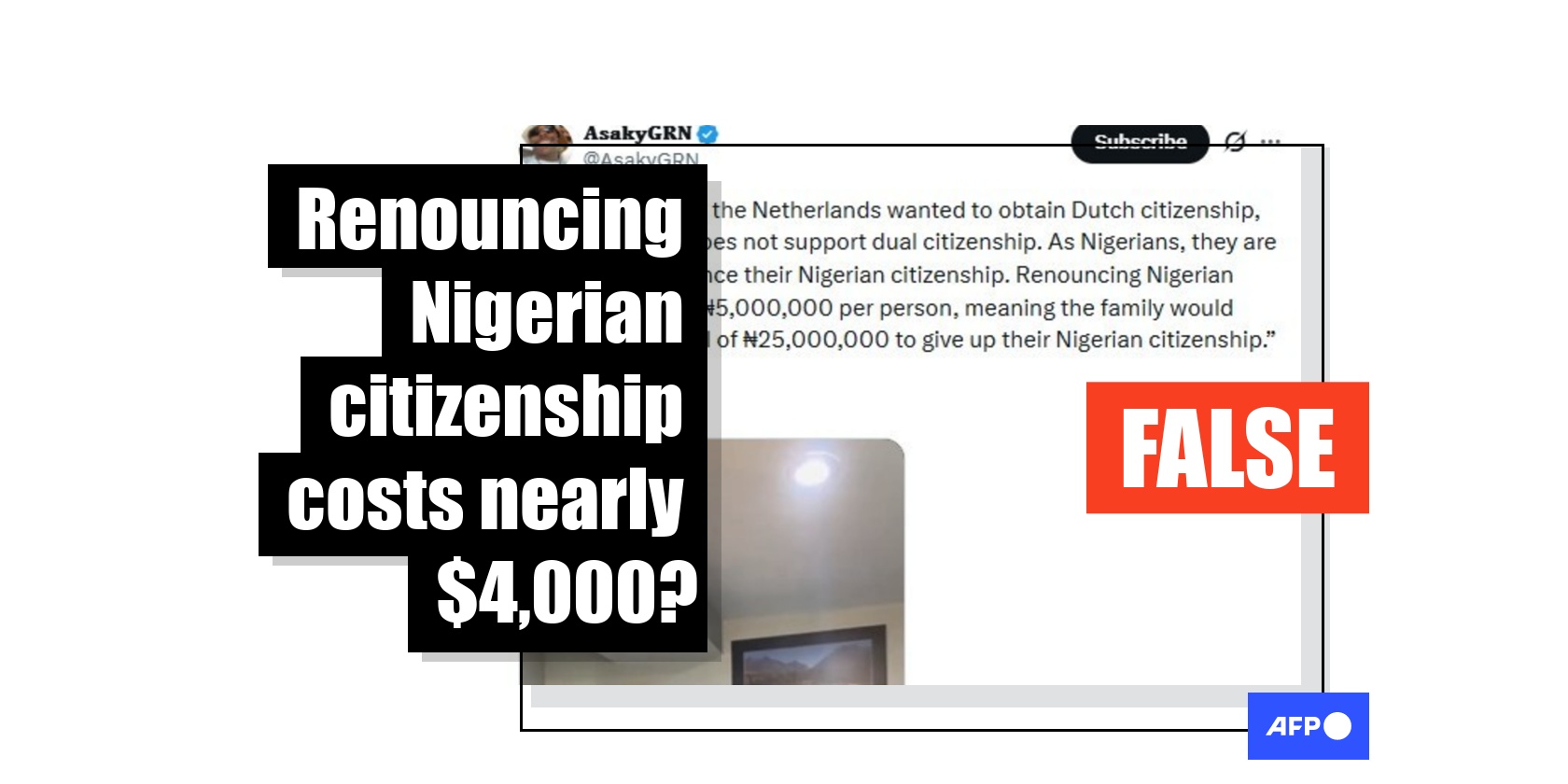
Social media post exaggerates cost of renouncing Nigerian citizenship
- Published on April 29, 2026 at 15:29
- 3 min read
- By Samad UTHMAN, AFP Nigeria
Surveys show that more than half of working Nigerians want to emigrate, driven by the search for economic opportunities, security and a better quality of life. In this context, a social media post claims that renouncing Nigerian citizenship costs 5,000,000 naira (about $3,718). However, the claim is false; the cost is less than $1,500, according to a government website and a Lagos-based immigration lawyer.
“A family of five in the Netherlands wanted to obtain Dutch citizenship, but the country does not support dual citizenship. As Nigerians, they are required to renounce their Nigerian citizenship,” reads the caption of an X post published on April 8, 2026.
“Renouncing Nigerian citizenship costs ₦5,000,000 ($3,718) per person, meaning the family would have to pay a total of ₦25,000,000 ($18,595 ) to give up their Nigerian citizenship,” the post adds, attributing the claim to an unspecified “man”.
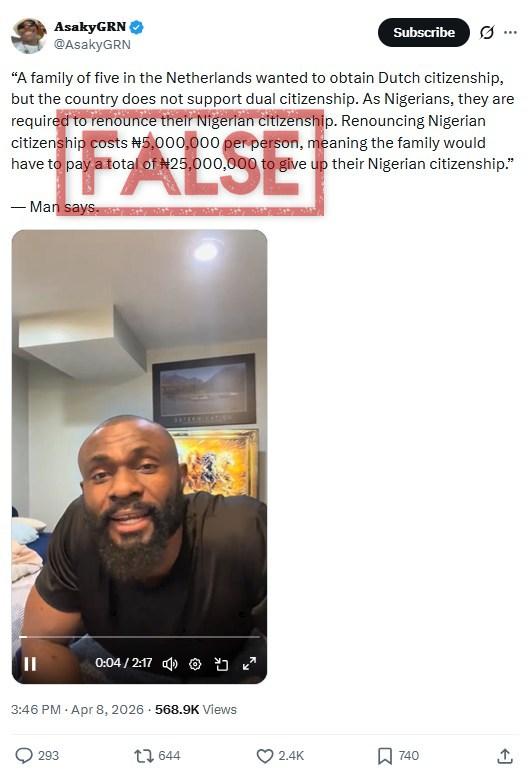
The post was shared alongside a video of a man narrating the story of a Netherlands-based Nigerian family of five who were allegedly billed five million naira per head to renounce their citizenship before they could get their Dutch passports.
Shared more than 600 times, the post was published by an account called “AsakyGRN”, which has 172,000 followers and frequently posts about Nigerian issues.
Known as “japa”, the wave of emigration from Nigeria has intensified in recent years, with estimates that millions have left the country since 2020 due to economic hardship, insecurity and the search for better opportunities (archived here).
Survey data show that more than half of working Nigerians and two-thirds of those unemployed have considered leaving, citing employment prospects and improved living conditions as key motivations (archived here).
This trend has raised concerns about the exodus of skilled professionals, especially in sectors such as healthcare (archived here).
However, the claim that renouncing Nigerian citizenship costs five million naira per person is false.
Less than $1,500
AFP Fact Check found that the official renunciation fee is 2,000,000 naira (about $1,487) per person, according to the Nigerian Ministry of Interior's website (archived here). This is less than half the amount claimed in the circulating clip.
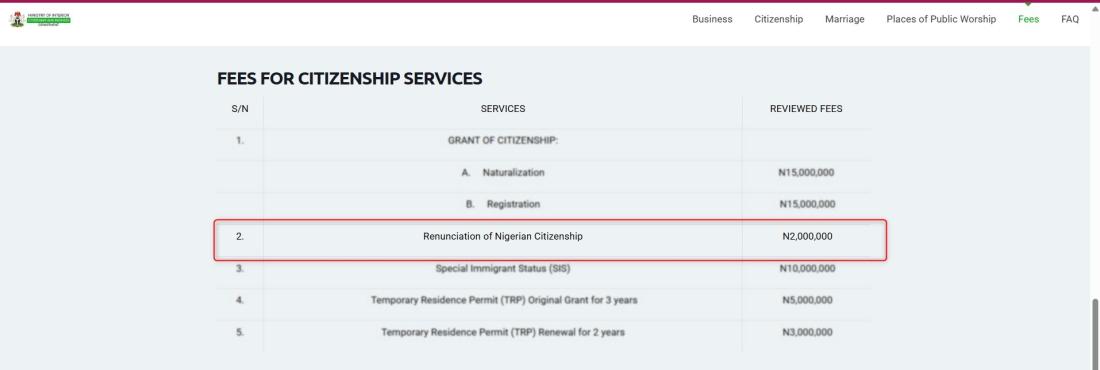
Lagos-based immigration lawyer Adeola Oyinlade confirmed this figure, adding that it does not cover extra costs such as courier services, attestation, notarisation or legal fees.
“To renounce Nigerian citizenship, one must be of full age (18 years or older) or a married woman, and provide a formal application letter, a completed Form G, original birth certificate and passport, proof of another citizenship or intent to obtain one, and passport photographs,” he told AFP Fact Check.
Form G is the application form used to declare and process the renunciation of Nigerian citizenship.
Renunciation is typically required when a country does not allow dual citizenship and requires applicants to revoke their original nationality as part of naturalisation. It can also arise when individuals choose to formally relinquish one citizenship to avoid legal, tax or allegiance conflicts.
Oyinlade added that the Nigerian president holds the final authority over renunciations and can withhold approval “if it is made during a war in which Nigeria is physically involved or if the renunciation is deemed contrary to public policy”.
“Once the president registers the renunciation, the individual ceases to be a Nigerian citizen. Reacquiring citizenship later is a significantly more complex legal process,” Oyinlade explained.
A media aide to the interior minister, Alao Babatunde, also corroborated the cost on the ministry's website, adding that “it is subject to periodic change, but the information on the website is accurate as of 2026”.
Dutch citizenship
The Netherlands generally discourages dual citizenship, but it does not ban it outright, as inferred in the claim. Under Dutch law, people applying for citizenship by naturalisation are usually required to renounce their original nationality (archived here).
Similarly, Dutch citizens who voluntarily acquire another nationality risk losing their Dutch citizenship, a policy aimed at limiting the instances of multiple nationalities (archived here).
However, there are exceptions. Dual citizenship is granted to individuals married to a Dutch citizen, those born with multiple nationalities, recognised refugees, or those who cannot renounce their original citizenship (archived here).
Copyright © AFP 2017-2026. Any commercial use of this content requires a subscription. Click here to find out more.
Is there content that you would like AFP to fact-check? Get in touch.
Contact us