Closure of Jerusalem church resurrects baseless 'attack on Christians' claims
- Published on March 25, 2026 at 08:03
- 3 min read
- By Dene-Hern CHEN, AFP Australia
Israeli authorities shut holy sites in Jerusalem’s Old City as war in the Middle East erupted, but this is not the first time the Church of the Holy Sepulchre has closed indefinitely as posts calling it an "attack on Christianity" claim. Covid pandemic restrictions forced the church to close for two months in 2020, contrary to the posts' claims access at the time was merely limited.
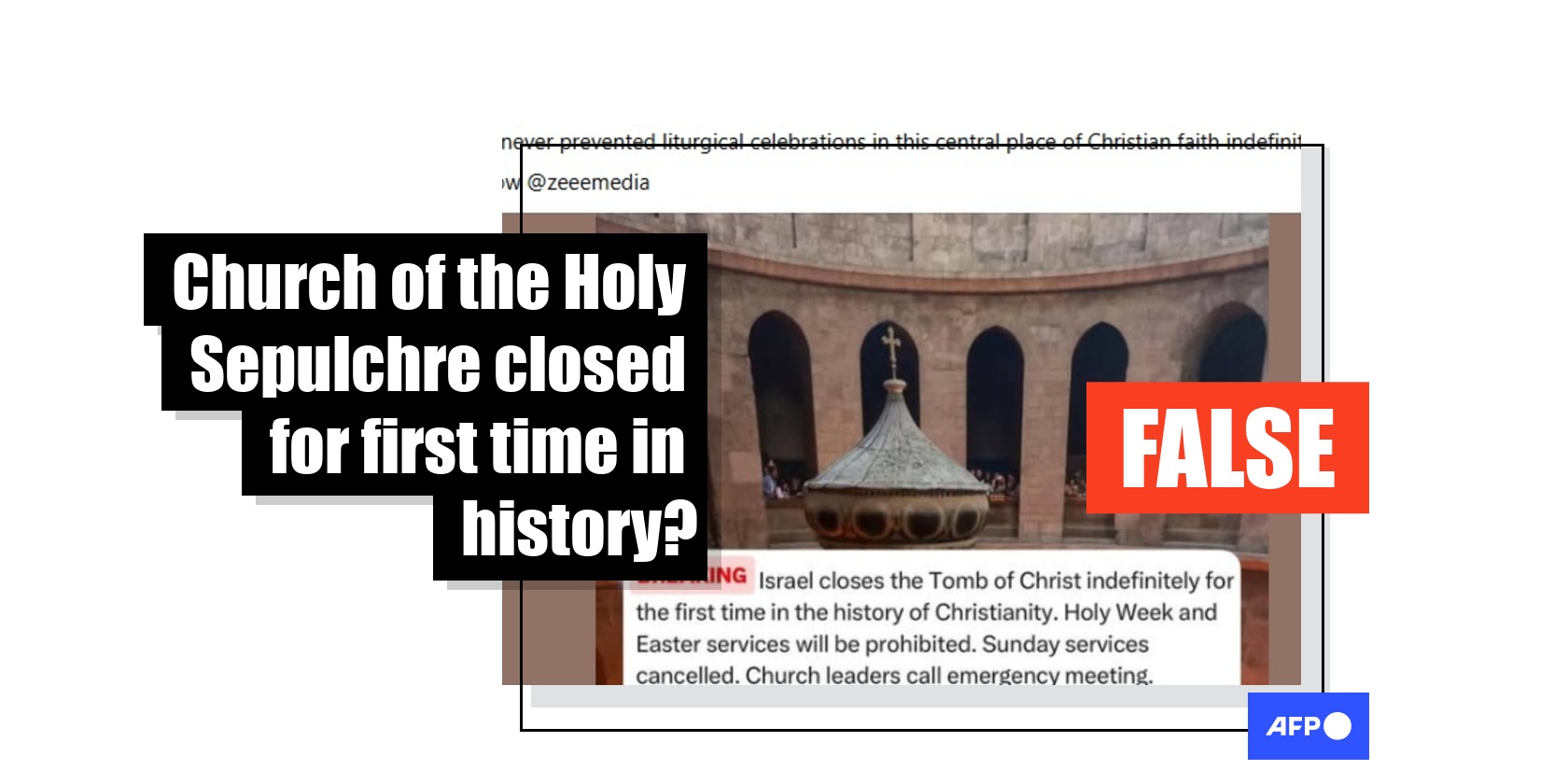
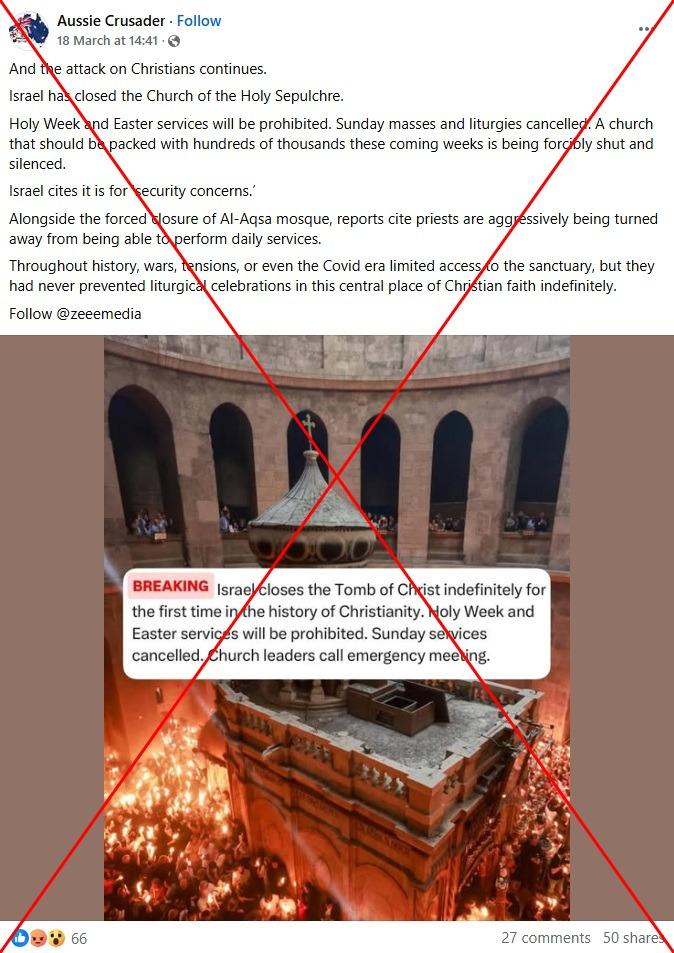
"Israel closes the Tomb of Christ indefinitely for the first time in the history of Christianity," says overlaid text on a Facebook image shared on March 18, 2026.
The image shows flames around the shrine surrounding what Christians believed to be Jesus's tomb in Jerusalem's Church of the Holy Sepulchre.
"And the attack on Christians continues," reads its caption.
It says Israel closed the church citing security reasons, and that Holy Week and Easter services as well as Sunday masses and liturgies will be prohibited and cancelled.
"Throughout history, wars, tensions, or even the Covid era limited access to the sanctuary, but they had never prevented liturgical celebrations in this central place of Christian faith indefinitely," it adds.
Similar claims were also shared elsewhere on Facebook, Instagram and TikTok.
Since Israel and the United States started the war with Iran on February 28, Israeli authorities have closed access to Jerusalem's world-renowned holy sites -- including the Al-Aqsa Mosque, the Church of the Holy Sepulchre and the Western Wall -- over security concerns (archived link).
Authorities said on March 16 they found "fragments of missiles and interceptor debris, some of significant size, at multiple sites in the Old City, including the Temple Mount complex, the Church of the Holy Sepulchre complex, and the Jewish Quarter" (archived link).
Four days later, a blast left a crater in a hillside just inside the Old City, spraying debris across a road, after a warning of incoming missiles fired from Iran (archived link).
AFP journalists at the scene saw the damage just a few hundred metres from the city's revered holy sites. AFP could not independently verify whether it was caused by a direct hit by a missile or fragments that fell after an interception.
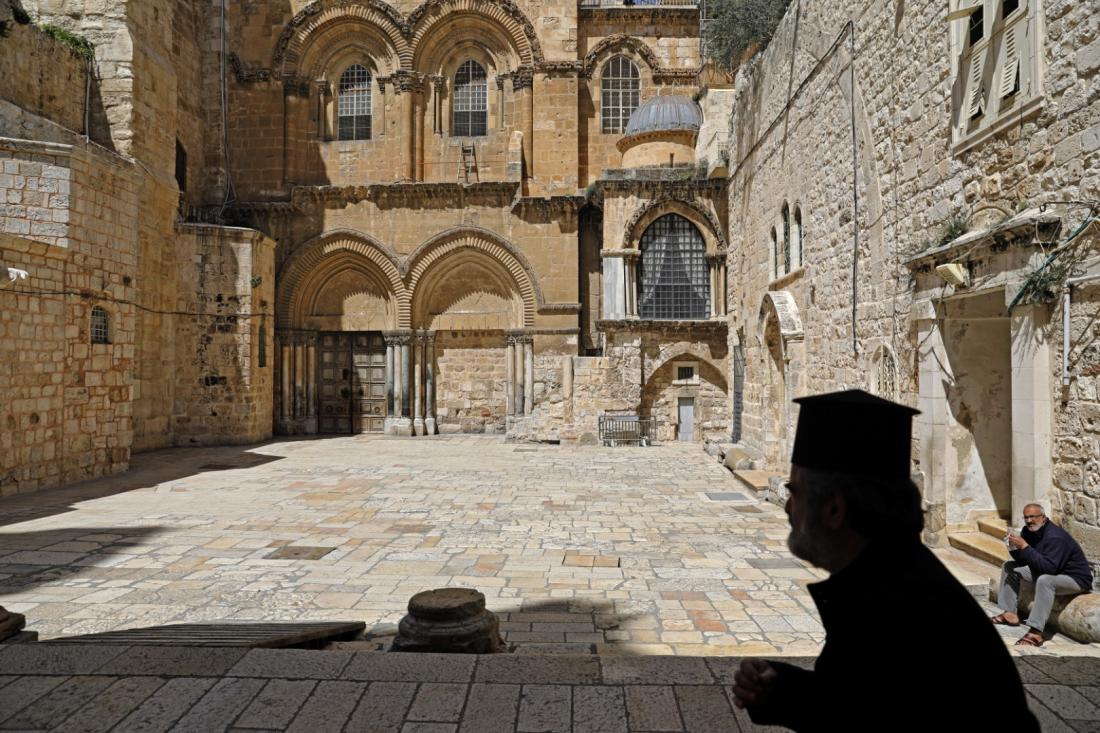
Restricting access to the holy site is rare, but it is not unprecedented as the posts suggest.
It was closed to the public in late March 2020 as Israel applied a series of restrictions meant to curb the spread of Covid-19, including shutting down places of worship (archived link).
The measures announced by Prime Minister Benjamin Netanyahu's office prohibited residents from leaving their homes except to buy essentials such as food and medicine, and to seek medical treatment or in some cases, for work.
The church partially reopened two months later, with a limited number of worshippers allowed to enter in coordination with the Christian denominations that control the site (archived link).
'Life, liturgies and rites continue'
As of March 25, 2026 at 0400 GMT, there is no indication of when the Church of the Holy Sepulchre will be reopened but the site's custodians said in a March 21 statement they are in constant dialogue with authorities (archived link).
They also said the friars present there had "never ceased, day or night, to carry out the scheduled celebrations, the rites, the daily processions, and the liturgical prayers".
"Even during these days, although access to the Basilica is restricted to the faithful for security reasons, prayer continues unceasingly in the Holy Places."
Francesca Romana Stasolla, a professor of Christian and medieval archaeology at the University of Rome Sapienza who led excavations at the Church of the Holy Sepulchre and lived there for three years, said that while the church may be closed to the public, religious activities would not stop (archived here and here).
"Life, liturgies and rites continue without interruption because the monks and friars who live in the convents and monasteries connected to the church carry on with their daily activities," she told AFP in a March 20 email.
"Easter will therefore be celebrated as usual, certainly with a reduced number of people, but the liturgies will continue regularly, as they always have," she said.
AFP has debunked several false claims stemming from the Middle East war, as well as similar claims about supposed attacks on Christian traditions.
Copyright © AFP 2017-2026. Any commercial use of this content requires a subscription. Click here to find out more.
Is there content that you would like AFP to fact-check? Get in touch.
Contact us