Altered photos showing damaged building falsely linked to US airstrikes in Nigeria
- Published on February 28, 2026 at 11:48
- Updated on March 13, 2026 at 17:14
- 6 min read
- By Samad UTHMAN, AFP Nigeria
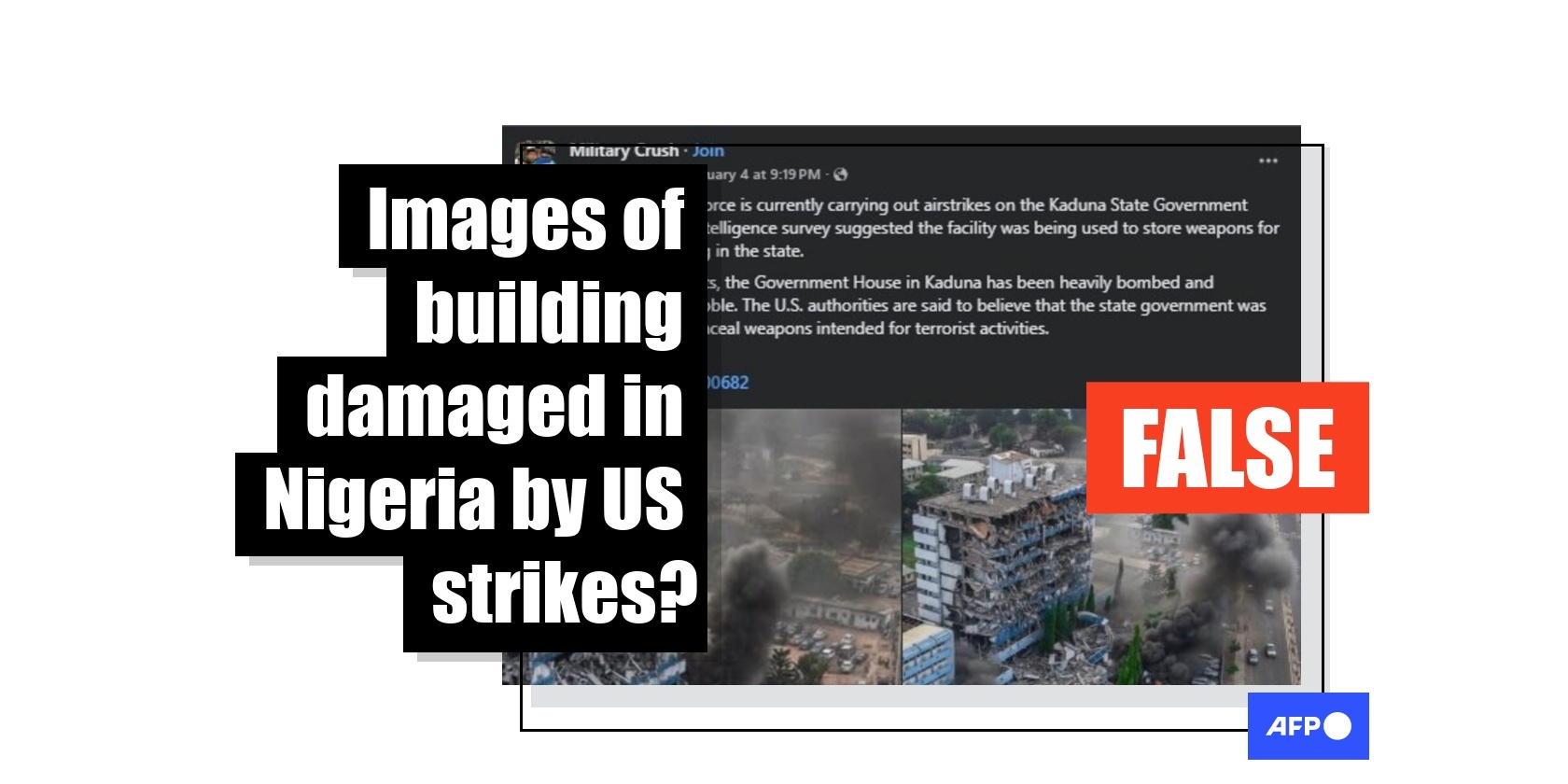
Contested claims by US President Donald Trump that Nigeria was ignoring the genocidal killings of Christians have led to a security cooperation agreement between the two countries. Posts on Facebook began sharing photos in February claiming to show a Nigerian state house destroyed by US airstrikes for allegedly concealing “weapons intended for terrorist activities”. This is false; the pictures were digitally altered and show a hotel, not the state residence in Kaduna. The original image was taken in 2021.
“Breaking News: U.S. Air Force is currently carrying out airstrikes on the Kaduna State Government House after an alleged intelligence survey suggested the facility was being used to store weapons for terrorist groups operating in the state,” reads part of a Facebook post shared on February 5, 2026.
“According to these reports, the Government House in Kaduna has been heavily bombed and reportedly reduced to rubble,” it adds. “The U.S. authorities are said to believe that the state government was using the premises to conceal weapons intended for terrorist activities.”
The post concludes by providing a link where further details are purportedly available.
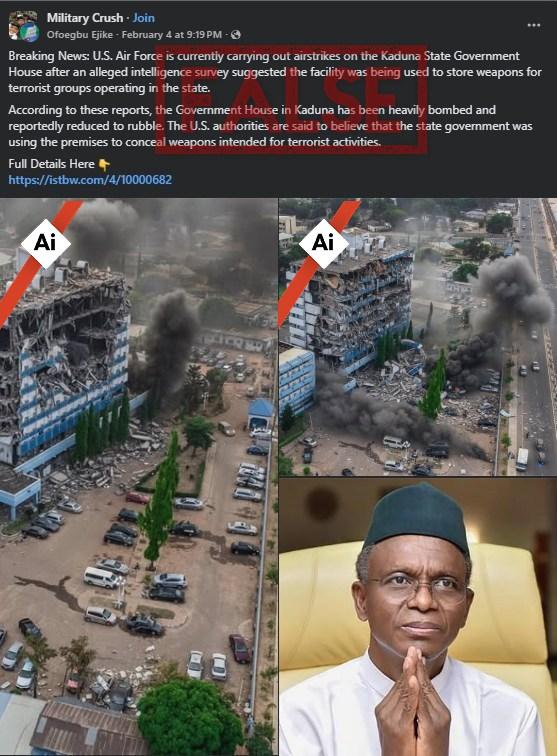
The post features two similar images of a damaged building and a picture of Nasir El-Rufai, the former governor of Kaduna state.
Similar claims were published on Facebook here, here, here and here.
US-Nigeria relations
Abuja has been under diplomatic pressure from Washington over Trump’s allegations regarding violence against Christians, which he said amounts to "genocide" and "persecution". The Nigerian government denied the accusations but expressed willingness to work with the US on security issues (archived here).
In December 2025, the US conducted targeted strikes on Islamic State-linked camps in the northwest of the country alongside Nigerian security forces (archived here).
Debris from the munitions reportedly fell on a hotel in Offa, about 800 kilometres (500 miles) from the strike targets. Three staff were injured (archived here).
In a virtual news conference in early February 2026, the head of the US Africa Command (Africom), Dagvin Anderson, said the US had deployed a small military team to Nigeria, adding that the two countries had decided to "increase collaboration" (archived here).
The Wall Street Journal later reported that the US was preparing to deploy 200 troops to train and support Nigeria in the country’s fight against Islamic militants (archived here).
However, the claim that US airstrikes destroyed the state house in Kaduna is false.
Doctored photos
Keyword searches for “Kaduna State Government House” established that it is structurally different from the building shared in the claim. It is also different in colour.
A photo of the official residence was published on X by a former presidential aide in 2017. The same photograph is featured on the state government’s official website and in multiple articles by local media (archived here, here and here).
Sir Kashim Ibrahim House, the ‘Kaduna State Government House’.
— Bashir Ahmad, OON (@BashirAhmaad) November 2, 2017
My friend, @MusadiqZpic.twitter.com/MO8gwRBQ6W
Notably, the claim includes a photo of the state's immediate former governor and references an alleged recent attack, further raising questions about its authenticity.
AFP Fact Check conducted reverse image searches and found the original picture of the building -- shown without even minor damage -- published on Instagram on December 15, 2021 (archived here).
The Instagram account belongs to “Kasim Abubakar Sadiq”, identified in the account’s bio as a videographer.
“I get creative when I’m bored,” the post reads, including hashtags indicating the photo was taken using a drone.
The original image bears the photographer’s signature stamp at the bottom right corner -- a detail that is also clearly visible in the images included in the claim. However, the original bears no sign of destruction, rubble or thick smoke.
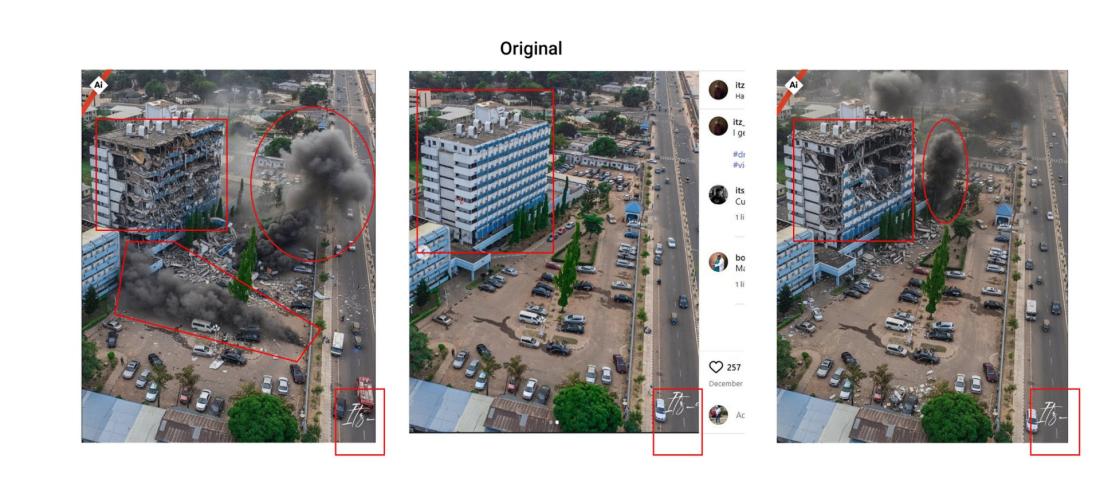
Further reverse image searches of the original image led to the New Nigeria Development Company (NNDC) website, which identifies the building as the Hamdallah Hotel in Kaduna (archived here).
This is corroborated by Google Maps Street View imagery of the hotel, which matches the structure shown in the claim.
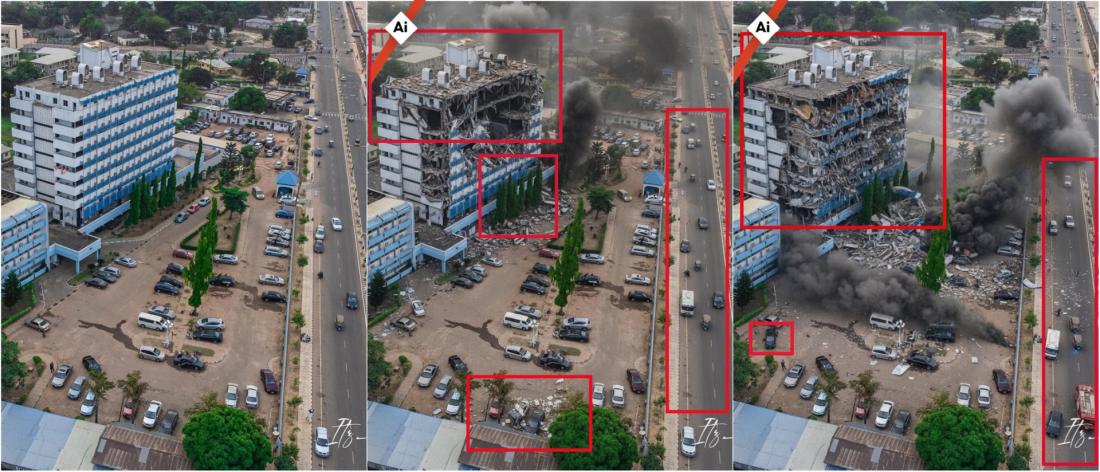
A closer look at the images shared in the claim reveals several anomalies consistent with AI-generated imagery.
In the first image, the placement of the rubble is inconsistent. The roof is filled with debris, despite the roof structure itself remaining intact. One corner of the parking lot is also strewn with debris and shows a damaged car, while the central area remains clean -- an unlikely outcome following a large explosion.
The second image appears to have a warping effect, making the building look as if it’s melting along the exposed floors and facade edges. The rubble piles at the bottom also do not match the building’s original structure.
In both images, piles of rubble are visible directly in front of the building, but the trees remain intact -- another unlikely outcome in the event of a blast that would cause such extensive damage. Several vehicles not present in the original image also appear to have been added, while others were repositioned or removed.
Furthermore, the smoke plumes in both images appear random, lack a clear source, and do not interact realistically with the atmosphere, resulting in minimal overall lighting changes relative to the original photo.
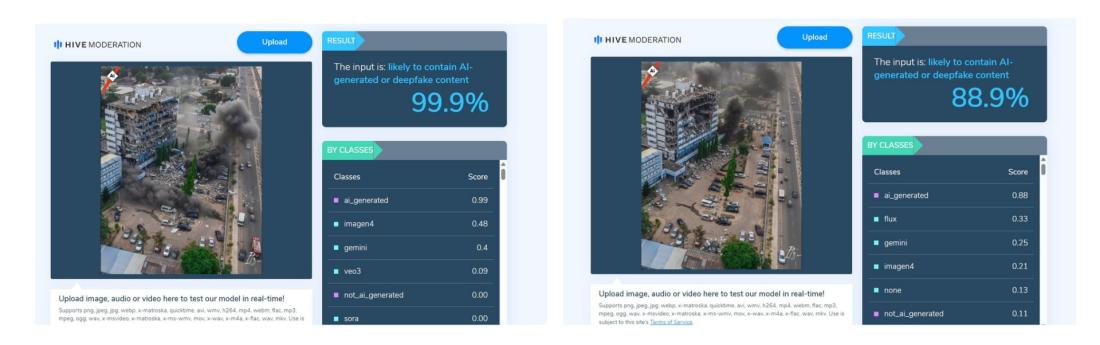
Analyses of the images using Hive Moderation, an AI detection tool, found a probability of 88.9-99.9 percent that they were artificially generated.
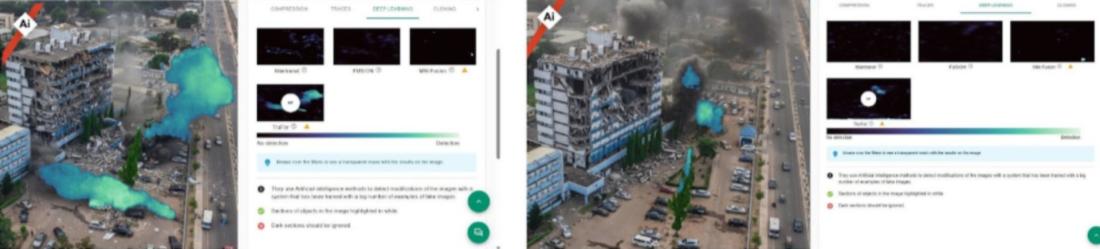
Further forensic analysis of the images using VeraAI also revealed visual elements consistent with manipulation, particularly in the smoke patterns.
AFP Fact Check also examined the website link included in the post’s caption. Multiple attempts to access it redirected to various betting sites -- meaning the link was clickbait.
We found no credible reports about the US conducting additional airstrikes in Nigeria beyond the December operation.
Updated to add last graphicMarch 13, 2026 Updated to add last graphic
Copyright © AFP 2017-2026. Any commercial use of this content requires a subscription. Click here to find out more.
Is there content that you would like AFP to fact-check? Get in touch.
Contact us