South African government did not issue a June 30 ultimatum to undocumented foreigners
- Published on June 3, 2026 at 10:48
- 5 min read
- By Tendai DUBE, AFP South Africa
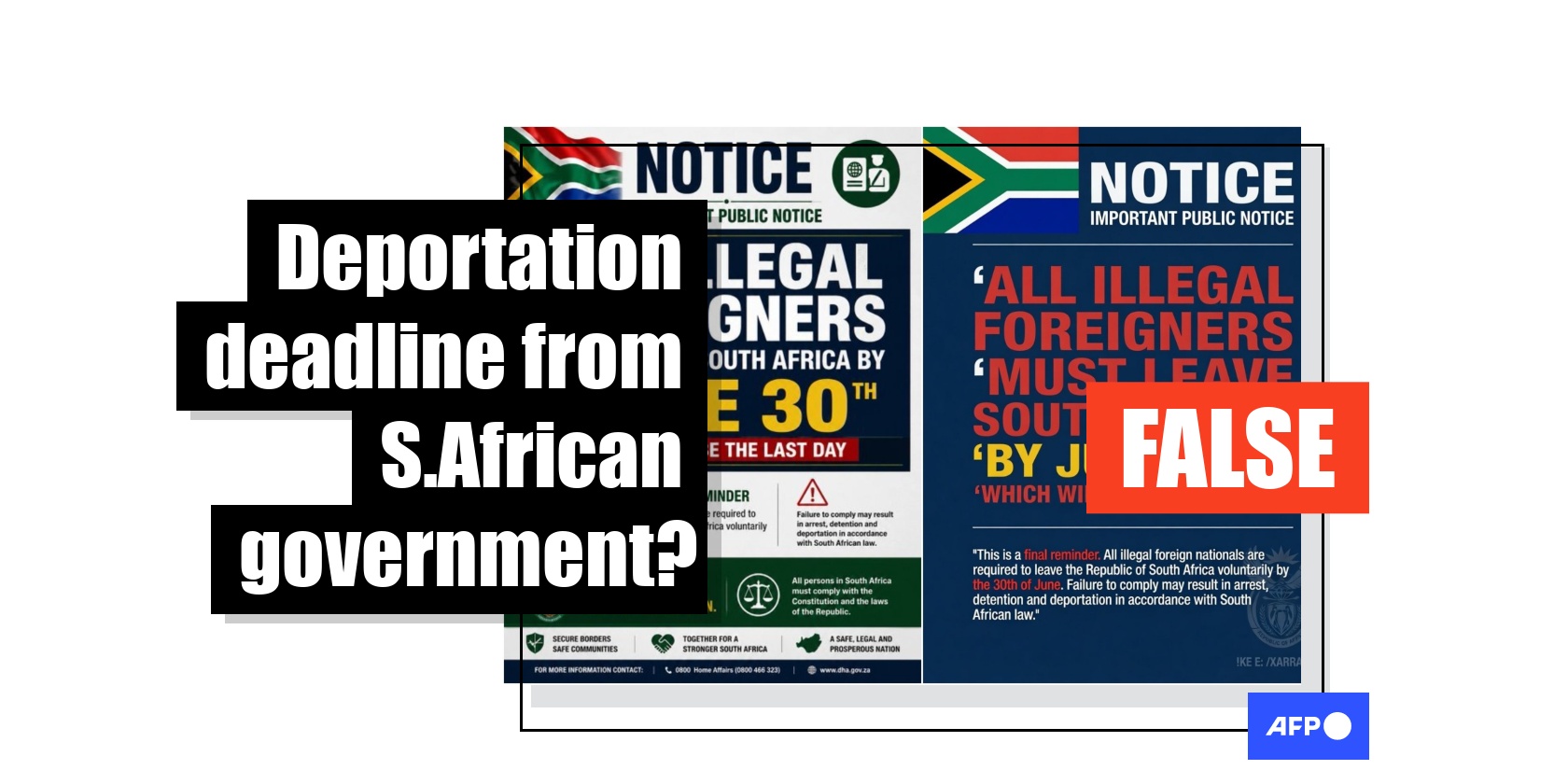
Anti-migrant protests in South Africa have led to some groups calling for undocumented foreigners to leave the country by June 30, 2026. A graphic bearing South Africa’s official coat of arms and the contact details for the Department of Home Affairs began to circulate in May, creating the impression that the deadline is officially sanctioned. However, the notice was generated with an AI program. The government says the deadline is “fake” and designed to cause panic.
“30 June 2026 is the deadline,” reads an X post published on May 9, 2026, and reposted more than 1,000 times.
The post includes a graphic reading: “ALL ILLEGAL FOREIGNERS MUST LEAVE SOUTH AFRICA BY JUNE 30TH WHICH WILL BE THE LAST DAY.”
It adds that failure to comply “may result in arrest, detention and deportation in accordance with South African law”.
Alongside the text is the country’s coat of arms and contact information for Home Affairs, the department responsible for citizenship and immigration.

The image circulated elsewhere on Facebook and X. Another version of it was published on X on May 18.

The user who published the first poster is affiliated with Operation Dudula, one of the groups at the forefront of anti-foreigner sentiment and often criticised for vigilantism (archived here).
Together with another group called “March and March”, supporters gathered in Durban in May, pushing for undocumented foreign nationals to leave the country by June 30, the latest in a broader wave of protests seen in recent months (archived here).
Their members argue that undocumented foreign nationals are straining South Africa’s resources, including public health services, employment opportunities and education, and contributing to rising crime (archived here and here).
Amid the protests, hundreds of foreign nationals gathered behind the gates of a church building in Durban's city centre on May 20, with some saying they feared for their safety.

A day later, Durban’s eThekwini Mayor Cyril Xaba said they would be taken to a refugee centre to have their immigration status verified (archived here).
“Those who fail the qualification to be in the country, who do not have the necessary documents, the police will then arrest them because that's a procedure,” Xaba said. “And then, obviously, what will then follow is the deportation”.
However, claims that the government has set a deadline for undocumented foreigners to leave the country are false.
Fake posters
AFP Fact Check did not find either of the posters on the official Home Affairs website.
The phone number on the first poster also doesn’t match the one provided on the department’s website, and attempts to call it led to an automated out-of-service message (archived here).

Additionally, official posters issued in recent months by the department differ in style, colour and font, with the Coat of Arms on the bottom left and a logo reading “Delivering dignity for all” on the right (archived here).

Analysis of both posters using AI detection tools Vera.AI and Hive Moderation also found that they were likely to be AI-generated.

Furthermore, the South African Police Service labelled the poster “fake” on its official social media platforms on May 14, 2026 (archived here).
“This notice is fake and forms part of disinformation aimed at misleading and causing unnecessary panic within communities,” reads the police statement.
“Government has not issued any directive ordering ‘all illegal foreigners’ to leave South Africa by 30 June, and the use of the South African Coat of Arms on the poster is misleading and unauthorised,” it adds, urging the public to “only rely on official government communication platforms”.
The emblem is protected under several acts, including the Trade Marks Act (1993), the Merchandise Marks Act (1941), the Heraldry Act (1962) and the Copyright Act (1978), as a government trademark. Only national government departments can use it, while all other entities must obtain permission from the Government Communication and Information System (GCIS) (archived here).
The South African government reiterated this on May 20, 2026, on X (archived here).
No use, reproduction or display of the Republic of South Africa’s Coat of Arms is permitted on any platform or product without permission from the South African Government.
— South African Government (@GovernmentZA) May 20, 2026
Legal implications for unauthorised use of the Coat of Arms:https://t.co/SptzMP64xj#GovZAUpdatespic.twitter.com/ZiavxzA3Ub
The Coat of Arms had also drawn scrutiny earlier in May 2026, after the Department of Sport, Arts and Culture questioned its appearance on branding used by the Somali Association of South Africa (archived here).
The association subsequently apologised (archived here).

During a South Africa-Botswana Bi-National Commission meeting on May 21, South African President Cyril Ramaphosa condemned acts of vigilantism and called for constructive dialogue to address migration issues on the continent (archived here).
Days later, South African government ministers held talks to address tensions over illegal migration as protesters again demanded that undocumented foreign nationals be made to leave the country (archived here).
AFP Fact Check has debunked other claims related to the recent anti-foreigner unrest in South Africa, in English and French.
Copyright © AFP 2017-2026. Any commercial use of this content requires a subscription. Click here to find out more.
Is there content that you would like AFP to fact-check? Get in touch.
Contact us