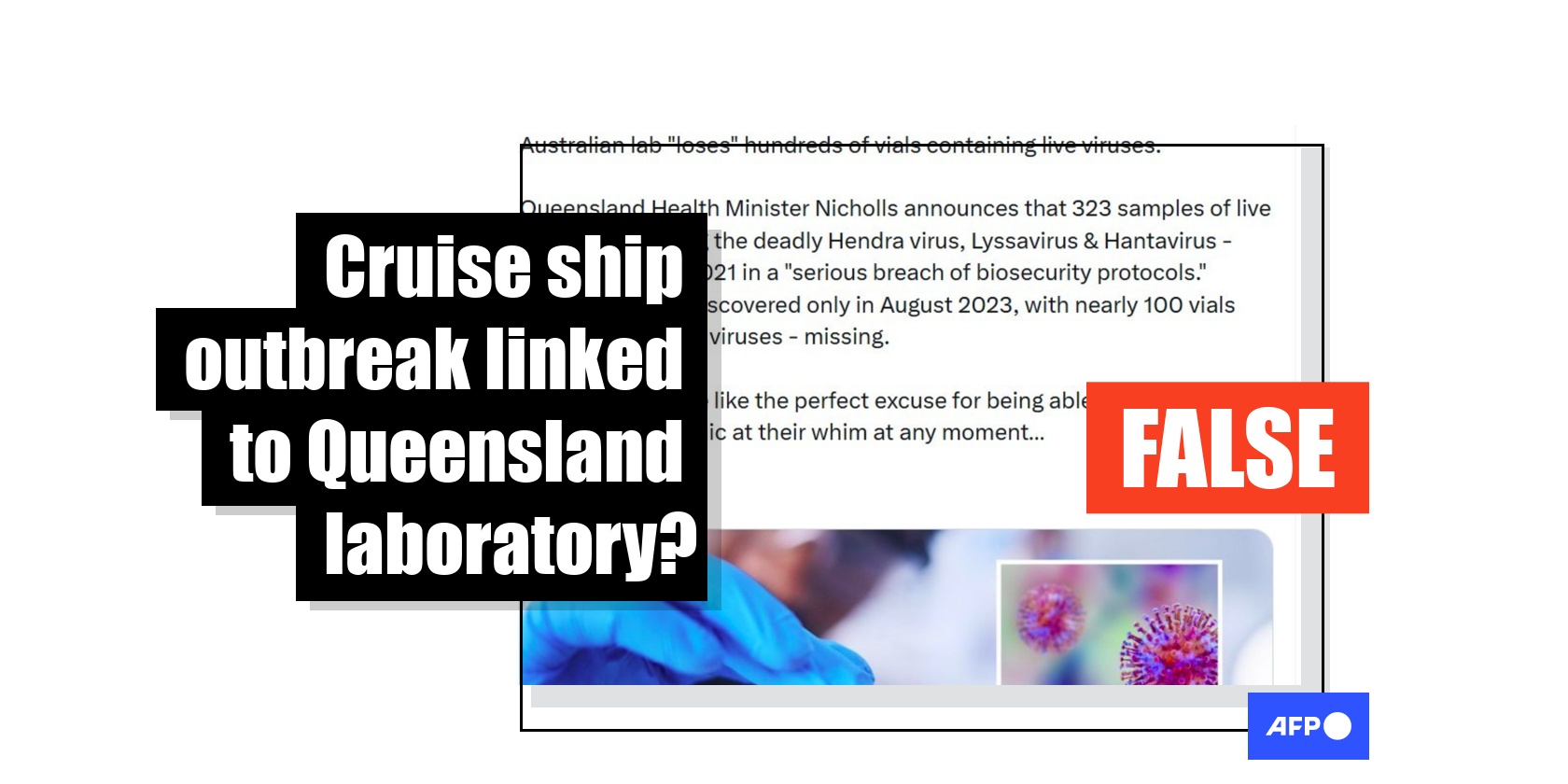
Baseless hantavirus 'scamdemic' claims cite unrelated Australia lab incident
- Published on May 21, 2026 at 11:00
- 4 min read
- By Dene-Hern CHEN, AFP Australia
The global scare prompted by a deadly hantavirus outbreak aboard an Atlantic cruise ship has revived Covid-era falsehoods, including posts baselessly linking the rare outbreak to 2024 reports of an Australian laboratory losing vials of viruses. The virus samples were unlikely to be lost but were "unaccounted for because of poor record-keeping", a subsequent investigation found. Laboratory-confirmed infections on the Dutch-flagged vessel point to the Andes virus, a strain endemic in parts of South America and already circulating for decades.
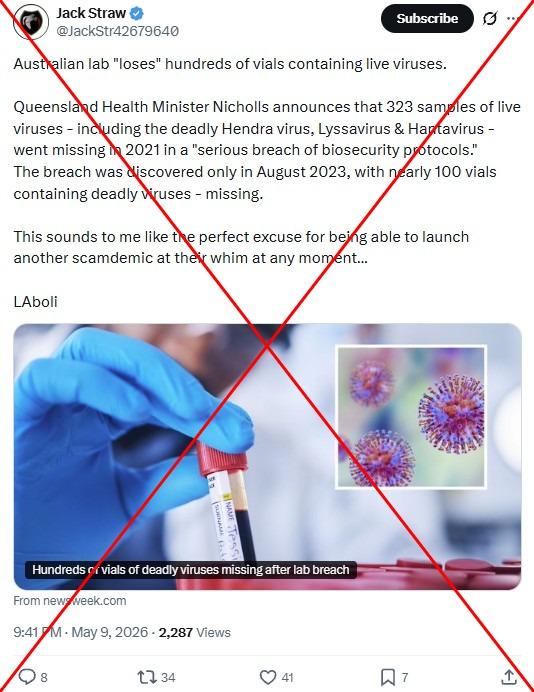
"This sounds to me like the perfect excuse for being able to launch another scamdemic at their whim at any moment," reads an X post shared by an Australia-based user on May 9, 2026.
It links to a December 2024 Newsweek report that hundreds of vials containing live viruses -- including hantavirus -- have gone missing from a laboratory in Queensland (archived link).
The state's health minister Tim Nicholls was quoted as saying the "serious breach of biosecurity protocols" happened three years prior.
Similar claims rocketed in Canada -- and in languages such as Dutch -- with some suggesting the Australian laboratory incident proves the recent hantavirus outbreak was an "engineered release".
References to "scamdemic" and "engineered release" echo frequently debunked Covid-19 conspiracy theories -- and play upon questions around how the pandemic began.
A pair of studies published in the peer-reviewed Science journal points to the natural origin of the coronavirus, previously unknown until its detection in late 2019 (archived link).
However, the World Health Organization (WHO) has said the lab leak hypothesis cannot be ruled out, following an inconclusive four-year investigation that was hamstrung by crucial information being withheld (archived link).
Covid-style misinformation resurged when three passengers of the MV Hondius, travelling from Argentina to Cape Verde, died from hantavirus -- for which no vaccines nor specific treatments currently exist (archived link).
No official reports have linked the outbreak to the Australian laboratory incident, contrary to the online posts.
'Poor record-keeping'
Moreover, an investigation into the laboratory incident commissioned by Queensland Health said the breach was related to materials discarded from a failed laboratory freezer (archived link).
The absence of proper documentation led to the perception that the samples had gone missing, but they were in fact "unaccounted for because of poor record-keeping".
"There was no risk or harm caused to staff or the broader community because of the breach," stated the report, which was released in September 2025.
It recommended measures to improve laboratory processes, including workforce training.
At the time the incident was reported, Queensland's chief health officer John Gerrard had said the virus samples "would degrade very rapidly outside a low temperature freezer and become non-infectious" (archived link).
"It's most likely that the samples were destroyed by autoclaving as is routine laboratory practice and not adequately recorded," he said, referring to a process of killing microorganisms like bacteria and viruses.
The same details were found in the full Newsweek report shared in the false posts.
A spokesperson with Queensland Health told AFP in a May 18, 2026 email: "There is no evidence of any link between the MV Hondius Hantavirus outbreak and the unaccounted virus samples from Queensland's virology laboratory".
"Importantly, none of the unaccounted virus samples contained Andes virus, which is the type of hantavirus linked to the outbreak on MV Hondius," the spokesperson added.
Andes virus
According to the WHO, a total of 10 hantavirus cases have been reported in the cruise ship outbreak, including three deaths as of May 15 (archived link).
People usually get infected through contact with infected rodents or their urine, droppings or saliva.
Eight infections aboard the ship were laboratory-confirmed for the Andes virus, and two were probable.
The strain is the only one known to transmit between humans, but human-to-human transmission is limited "among close and prolonged contacts", the WHO said (archived link).
Andes virus is endemic in South America, with human cases reported primarily in Argentina and Chile (archived link).
All known cases in the current outbreak were people on board the ship, with the global health agency saying the risk to the general population is "absolutely low" (archived link).
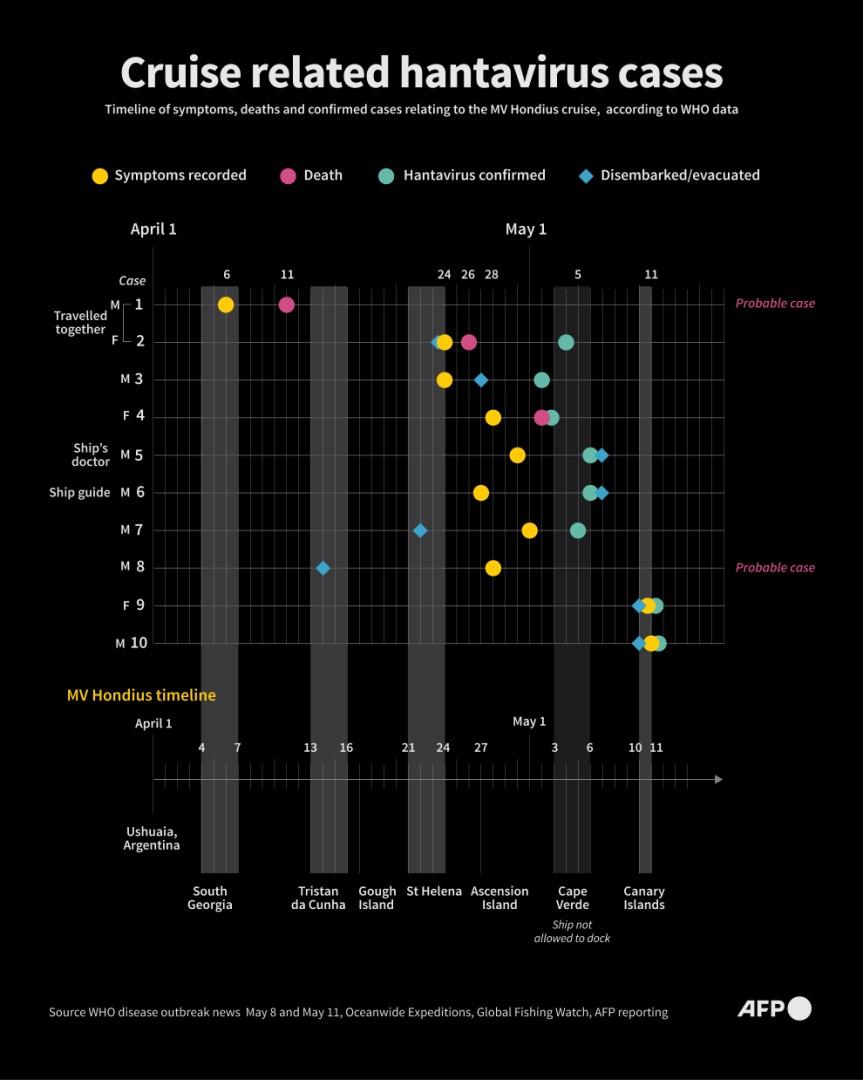
The first person to die had spent 48 hours in the Argentinian city of Ushuaia with his wife -- who died two weeks later -- before embarking on the cruise, raising suspicions that they had contracted the virus in the country (archived link).
Provincial officials deny this hypothesis, with local scientists believing it is more likely that the infections aboard the cruise ship occurred in another region.
Andes virus infection in humans was first described in Argentina in 1995 and in Chile later the same year -- predating the Australian laboratory breach by decades (archived here and here).
So-called "old world" hantaviruses were discovered much earlier, when an outbreak sickened more than 3,000 United Nations troops fighting in the 1950-53 Korean War (archived link).
Although infections are "relatively uncommon globally", an estimated 10,000 to over 100,000 occur every year, with some cases presenting high fatality rates, according to the WHO.
More of our reporting on hantavirus misinformation can be found here.
Copyright © AFP 2017-2026. Any commercial use of this content requires a subscription. Click here to find out more.
Is there content that you would like AFP to fact-check? Get in touch.
Contact us