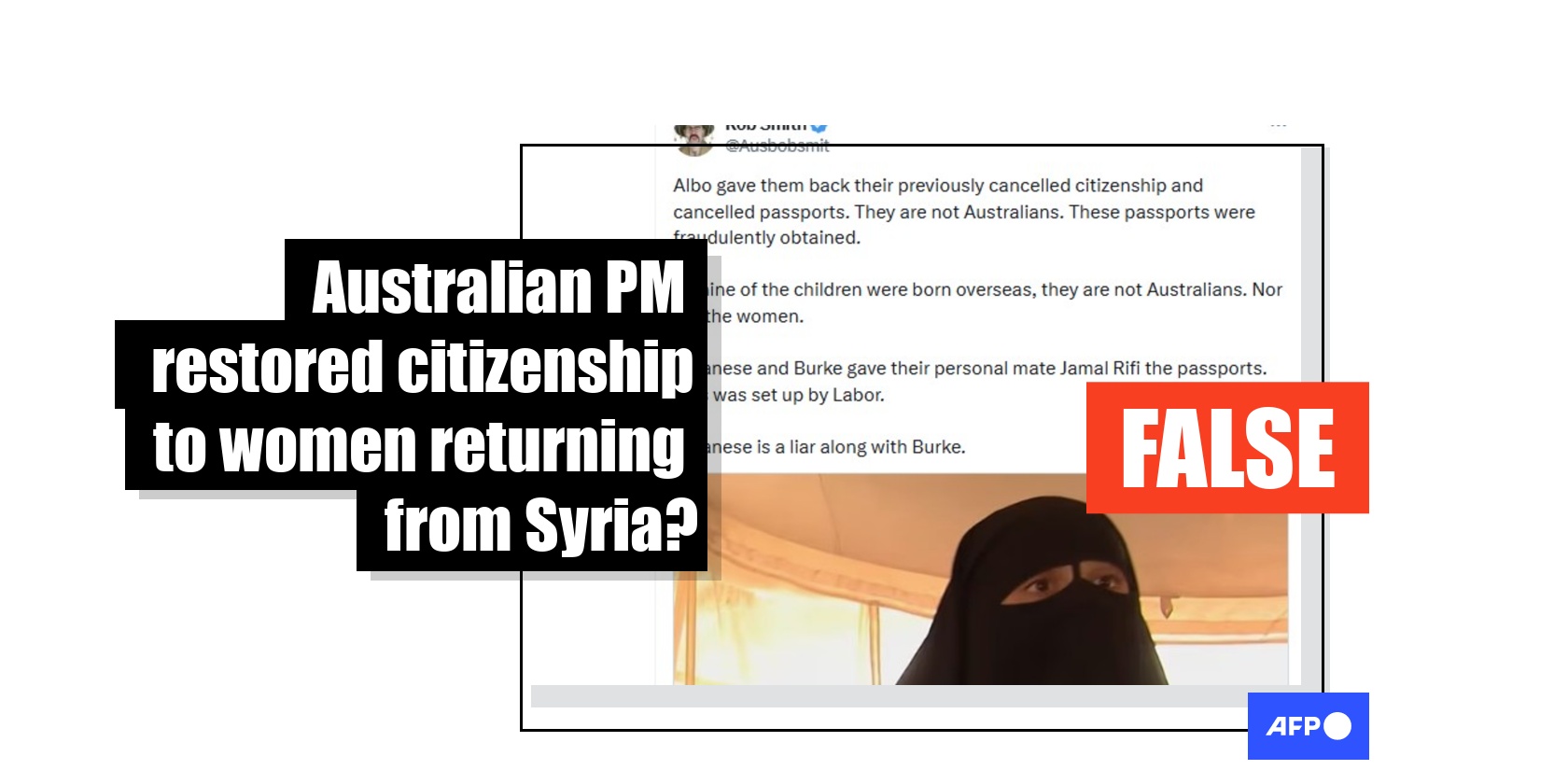
False citizenship claims targeting IS-linked women anger Australians
- Published on May 14, 2026 at 05:51
- 4 min read
- By Dene-Hern CHEN, AFP Australia
After a group of women linked to Islamic State jihadists returned to Australia on May 7, posts falsely claimed Prime Minister Anthony Albanese restored "their previously cancelled citizenship". The women and their children are Australian citizens by law, which means they have the right to return home, according to the government. An international law expert told AFP the threshold to bar a citizen from returning home is very high and should be reserved only for "an exceptional measure".
"Albo (Albanese) gave them back their previously cancelled citizenship and cancelled passports. They are not Australians," reads the caption of an X post published on May 7, 2026.
The post also shares an image of a woman in a niqab -- a veil over the face worn by some Muslim women.
"These passports were fraudulently obtained. All nine of their children were born overseas, they are not Australians. Nor are the women," adds the user, who frequently writes anti-government posts that have been previously fact-checked by AFP.
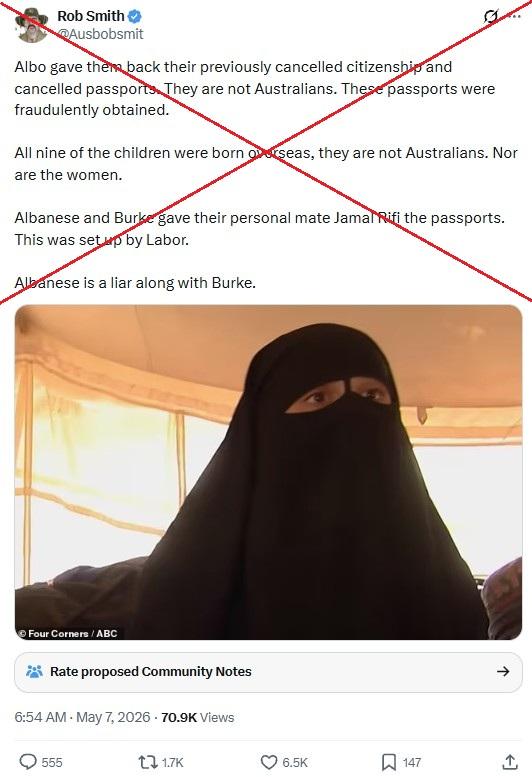
Similar posts also appeared elsewhere on X and on Facebook, where they were shared in anti-Labor Party groups.
Hundreds of women from Western nations were lured to the Middle East as the Islamic State group gained prominence over a decade ago, in many cases following husbands who had signed up as jihadist fighters.
On May 7, 2026, four women and their nine children returned to Australia for the first time after allegedly sneaking into Syria in the early 2010s (archived link).
Two of the women, Kawsar Ahmad, 53, and her daughter Zeinab, 31, were immediately arrested after arriving at Melbourne international airport.
They faced a raft of "crimes against humanity" charges, including possessing a slave, using a slave, and slave trading.
Another woman, Janai Safar, 32, was arrested after touching down in Sydney and was charged with entering a restricted area and joining a “terrorist organisation”.
A fourth woman travelling with the group was not arrested.
Widely known as the "ISIS brides", the case has stirred strong feelings in Australia, with critics accusing the women of turning their back on Australia and believing that they should be left to face the consequences.
This group is not the first Australian citizens to return from Syria's refugee camps -- small groups of women and children flew back to Australia in 2019, 2022 and 2025.
Comments on the false posts repeatedly questioned whether the women and children were Australian citizens, with many calling them "traitors".
But the four women are in fact Australian citizens, which the government has repeatedly said.
Citizenship is also conferred to children born outside of Australia if they have Australian citizen parents, according to Section 16 (2) of the Australian Citizenship Act (archived link).
'Limited way' to revoke citizenship
International law expert Donald Rothwell of Australian National University's Law School told AFP on May 11 that "there is an exceptionally limited way in which citizenship can be legally revoked" (archived link).
That can happen if someone is convicted for certain terrorist and national security-related offences "but only if the individual has another citizenship to fall back on", he said, pointing to Sections 34 and 36 (C) of the Australian Citizenship Act (archived link).
Rothwell also said that since one or both parents are Australians, then the children will be citizens.
While the government can issue a temporary exclusion order, in order to do that "somebody must have been convicted of a foreign terrorist defence or they had an adverse security assessment issued against them by one of the Australian security agencies", Rothwell explained.
Home Affairs Minister Tony Burke had announced in February that one citizen -- among the group of women and children at the Syrian camp -- had been issued a temporary exclusion order, done on the advice from security agencies (archived link).
'Citizens are entitled to passports'
Despite holding citizenship, government officials had said before the group's May 7 return that Australia would not help to repatriate them, adding that if they were to return "they will be met with the full force of the law" if they had committed a crime (archived link).
The day after they returned, Prime Minister Albanese was again asked about the women's circumstances by local radio show Nova Melbourne -- which can be heard on the 77:22 minute mark (archived link).
"Australian citizens are entitled to Australian passports. They're entitled to come into Australia. What we're entitled to do though is to throw the book at them and that's precisely what we're doing," Albanese said.
He reiterated that they are Australian citizens and the law allows them the right to return (archived link).
Forbidding a citizen from travelling back to their home country "should be an absolutely exceptional measure", Rothwell said.
"International law says that persons have a right to travel and they have a right to return to their home country," he said. "It's good that the bar is set high."
He added that one exception in the recent past was during Covid, when temporary orders were issued against Australians in India from being able to return under the Biosecurity Act (archived link).
"It was a very temporary measure, which applied only a very short period of time," Rothwell said.
AFP has previously debunked misinformation about citizenship issues in Australia here.
Copyright © AFP 2017-2026. Any commercial use of this content requires a subscription. Click here to find out more.
Is there content that you would like AFP to fact-check? Get in touch.
Contact us