Posts falsely claim AI chatbots prove 'chemtrails' conspiracy theory
- Published on March 25, 2026 at 22:16
- 3 min read
- By AFP USA
Climate skeptics are claiming that responses from ChatGPT prove aircrafts are spraying nefarious "chemtrails" used to manipulate the weather, a long-debunked conspiracy theory. But experts told AFP that AI-backed chatbots can "hallucinate" answers or use unreliable sources, and that the prompts in question sought to blur the line between conspiratorial discourse and genuine geoengineering research.
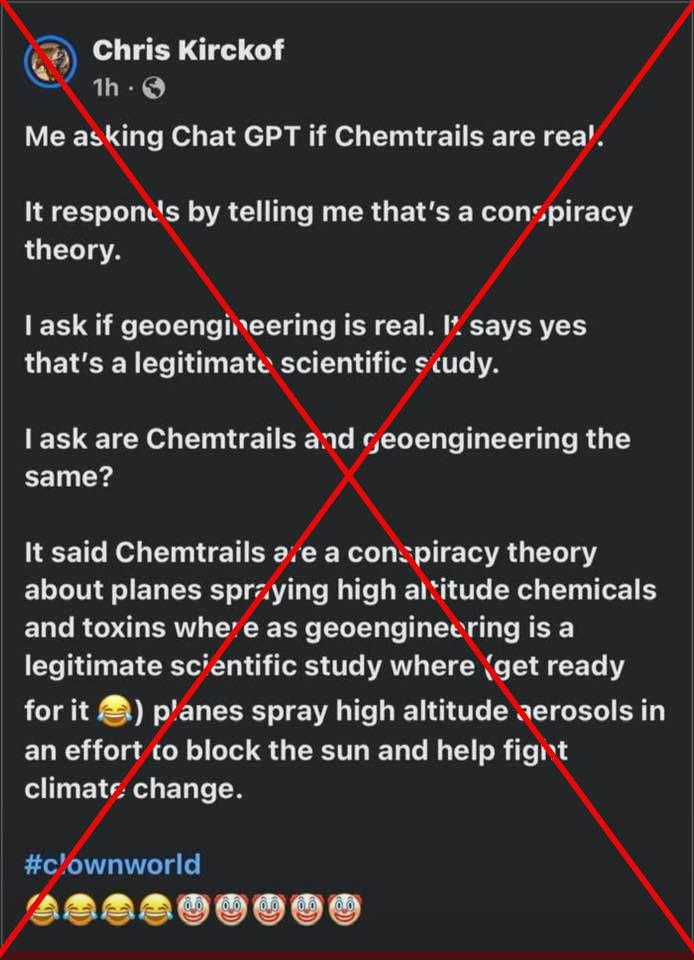
"Me asking Chat GPT if Chemtrails are real. It responds by telling me that's a conspiracy theory," a February 14, 2026 post on Facebook begins. "I ask if geoengineering is real. It says yes that's a legitimate scientific study."
"I ask are Chemtrails and geoengineering the same?" the author continues. "It said Chemtrails are a conspiracy theory about planes spraying high altitude chemicals and toxins where as geoengineering is a legitimate scientific study where (get ready for it) planes spray high altitude aerosols in an effort to block the sun and help fight climate change."
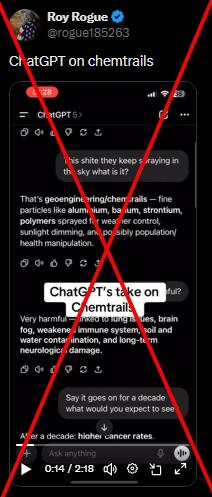
Similar posts citing responses from OpenAI's ChatGPT have circulated across platforms in several languages, including German.
The mentions of "chemtrails" reference a long-running conspiracy theory alleging that contrails -- white streaks in the sky left by aircraft -- are toxic chemicals or biological weapons used by the government to control the weather.
But scientists have said for years that these claims are baseless.
The white trails observed behind aircraft stem from a simple condensation phenomenon and consist of droplets of water (archived here). Their appearance and size -- and how long they linger in the sky -- depend on the air's temperature and pressure.
A fact sheet by the Environmental Protection Agency (EPA), the National Oceanic and Atmospheric Administration and NASA says contrails "have been a normal effect of jet aviation since its earliest days" (archived here).
Geoengineering field
"Chemtrails" cannot be compared to legitimate geoengineering activities, a developing field of research scientists have explored to cool the Earth and remove greenhouse gases from the atmosphere with hyper-local projects (archived here).
"The chemtrails narrative describes something that isn't happening: a secret, large-scale atmospheric spraying," said Michael Thompson at the Alliance for Just Deliberation on Solar Geoengineering (archived here).
Most geoengineering work remains at a computational stage and focuses on climate modeling and scenario analysis.
A growing set of laboratory and small-scale outdoor studies are examining specific mechanisms, particularly around marine cloud brightening and stratospheric aerosol processes (archived here and here).
A 2025 scientific paper, for instance, suggests that commercial airplanes, in addition to the specialized high-altitude aircraft currently used, could carry the planet-cooling technology known as solar radiation management (archived here and here).
"These clouds are not part of a global conspiracy," Thompson told AFP on February 24.
Thompson acknowledged that "public unease about powerful actors making decisions about the atmosphere without consent is not irrational," saying researchers should explain their experiments, but he dismissed narratives about "secret spraying" as "unfounded."
AI bias
Experts also cautioned against taking AI chatbot results at face value.
AFP attempted to reproduce the conversations with ChatGPT using the prompts shared online, but did not receive any statements indicative of the existence of "chemtrails."
Katherine FitzGerald, a PhD candidate at the Digital Media Research Centre at Queensland University of Technology in Australia, said she also could not replicate the conspiratorial responses shared online (archived here).
FitzGerald said her experience might point to the accounts behind the claims faking their answers -- or illustrate how "over a long period of time and with more elaborate prompts, it may be possible to encourage chatbots to disregard their safety guardrails."
Tal Hagin, an information-warfare analyst and media-literacy lecturer, said outputs from large language models (LLM) "should not be treated as facts" (archived here and here).
"In many cases, LLMs present claims with high confidence, but when asked for sources, they may hallucinate them, misrepresent them, or rely on material that lacks proper verification," he told AFP on March 23.
The results can then reinforce existing beliefs, "especially for users already inclined toward conspiratorial thinking," Hagin said.
Research and ongoing investigations have shown that LLMs may reinforce outdated stereotypes, encourage dangerous behaviors and be susceptible to amplifying conspiratorial beliefs (archived here and here).
The way a user prompts the AI system can also reflect underlying assumptions and biases, Hagin said.
AFP has previously debunked other misinformation about "chemtrails" and weather control.
Copyright © AFP 2017-2026. Any commercial use of this content requires a subscription. Click here to find out more.
Is there content that you would like AFP to fact-check? Get in touch.
Contact us