Canadian broadcaster did not publish AI-generated image after Khamenei's death
- Published on March 5, 2026 at 19:11
- 2 min read
- By Gwen Roley, AFP Canada
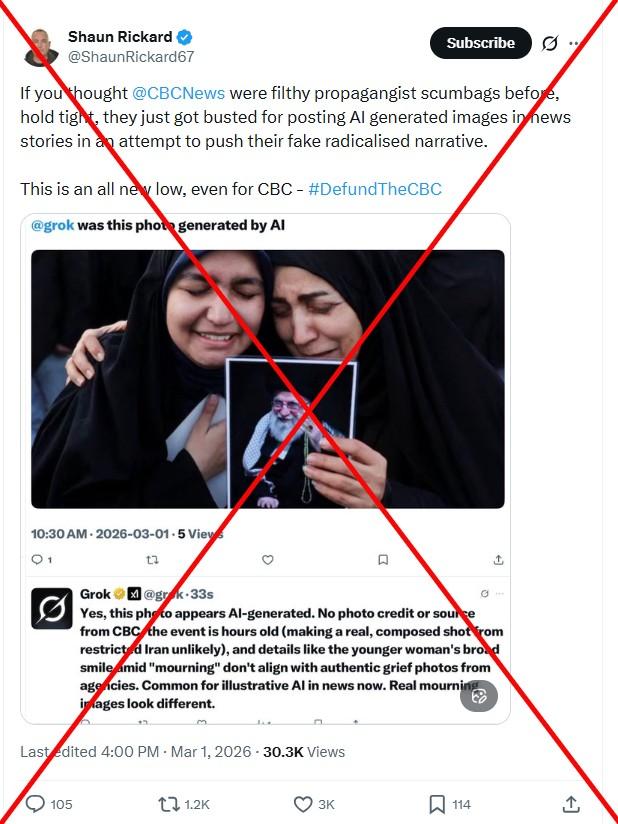
Social media users and vloggers are claiming the Canadian Broadcasting Corporation (CBC) ran an image generated by artificial intelligence in an article on the Iranian supreme leader killed by US-Israeli strikes. But while some have objected to the CBC's use of the picture of two women crying, the claims that it is fake appear to have originated with a hallucinated response from X's chatbot Grok; the original photo was distributed by Reuters and published by several other news organizations.
"This is an all new low, even for CBC," says a March 1, 2026 X post sharing a screenshot of the conversation with the social network's AI chatbot.
The image shows Grok responding to a query about a picture of two women holding up a photo of the late Ayatollah Ali Khamenei, Iran's hardline spiritual guide, by saying the visual appears to be synthetic and that the CBC published it with no source.
"Real mourning looks different," Grok says.
The screenshot also spread on TikTok, Facebook and Instagram. The claim that the CBC published an AI-generated image was then repeated in YouTube and Rumble videos viewed tens of thousands of times.
The United States and Israel triggered the war in the Middle East on February 28 with strikes on Tehran that killed Khamenei, the top political authority in Iran since 1989.
After Khamenei's death, several prominent Canadian social media accounts scrutinized CBC's publication of the photo (archived here and here). One suggested the broadcaster had "some other narrative" to push by using a photo of two woman crying over someone "who imposed some of the most restrictive laws on the rights of women in the world."
"I can't even tell if this picture is real or AI-generated," another influencer said in a March 1 Facebook reel (archived here).
However, the claim that the picture was created using artificial intelligence is unfounded.
CBC published the image alongside a February 28 article covering Khamenei's death (archived here), with the photo attributed to Reuters and West Asia News Agency (WANA).
Kerry Kelly, a spokeswoman for CBC, told AFP on March 3 that Reuters had confirmed the authenticity of the photo's metadata.
The picture also appears saved to a Reuters online content library, where it is credited again to WANA and photographer Majid Asgaripour (archived here).
Asgaripour's professional Instagram account, which says he is based in Tehran, includes other Reuters photos of mourners reacting to Khamenei's death (archived here). AFP reached out to Asgaripour for comment but did not receive a response.
Several other outlets, including The Guardian and Radio Free Europe-Radio Liberty, republished the same photo of the women crying while holding Khamenei's picture (archived here and here).
The original Grok response suggesting the image was fabricated was triggered by a prompt from an account that is labeled as parody. The account then cited Grok's reply in a post claiming the CBC "uses AI generated photos to create fake stories."
Grok previously generated confusion about the veracity of famine in Gaza after the chatbot falsely placed a 2025 AFP photo of an emaciated Palestinian child in Yemen years earlier.
The internet has been awash with misleading claims and misrepresented images about the war in the Middle East.
Read more of AFP's reporting on misinformation in Canada here.
Copyright © AFP 2017-2026. Any commercial use of this content requires a subscription. Click here to find out more.
Is there content that you would like AFP to fact-check? Get in touch.
Contact us