Maps mislead on state identification requirements to vote, purchase gun
- Published on February 25, 2026 at 21:24
- 3 min read
- By Sahas WIJEWARDENE, AFP USA
As US President Donald Trump backs federal legislation to subsume state laws with strict voter identification requirements, a chart has resurfaced in social media posts questioning why regulations governing voting are more widespread than those for gun purchases. But the graphic does not accurately depict the legal mandates in place, including a federal law that requires photo identification for firearm purchases from licensed dealers across the country.
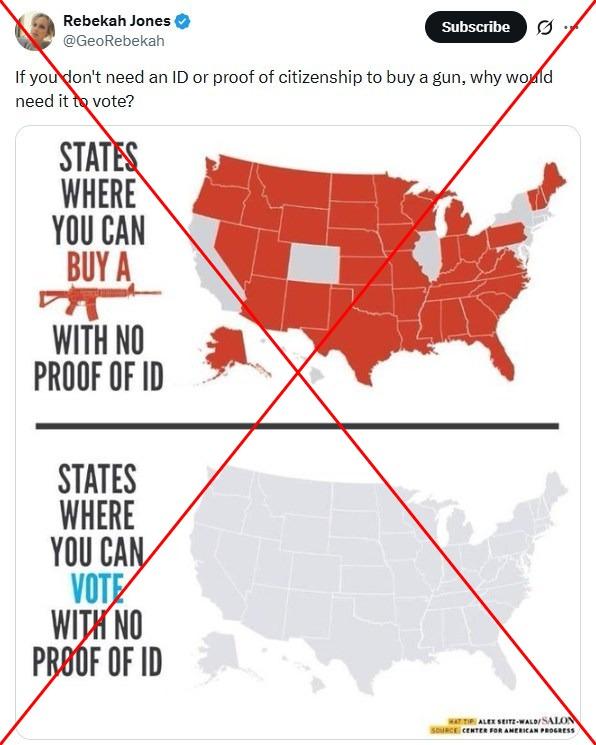
"If you don't need an ID or proof of citizenship to buy a gun, why would need it to vote?" a February 12, 2026 post on X asks.
The attached image includes two maps of the United States, one which seems to show most states having lax identification requirements to purchase a firearm and another asserting that every state requires it to vote.
The same user also shared the image on Facebook and Instagram gathering tens of thousands of comments.
The posts gained traction as the US House of Representatives passed the Safeguard American Voter Eligibility (SAVE) Act which is currently with the Senate.
It would require individuals to provide documentary proof of US citizenship when registering to vote and to provide photo identification to cast a ballot in federal elections.
A study by the University of Maryland found that more than 21 million eligible voters do not have easy access to documents proving citizenship.
Still, Trump is voicing support for the proposed regulation, including using his State of the Union address to call on lawmakers to pass the bill.
False claims that undocumented individuals are casting ballots in large numbers have been repeatedly raised by Trump and other Republican lawmakers despite numerous investigations, election audits and court rulings that have found no evidence of widespread non-citizen voting.
And the maps -- which a reverse image search reveals have circulated since 2013 -- do not accurately depict states which waive identification requirements at polling places.
Variable election laws
Currently, states set their own election rules, and in many locations there is a difference between the identification requested to cast a ballot and the documents required to register to vote.
As of October 2025, a majority of states require photo identification to cast a ballot (archived here).
California is one of 12 states and the District of Columbia that do not ask for photo identification on Election Day (archived here). However, any first time voter who did not provide a driver's license number, California identification number or the last four digits of a social security number on the registration form can be asked for identification (archived here).
The Help America Vote Act -- signed into law by former president George W. Bush -- put in place "minimum requirements for verification of voter registration information, including driver's license number or the last four digits of a Social Security number." It also strengthened identification requirements for first time voters who register to vote by mail.
Some states verify identity through other methods including a government-issued document showing name and address, a utility bill or bank statement.
Gun purchase regulations
Similarly, each state has different legal requirements to purchase a firearm, including but not limited to background checks, license permits and restrictions on certain types of weapons.
Federal law, including the Gun Control Act of 1968, requires all companies with a Federal Firearms License to require a valid photo identification, conduct a background check and fill out the ATF Form 4473 Firearms Transaction Form (archived here, here and here).
However, this requirement only applies to federally licensed dealers -- private, person-to-person sales are regulated differently depending on the state.
A study conducted in early 2025 by YouGov found that 64 percent of gun-owning households reported acquiring at least one firearm from a licensed dealer (archived here), but loopholes that allow for unregulated sales can lead to illegal trafficking of weapons.
Read more of AFP's coverage of misinformation impacting US politics here.
Copyright © AFP 2017-2026. Any commercial use of this content requires a subscription. Click here to find out more.
Is there content that you would like AFP to fact-check? Get in touch.
Contact us