
False posts twist Philippine leader's remarks on banking fees
- Published on August 14, 2026 at 07:02
- 2 min read
- By Tatiana MALIGRO, AFP Philippines
Philippine President Ferdinand Marcos's annual State of the Nation address sparked a torrent of posts falsely claiming he promised zero transaction charges for all local banks, only to be rebuked by the central bank. A review of his speech found Marcos made no such remarks although he spoke briefly about the topic. The central bank's statement was issued days before Marcos's address and sought to clarify a recently issued circular on banking fees.
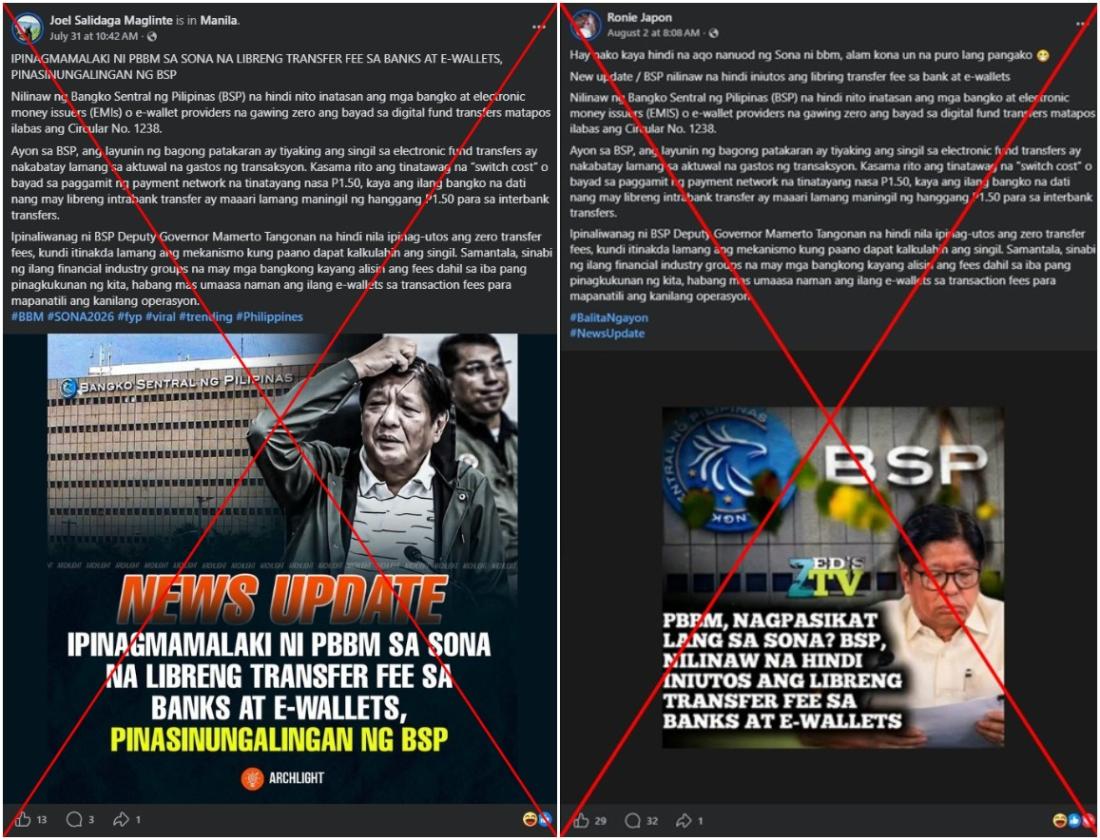
"PBBM boasts about free bank and e-wallet transfers in SONA, but the central bank belies the claim," says a Tagalog-language Facebook post on July 31, using the president's popular initials and the acronym for his annual address.
It goes on to claim central bank deputy governor Mamerto Tangonan said banks and e-wallets are not required to waive transaction fees completely but only to price the charges fairly.
Another Facebook post shared August 2 similarly criticised Marcos, saying his speech was "all merely promises".
Marcos's late July address came at a time of heightened political tensions, with Vice President Sara Duterte in the middle of an impeachment trial, while voters have also been roiled by a corruption scandal tied to bogus flood control projects.
Posts similarly claiming the central bank admonished Marcos for supposedly bragging about zero banking fees circulated elsewhere on Facebook.
"He's never done anything right. All his promises are just a scam," one user commented. Another said: "The Philippines was tricked again."
But a review of Marcos's speech found he did not say all banks had removed transaction fees (archived link).
"Banks and e-wallets were encouraged to reduce their usual online transaction fees. Since then, many banks and e-wallets have reduced or waived their online transaction fees," he said.
Moreover, the remarks by central bank official Tangonan were not directed at the president, contrary to what the false posts claim.
Tangonan spoke about the banking charges during an interview with radio station DZMM Teleradyo on July 25 -- two days before Marcos's address (archived link).
He said there were misconceptions that a central bank notice issued in June required banks and e-wallet operators to make transfer fees zero (archived link).
"Just to be clear, did the central bank order to make transfer fees zero? Because there were so many entities that made it zero, right?" the host asked.
"But that's not the case," he replied. "If you read Circular 1238, all it says is to charge reasonable fees."
The notice -- known as Circular 1238 -- ordered banks and financial institutions to price their transaction fees based on the actual costs of transferring money through a payment network. They must justify how the price is calculated to the central bank.
In response to the circular, several Philippine banks announced they would eliminate certain transaction fees. The country's two largest e-wallets -- GCash and Maya -- said they would reduce their charges to 10 Philippine pesos ($0.16) per transaction (archived here and here).
Tangonan's clarification was reported widely by local media organisations (archived here, here and here).
AFP also debunked other misinformation linked to the Philippine financial system.
Copyright © AFP 2017-2026. Any commercial use of this content requires a subscription. Click here to find out more.
Is there content that you would like AFP to fact-check? Get in touch.
Contact us