India's Modi not alone in giving land acknowledgement during Australia visit
- Published on July 16, 2026 at 09:41
- 4 min read
- By Dene-Hern CHEN, AFP Australia
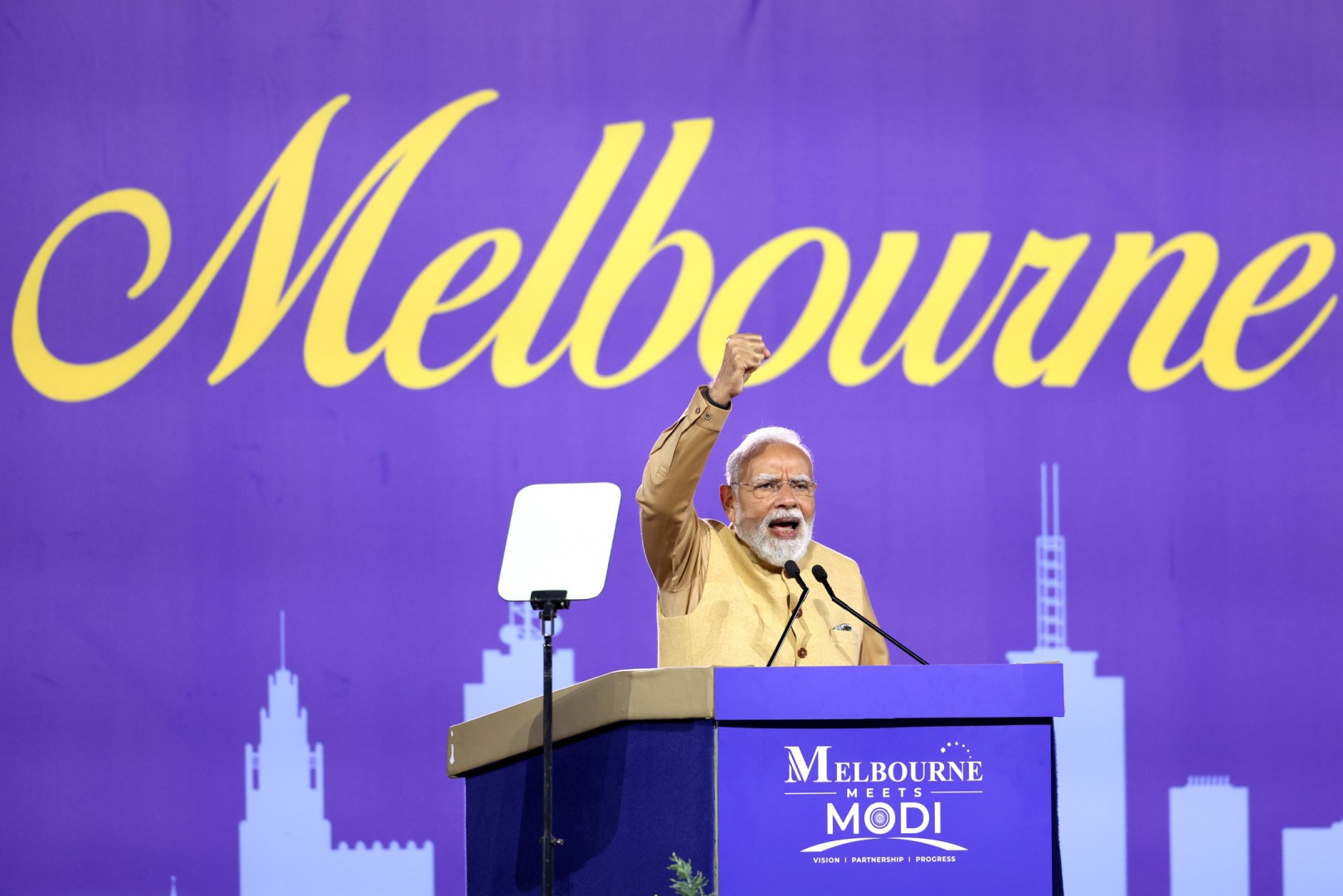
Indian Prime Minister Narendra Modi opened a speech during a July 2026 visit to Australia by performing a land acknowledgement, a common practice that far-right websites and social media posts have misconstrued as a jab at the non-Indigenous population. The cultural tradition has long featured in public settings to show respect for the country's Aboriginal roots, and Modi's recitation was not unique -- several visiting foreign leaders have previously followed the custom.
"If you ever talk to one of these Indians, they always say, 'It's not your land; it's Aboriginal land'," reads an X post shared on July 10.
"So, to him, saying a Welcome to Country means white people can't complain about Indians flooding the country because it isn't their land".
It shares a post from The Noticer, a far-right website that AFP has previously fact-checked for spreading misinformation, along with a clip from Modi's speech in Melbourne on July 9 (archived link).
"I would like to begin by acknowledging the traditional owners of the land on which we meet, and I pay my respects to the elders past, present and emerging," he says in the video.
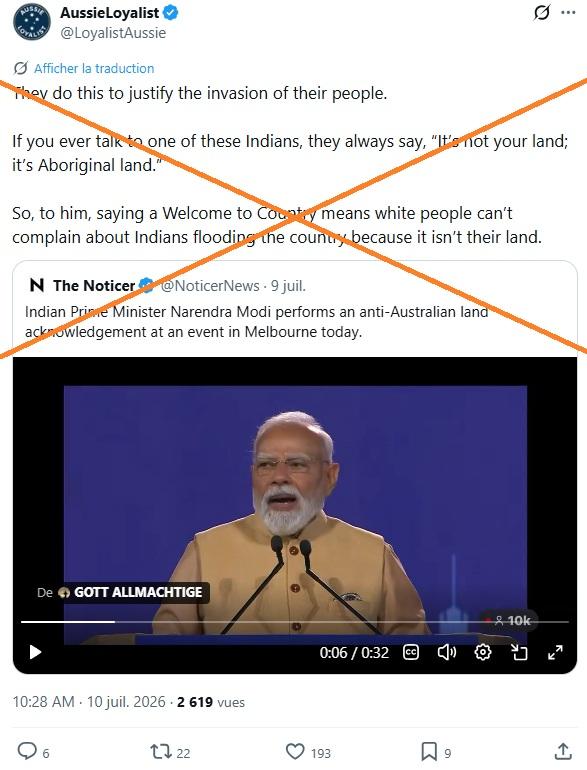
The Noticer also shared a graphic about Modi's speech to its nearly 100,000 Facebook followers, with a caption that partly reads: "They do this to justify the invasion of their people".
The narrative has also spread elsewhere on Facebook and X.
The Indian prime minister received a rock-star welcome from nearly 30,000 cheering and applauding fans at a "Melbourne Meets Modi" event held at a stadium as part of his three-day visit to Australia (archived link).
The two countries have grown considerably closer in recent years, partly driven by a joint desire to keep Beijing's military ambitions in check while cultivating trading partners outside China.
The Indian diaspora in Australia has also increased in recent years. For the first time, the country's largest group of residents born overseas is from India, according to population statistics through June 2025 (archived link).
The trend has coincided with a rise in anti-immigration rhetoric -- fuelled in part by a series of marches held across Australia since 2025 -- and criticism of Prime Minister Anthony Albanese and his centre-left Labor Party (archived here and here).
Common practice
Some posts incorrectly called Modi's remarks a "Welcome to Country", which the University of New South Wales describes as a "ceremony performed by a local Aboriginal person of significance (usually an Elder) to acknowledge and give consent to events taking place on their traditional lands" (archived link).
Modi was actually giving an "Acknowledgement of Country" -- an opportunity for anyone to "pay their respects" to Australia's Indigenous population, said expert Jie Pittman, who hosts a weekly radio show on Australian Aboriginal culture (archived here and here).
"Acknowledgement of the country can be done by anyone, even a non-Indigenous person," Pittman told AFP.
Footage from Indian broadcaster NDTV shows Modi opened his speech with the acknowledgement heard in the posts before continuing with remarks largely in Hindi (archived link).
Across Australia, the same acknowledgement commonly precedes speeches, meetings and other events -- from university lectures to rugby games.
Many foreign leaders visiting Australia have given it, too -- particularly in formal settings:
- Former British prime minister David Cameron gave the acknowledgement in parliament during a state visit in 2014, when Australia was governed by Tony Abbott's Liberal party (archived link).
- Ex-US president Barack Obama also gave it in parliament in 2011, and again in 2014 when he spoke at the University of Queensland in Brisbane (archived here and here).
- In more recent years, other dignitaries who delivered the acknowledgement include Philippine President Ferdinand Marcos Jr, Papua New Guinea Prime Minister James Marape and European Commission President Ursula von der Leyen (archived here, here and here).
Growing controversy
Despite its long history, the acknowledgement has in recent years become a touchstone for controversy, with some politicians choosing not to say it in public events (archived link).
Pauline Hanson, leader of the far-right One Nation party, previously called for a ban on the practice, calling it "racially divisive" (archived link).
In June 2026, she said during a speech at the National Press Club: "Don't expect a divisive 'Welcome to Country' from me" (archived link).
During Anzac Day last year, services in Perth and Melbourne marking the ill-fated World War I landing of Australia and New Zealand Army Corps troops at Gallipoli were briefly disrupted by booing and heckling during the Welcome to Country ceremony (archived link).
Pittman, the radio host, said many Australians misunderstand the tradition. For him, it is akin to a blessing from "people who are going to look after them physically, but also energetically or spiritually".
"A lot of Australians today might not even know a First Nations person to understand, to have an opportunity for them to get that understanding," he said.
"But we don't want to have this stranger feeling in our community. That's why the Welcome to Country is so important, and that's why it's important that there's education and that there's actually chances and opportunities for ceremonies".
AFP has previously covered misinformation about Australia's Indigenous population here and here.
Copyright © AFP 2017-2026. Any commercial use of this content requires a subscription. Click here to find out more.
Is there content that you would like AFP to fact-check? Get in touch.
Contact us