Canada's UNDRIP Act does not supersede private property rights: experts
- Published on July 16, 2026 at 21:30
- 4 min read
- By Gwen Roley, AFP Canada
Several Indigenous land rights cases in Canada have led to online angst about the security of property ownership in the country, with many claiming land grabs will take place as a result of the Canadian commitment to the United Nations Declaration on the Rights of Indigenous Peoples (UNDRIP). However, legal experts told AFP that while UNDRIP does outline the right to restitution for improperly taken land, it does not include any stipulation which overrides property rights.
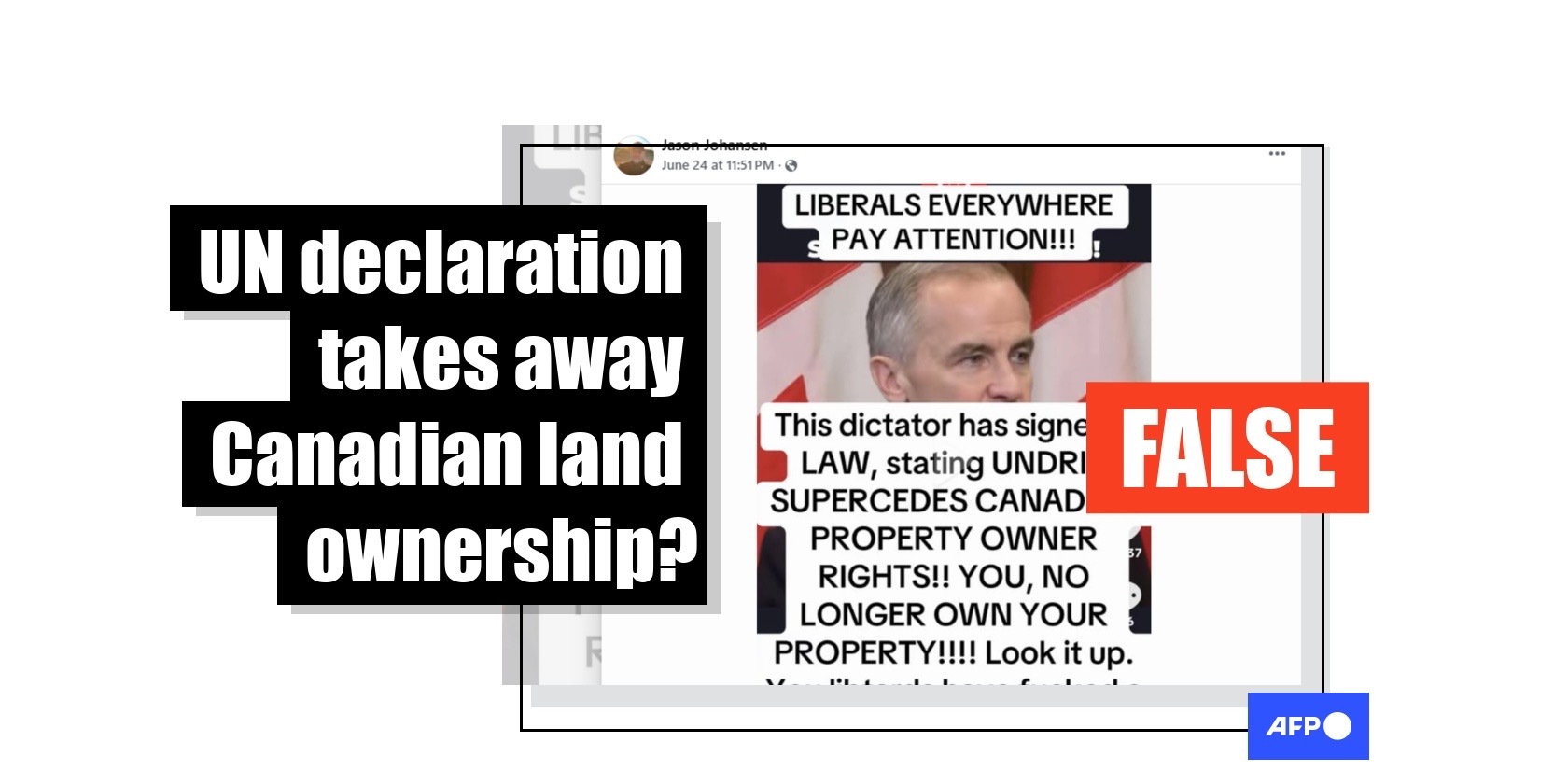
"This dictator has signed a LAW stating UNDRIP SUPERCEDES CANADIAN PROPERTY OWNER RIGHTS!! YOU, NO LONGER OWN YOUR PROPERTY!!!" claims the text over a photo of Canadian Prime Minister Mark Carney in a June 24, 2026 Facebook post.
It references the resolution, first adopted by the UN General Assembly in 2007, establishing a standard of rights for Indigenous people living in colonized states (archived here and here).
The picture was shared thousands of times across Facebook and also appeared on Instagram and TikTok.

Canada originally voted against UNDRIP but changed course and passed its own UNDRIP Act (UNDA) in 2021 requiring the government to ensure its laws are consistent with the international declaration (archived here).
Over the past year, claims about UNDRIP and private property took off across platforms, often denouncing the United Nations for supposedly meddling in domestic matters, echoing previous unfounded claims about UN resolutions forced on citizens.
"At its core, UNDRIP obligates signatory nations to vest property ownership back into the hands of the Indigenous Peoples who preceded European colonization," claims a June 1 Instagram post.
However, the Canadian Department of Justice told AFP UNDRIP is an international human rights instrument that can help interpret and apply Canadian law, but it does not create new rights that supersede other statues or the Canadian constitution.
"Neither the UN Declaration nor the UN Declaration Act override property rights," spokesman Kwame Bonsu said in a July 6, 2026 email.
UNDRIP and land rights
Robert Hamilton, an associate professor at the University of Calgary Faculty of Law, said UNDRIP and UNDA focus on recognizing Indigenous political rights and the right to self-determination (archived here and here).
Article 26 of UNDRIP lays out Indigenous peoples' rights to lands "they have traditionally owned, occupied or otherwise used or acquired," but in a July 7 interview, Hamilton said this was principally focused on lands which have been improperly or unlawfully taken.
He said the declaration envisions that ensuing land cases would result in redress for the wronged Indigenous group, but seizure of private property would be unusual.
"Almost always compensation is going to be what people identify as the most appropriate means," Hamilton said.
Article 46 of UNDRIP places limits by saying that the declaration cannot be understood in a way that undermines the territorial integrity of states, therefore precluding "mass seizure of land," he added.
Mineral rights case in British Columbia
Hamilton and others who spoke to AFP pointed to the recent fracas over provincial legislation committing British Columbia to UNDRIP as a reason for misconceptions.
The western province passed its Declaration on the Rights of Indigenous Peoples Act (DRIPA) in 2019, which like the federal version was understood as a pathway for incorporating UNDRIP into the province's laws (archived here).
However, many called for DRIPA to be repealed either in whole or in part after a December 2025 court ruling found the province's mineral tenure system did not properly consult with Indigenous groups and was inconsistent with UNDRIP (archived here).
Some feared the decision meant any British Columbia law which did not conform with the UN declaration was putting the province at litigation risk. But others -- including many First Nations groups -- opposed pulling back from the legislation and the province eventually said it would not be immediately modifying the act.
The court decision did not appear to implicate private property rights and the case is not yet settled as the Supreme Court of Canada will hear an appeal (archived here).
Cynthia Callison, whose law firm Callison & Hanna specializes in representation for Indigenous governments (archived here), told AFP that she could not see a scenario where bringing British Columbia's laws in line with UNDRIP would lead to a suspension of ownership rights.
"There's absolutely no precedent for that," she said in a July 9, 2026 interview.
Like Hamilton, Callison agreed that Indigenous groups seeking redress for improperly taken land, as outlined in UNDRIP, would most likely receive financial restitution. She pointed to survivors of the Second World War's Japanese internment camps in Canada, who received financial compensation rather than the return of their seized property (archived here).
Conflation with Cowichan case
Benjamin Ralston, assistant professor at the University of Saskatchewan College of Law (archived here), also said Canadian commitments to UNDRIP would not suspend property rights.
On July 7, he said the "outlandish" claims appeared to conflate UNDRIP and concerns about an August 2025 court decision granting Aboriginal title to the Cowichan Nation over an area of British Columbia which includes privately owned homes.
He said that while the ruling mentions UNDRIP, the decision was based on longstanding Canadian legal doctrine and has little to do with the international resolution (archived here and here).
While many have claimed the ruling puts homeowners' rights at risk, the Cowichan Nation stated the decision does not erase private property (archived here).
Furthermore, the ruling asserts private property and Aboriginal title can coexist and calls on the government of British Columbia to negotiate with the Cowichan on how to reconcile overlapping claims (archived here and here).
A final ruling is not in place as the provincial government and other local Indigenous groups have said they will appeal the decision (archived here).
Reconciliation process
Merle Alexander, who works on UNDRIP's implementation as principal lawyer at Miller Titerle + Company, described the UN declaration as one method in the government's toolkit working towards reconciliation with Indigenous people (archived here and here).
He also qualified that not all Indigenous people were satisfied with UNDRIP's adoption since it could limit paths to redress.
In a July 13, 2026 interview, he dismissed the idea that bringing federal or British Columbia laws in line with the UN declaration would mean transferring ownership of land to Indigenous people.
He said that the provincial and federal commitments to UNDRIP set out a legal reform process which involves consultation with Indigenous groups. While the mineral rights case in British Columbia appeared to mandate an acceleration of that process, he said there is no precedent to build an amendment which could call for the seizure of private property.
Read more of AFP's reporting on misinformation in Canada here.
Copyright © AFP 2017-2026. Any commercial use of this content requires a subscription. Click here to find out more.
Is there content that you would like AFP to fact-check? Get in touch.
Contact us