Document giving African nationals May deadline to leave Cambodia is fake
- Published on July 8, 2026 at 10:45
- 4 min read
- By Monique NGO MAYAG, AFP Senegal
- Translation and adaptation Samad UTHMAN, AFP Nigeria
Cambodia is intensifying its fight against online scams and cybercrime, arresting more than 3,000 people in May, many of them foreign nationals. In this context, internet users have claimed on social media that the Cambodian government ended a visa exemption for all African citizens, setting a deadline of May 31, 2026, for people to leave the country or face imprisonment. However, the Cambodian government denied the claim, saying that a document shared on social media as an official notice was fake.
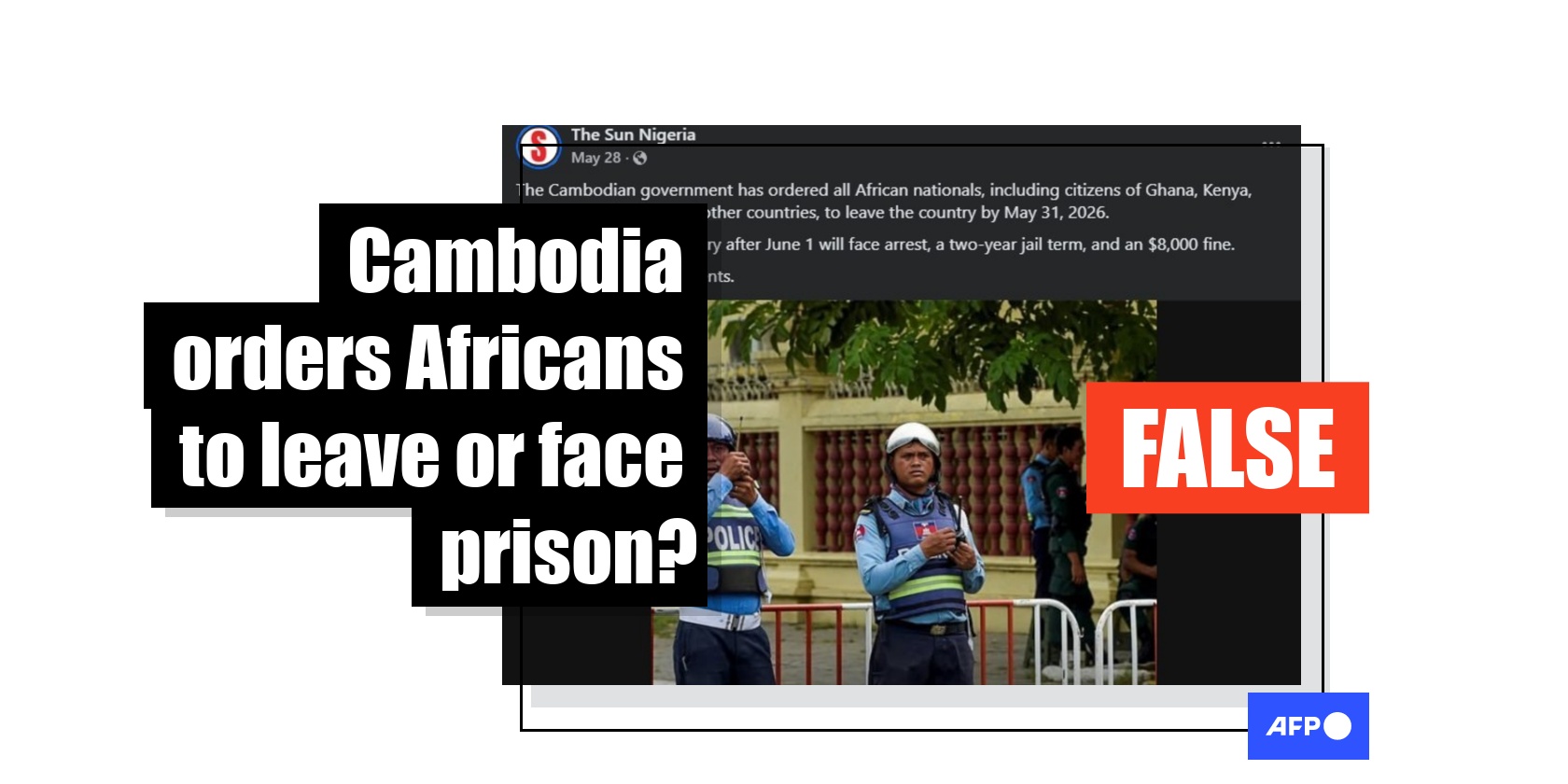
“The Cambodian government has ordered all African nationals, including citizens of Ghana, Kenya, Cameroon, Uganda and other countries, to leave the country by May 31, 2026. Those found in the country after June 1 will face arrest, a two-year jail term, and an $8,000 fine”, reads the caption of a Facebook post published on May 28, 2026.

The post, shared more than 1,000 times, was published by Nigerian news publisher The Sun. Attached to the post was a link to a news article on its website with the headline, “Cambodia sets May 31 exit deadline for Africans”.
In the report, The Sun wrote that a Cambodian immigration boss, Som Sopheak, directed “citizens of Ghana, Kenya, Cameroon, Uganda and other countries, to leave Cambodia on or before May 31” in a circular.
The report also added that nationals of the specified African countries who failed to leave would be arrested by the Cambodian police from June 1, 2026.
The Sun quoted the circular as reading: “All concerned are hereby informed to strictly comply with this notice. The Royal Government of Cambodia will not tolerate any violation of our immigration laws.”
A similar news headline was published on the front pages of other Nigerian (here and here) and Ghanaian media in English, where the same circular is referred to as the source. Another post published by a Facebook user claimed that the leave order only applied to Cameroonians.

Elsewhere on Facebook, the claim has been shared by different accounts here,here, here, and here.
The Cambodian National Police announced on May 24, 2026, that they had arrested 3,320 people from 32 different nationalities since the beginning of the month as part of a campaign to dismantle online scam networks (archived here).
However, the claim that Africans in Cambodia were asked to leave the country before the end of May is false.
No general visa exemption
AFP Fact Check reviewed the official list of visa exemption agreements published by Cambodia’s Ministry of Foreign Affairs (archived here).
The list shows that among African countries, only Seychelles and Morocco have such agreements with Cambodia, meaning that the Asian country does not provide a general visa exemption for all African nationals.
Therefore, the claim that Cambodia ended a general visa exemption for African nationals is inaccurate, as such an exemption does not exist for most African countries
Keyword searches conducted on various search engines also failed to show any official record of communication from Cambodian authorities ordering African nationals to leave Cambodia.
On the contrary, the department in charge of immigration within the Cambodian Ministry of the Interior published a denial on its official Facebook page on May 29, 2026, in which it describes the claims circulating online as “fake news” (archived here and here).
Cambodian authorities accused Ghanaian media outlets Campaigner Online and News Ghana of being behind the rumour, stating that “the information published on these websites is completely false”.
In another Facebook post, the Cambodian government described the disinformation published by the two Ghanaian media outlets as a “deliberate attempt to distort the facts, mislead international public opinion and damage the reputation and image of the Kingdom of Cambodia” (archived here).
The ministry maintains that it has not taken any measures to force African nationals to leave the country.
Rwanda also described the claim as false. In a statement posted on X, its diplomatic mission in Cambodia said that the document circulating online “does not constitute an official communication from the Cambodian authorities”, further urging the public to “rely only on information published through official government channels and verified by diplomatic missions” (archived here).
Thank you for your concern.
— Embassy of Rwanda in Korea, Cambodia and Laos (@RwandainKorea) May 29, 2026
We would like to clarify that the document circulating online is not an official communication from the Cambodian authorities.
We encourage the public to rely only on information published through official government channels and verified diplomatic… https://t.co/hmppDwrv2D
AFP's bureau in Cambodia told AFP Fact Check it had neither heard of nor observed any mass expulsions of African nationals since May 31, apart from arrests linked to the ongoing crackdown on online scam operations.
Hotbed of cyber scams
In an interview with AFP in February 2026, Cambodian Prime Minister Hun Manet said that online scam centres were “destroying” the country’s economy (archived here).
According to experts interviewed by AFP, Cambodia has become one of the main hubs for cyber scams in Southeast Asia, involving thousands of foreigners in online frauds, sometimes voluntarily, sometimes under duress from organised criminal groups.
Faced with the growing scale of online scam operations, Cambodian authorities have intensified their crackdown, including an operation announced by the national police on May 24 (archived here).
The crackdown ultimately led to the deportation of 2,847 foreign nationals from 29 countries. The Ministry of Immigration wrote in a Facebook post dated June 2 that the deportations were carried out from May 20-31 and shared video footage of the operation (archived here).
Among the deported were nationals from several African countries (Uganda, Cameroon, Ghana, Liberia, Rwanda, Nigeria, Guinea, Kenya, and Zimbabwe), as well as from China, Vietnam, India, Pakistan, and the United States. The administration specified that 348 women were among those expelled.
The arrest was part of an anti-scam operation and was not an exercise to evict targeted foreign nationals.
Copyright © AFP 2017-2026. Any commercial use of this content requires a subscription. Click here to find out more.
Is there content that you would like AFP to fact-check? Get in touch.
Contact us