
Morocco did not leave the pitch during the 1976 AFCON final against Guinea
- Published on April 2, 2026 at 14:21
- 5 min read
- By Monique NGO MAYAG, AFP Senegal
- Translation and adaptation Samad UTHMAN, AFP Nigeria
Africa’s football governing body invalidated the result of the 2025 Africa Cup of Nations (AFCON) tournament in March, stripping Senegal of the title and awarding it to hosts Morocco. This followed a pitch walk-off by Senegal’s players during the final, which officials said amounted to a forfeit. Since this controversial decision, numerous social media posts have claimed that the Moroccan team acted similarly during the 1976 AFCON without facing any sanctions. Others allege that Guinea, Morocco’s opponent at the time, has filed a lawsuit to reclaim their supposedly stolen victory. But this is false: the Moroccan team never abandoned the pitch during that match, according to several experts interviewed by AFP Fact Check, including a Guinean player who was on the field that day. The Guinean Football Federation also denied initiating any legal proceedings.
During the AFCON final held in Rabat on January 18, 2026, Senegal defeated the hosts Morocco in a 1-0 match marked by numerous incidents (archived here).
In the final minutes of the game, Senegal had a goal disallowed, and the Moroccan team was awarded a penalty. The decisions angered the Senegalese players, most of whom left the pitch for about 15 minutes in protest. They eventually returned, motivated by their captain, Sadio Mané, and won the match after extra time.
However, following an appeal filed by Morocco, the Confederation of African Football (CAF) stripped the Lions of Teranga of their title on March 17, ruling that a walk-off constituted a forfeit (archived here and here).
The decision drew strong criticism across Africa and led to claims about a similar incident in the 1976 tournament.
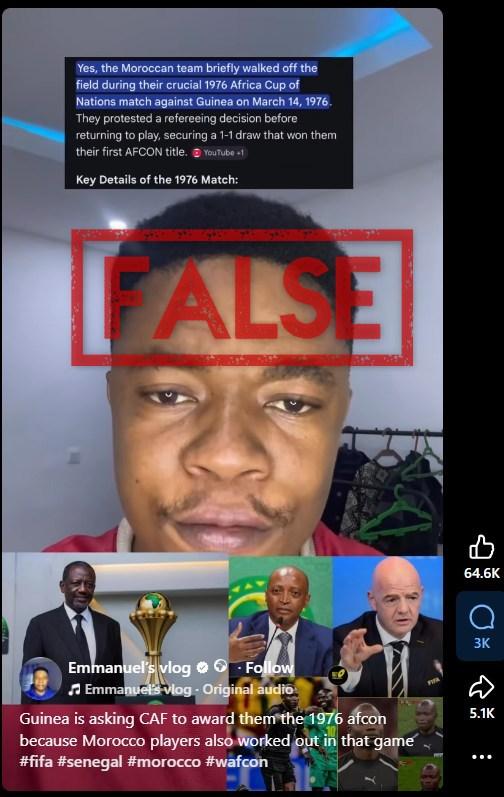
“Guinea is asking CAF to award them the 1976 AFCON because Morocco players also worked out in that game,” reads a Facebook post published on March 21, 2026, and shared more than 5,000 times.
A screenshot with text overlaid on the clip reads: “Yes, the Moroccan team briefly walked off the field during their crucial 1976 Africa Cup of Nations match against Guinea on March 14, 1976. They protested a refereeing decision before returning to play, securing a 1-1 draw that won them their first AFCON title.”
Several media platforms also published the claim, including Nigerian newspaper Daily Trust (here and here) and the French daily L'Équipe, which has since corrected its article and apologised (archived here).
Posts have been shared elsewhere on Facebook (see here, here, and here), on Instagram in English, and also in French (here and here).
They seem to rely on a video excerpt featuring sports commentator Remy Ngono, who made the claim on January 30, 2026, during the “Radio Foot” programme on Radio France Internationale (RFI).
However, the claims regarding the 1976 AFCON final are false.
Morocco ‘won fairly’
There is no full recording of the March 14, 1976, match readily available online or in archives accessible to AFP Fact Check. However, archival footage of key moments from the match offers no evidence that Morocco left the pitch (archived here).
AFP Fact Check contacted Ngono, but he has yet to respond.
We also spoke to eyewitnesses, including Chérif Souleymane, a Ballon d’Or winner and Guinean footballer who scored in that match (archived here).
Now 82, he denied the claim that the Moroccan team abandoned the field at some point during the match.
“No, no, that’s not true!” he told AFP Fact Check. “I scored the first goal, from a corner kick,” he recalled, and it didn’t cause “any incidents”.
“They won fairly, by the book. There was absolutely nothing wrong with it,” he reiterated.
Another Guinean player from that era, Ismaël Sylla, also dismissed the claim in an interview with TV5 Monde in French on March 20 (archived here).
“It’s false, it’s not true. The Moroccans didn’t leave the stadium after Chérif Souleymane’s goal. We continued playing until they equalised toward the end,” said the former midfielder, who was in his twenties during the tournament.
“The match proceeded normally. There were no incidents. Nothing!” he added.
Some listeners who followed the match on the radio share this memory. Among them, Mouctar Bah, a Guinean journalist working at the AFP bureau in Conakry, recalls following the match “from beginning to end” without any incident. Still “in high school at the time”, he had listened to the match commented on by Pathé Diallo on Radio Conakry and “trembled all over” at the time of Morocco’s equaliser.
No evidence of a walk-off
No articles or reports on the 1976 final mention a Moroccan walk-off. There is also no evidence of the alleged incident in this article by French magazine Jeune Afrique, nor in this French publication from the Moroccan Broadcasting and Television Company (archived here and here).
There is also no mention of the alleged incident in the FIFA or CAF archives (archived here and here).
Saïd El Abadi, a sports journalist and author of the book History of African Football, said that he found no reliable mention of such an event after reviewing numerous archives to write his book, particularly for a chapter on incidents that have marked African football.
“I never heard of it in any of the archives I consulted,” he told AFP Fact Check. “I also spoke with a great many people in Africa while researching this book, and I never heard of any incidents involving Morocco leaving the pitch during the 1976 Africa Cup of Nations.”
The journalist said accounts he gathered from Moroccan players involved in the final, whom he met in Rabat in January 2026, did not include any mention of a walk-off.
“They spoke of tension and a red card, but nothing out of the ordinary,” he said.
“If such an incident had occurred, it would have left a lasting impression and been widely reported,” he added, noting that no similar case had been recorded in AFCON history before this year’s tournament.
No appeal from Guinea
Claims that the Guinean Football Federation filed a petition to challenge the 1976 result are also false.
In a statement published on March 22, 2026, the federation denied the claim (archived here).
The statement, translated from French, said the local football body “has not initiated any proceedings, either with the Court of Arbitration for Sport (CAS) or with the Confederation of African Football (CAF), in connection with the 1976 Africa Cup of Nations”.
The body added that it recalls the 1976 AFCON did not have a “classic final”, but “a final group in the form of a mini-championship, the ranking of which directly determined the winner”.
“In this context, Morocco finished at the top of this final group and was regularly [in the sense “fairly” -- editor's note] crowned African champion” ahead of Guinea, the federation said.
Senegal’s appeal
Following CAF’s decision to award Morocco the 2025 trophy, the Senegal Football Federation (FSF) described the judgment as “unfair, unprecedented and unacceptable” and filed an appeal with the Court of Arbitration for Sport (CAS) in Lausanne, Switzerland, on March 25 (archived here, here, and here).
In their appeal, Senegalese football officials have called for the decision to be overturned, and for the national team to be declared winners of the AFCON (archived here).
In a press conference held the following day in Paris with the group of lawyers appointed by the FSF, its president, Abdoulaye Fall, stated that the Senegalese team was the victim of “the most blatant administrative heist in the history of our sport” (archived here).
“This is an attack against the federation, football, and the sporting discipline,” added Seydou Diagne, who is leading the group of lawyers.
According to Senegal’s legal team, Morocco, despite being declared champions, has not received the medals, prize money, or the trophy, as it had requested.
Senegal presented the trophy to its supporters during its friendly match against Peru on March 28, despite being stripped of the title (archived here).
Copyright © AFP 2017-2026. Any commercial use of this content requires a subscription. Click here to find out more.
Is there content that you would like AFP to fact-check? Get in touch.
Contact us