Letter accusing Eritrea of troop incursion into Ethiopia taken out of context
- Published on February 18, 2026 at 12:29
- 2 min read
- By Tolera FIKRU GEMTA, AFP Ethiopia
Ethiopia has accused Eritrea of troop incursions in a formal letter that drew a terse response from its neighbour. Posts shared on Facebook claim that Ethiopia also demanded Eritrea withdraw its forces from the Red Sea port of Assab, asserting the territory as its own. However, this is misleading: while the letter raises issues about access to Assab, Ethiopia did not order Eritrea to relinquish the strategic port.
"The Ethiopian government requested: ‘Eritrea must immediately withdraw its troops from Assab port, my territory," reads an Amharic Facebook post published on February 8, 2026.
Assab is a strategic port city in the southern Red Sea region of Eritrea.
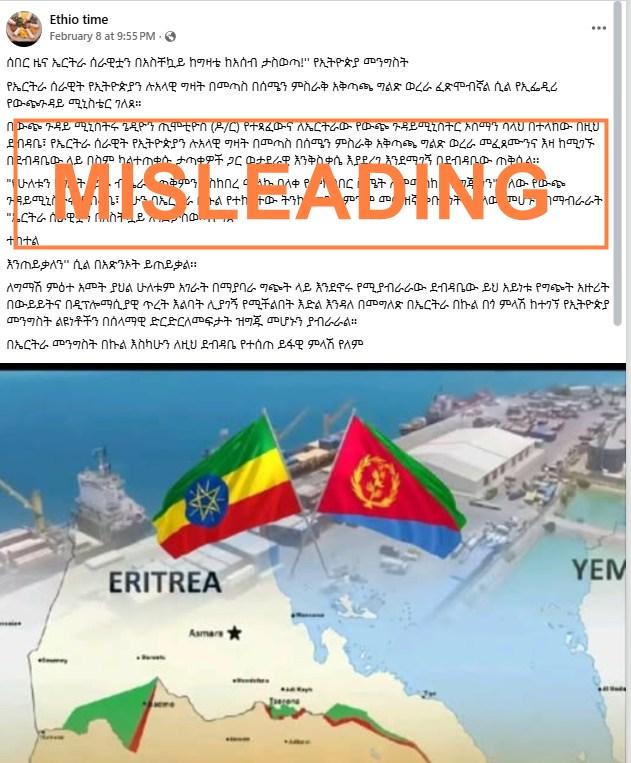
The post paraphrases a letter in which Ethiopia’s foreign affairs ministry accuses Eritrea of violating its sovereignty by carrying out “a clear incursion in the northeast”, known as the Tigray region.
“It adds that the current actions attributed to Eritrea are unacceptable under any circumstances and publicly calls on Eritrea to immediately withdraw its troops and commit to peaceful negotiations,” the post says, in reference to the letter.
Similar claims were shared elsewhere on Facebook the same day.
The two nations have long been enemies, but their rivalry eased during the Tigray war, which ended in 2022 (archived here).
The brief conciliation has since been upended by political upheaval in the Horn of Africa and regional power plays, among them Ethiopia’s insistence on gaining access to Assab Port, which became part of Eritrean territory after independence in 1993, leaving Ethiopia landlocked (archived here and here).
Eritrea denies pushing its troops into Tigray, but observers still fear a new conflict is brewing (archived here).
However, the claim that Ethiopia asked Eritrea in a letter to withdraw troops from Assab is misleading.
Letter to Eritrea
AFP obtained a copy of the letter, dated February 7, 2026, from social media, and its authenticity was confirmed with Ethiopia’s foreign affairs ministry the following day.
Although the diplomatic missive was not published on social media by the Ethiopian government, it was shared on X by diplomats and analysts here and here (archived here and here).
U.S. involvement is not necessary in every issue but the risk of renewed conflict between Ethiopia and Eritrea demands U.S. attention. Ethiopia is asking for discussions on a number of critical issues and such negotiations need high level support. War would be unimaginable! pic.twitter.com/d47fSJ9PxG
— Tibor Nagy (@TiborPNagyJr) February 8, 2026
In the letter, Ethiopia’s Foreign Affairs Minister Gedion Timotheos calls on his Eritrean counterpart Osman Saleh Mohammed to immediately withdraw troops from the Tigray region, accusing its neighbour of sovereign violations and conducting military operations in the northeast with rebel groups (archived here).
However, the letter also appeals for an end to escalating hostilities and expresses Ethiopia’s readiness to hold peaceful dialogue to resolve outstanding disputes between the two countries, including its desired access to Assab Port as part of its efforts to gain sea access.
“Ethiopia is willing to engage in good faith negotiations for a comprehensive settlement of all issues of mutual interest, including maritime affairs and the issue of access to the sea through the port of Assab,” the letter states.
However, nowhere does Ethiopia demand the withdrawal of Eritrean troops from Assab, nor does it claim the port as its own territory.
In response to the letter on February 9, 2026, Eritrea rejected the accusation, describing Ethiopia’s claims that Eritrean troops were present inside its territory as “false and fabricated” (archived here).
AFP Fact Check has previously debunked claims related to Assab Port here and here.
Copyright © AFP 2017-2026. Any commercial use of this content requires a subscription. Click here to find out more.
Is there content that you would like AFP to fact-check? Get in touch.
Contact us