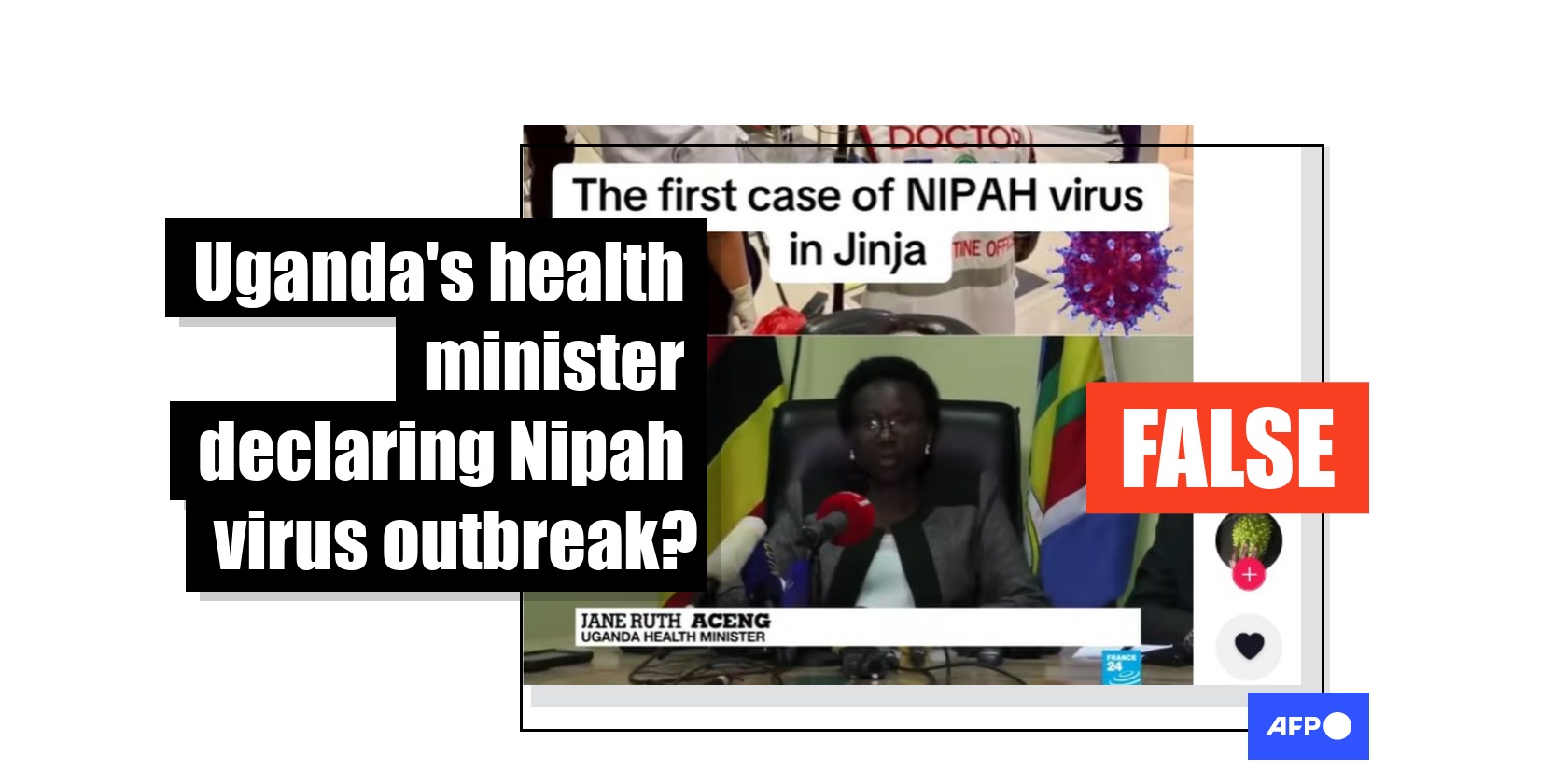
Old Ebola video resurfaces in posts falsely claiming outbreak of Nipah virus in Uganda
- Published on February 17, 2026 at 08:43
- 5 min read
- By Tolera FIKRU GEMTA, AFP Ethiopia
In late January 2026, Indian authorities confirmed two new Nipah virus cases in West Bengal state. Following the news, a video circulated on social media in Africa purportedly showing Uganda’s health minister confirming the first case of the virus in her country. However, the footage has been used deceptively; it was filmed in 2019 during a media briefing on Ebola transmissions in Uganda. There are no confirmed cases of Nipah virus in Uganda.
The text overlay at the top of a TikTok video published on January 30, 2026, reads: “The first case of NIPAH virus in Jinja,” while another one at the bottom adds: “3 suspects in Kasese.”
Jinja is a city in Uganda's eastern region, while Kasese is a municipality in the country's western region.

The post has been shared more than 11,500 times.
The clip contains video of what appears to be a press briefing in a boardroom, an image of health workers and a graphic of a virus molecule. A banner at the bottom of the clip reads: “Virus outbreak.”
The video shows Uganda’s Health Minister, Jane Ruth Aceng, speaking in front of the camera.
“One confirmed case, a five-year-old child,” says Aceng. “We have two probable cases whose blood samples are already with us, and we have three suspects who are already in the isolation facility.”
The clip then cuts to a narrator speaking in Luganda, one of Uganda's local languages.
“To prove to you that Nipah Virus is here. It is like Covid-19,” says the voice. “Since we came out of Covid-19, it (Nipah Virus) is a disease which has signs like those of Covid-19 and they say it is deadly.”
“They say in just one minute, it can kill 2,000 people. All countries have put border restrictions,” the voice concludes.
While the narrator speaks, health practitioners in full protective gear conducting safe burials and working in isolation facilities are seen on the screen.
The post was also shared on Facebook here.
Nipah virus
On January 26, 2026, India confirmed two cases of Nipah virus in the eastern state of West Bengal (archived here).
The country’s health ministry said that nearly 200 close contacts were traced and all tested negative, indicating the outbreak was effectively contained.
Nipah virus is a zoonotic disease, meaning it is an infectious disease that spreads between animals and humans. Symptoms include fever, headache, muscle pain, sore throat, coughing, breathing difficulties, vomiting and diarrhoea, typically appearing between three to 14 days after exposure (archived here).
There is no specific antiviral treatment for Nipah virus infection. Medical care is supportive, focusing on managing symptoms and complications such as respiratory distress or kidney dysfunction.
The virus was first identified in 1998 during an outbreak among pig farmers in Malaysia, and caused at least 17 deaths in India’s Kerala state in 2018.
However, the clip shared on social media does not show a Nipah virus outbreak confirmation in Uganda.
2019 Ebola outbreak
By using InVID-WeVerify to conduct reverse image searches on keyframes from the video, AFP Fact Check traced the original footage to a video published on YouTube on June 12, 2019, by France 24 (archived here).
“First case of Ebola in Uganda confirms spread of disease from DRC,” the video’s title reads.
Ebola is a severe and often fatal disease affecting humans and other primates, and spreads through direct contact with the bodily fluids of an infected person (archived here).
The 90-second report covered an Ebola outbreak that spread into Uganda from the neighbouring Democratic Republic of Congo (DRC).
About 22 seconds into the original footage, Aceng talks about the confirmed and suspected Ebola cases. The TikTok clip was taken from this segment.
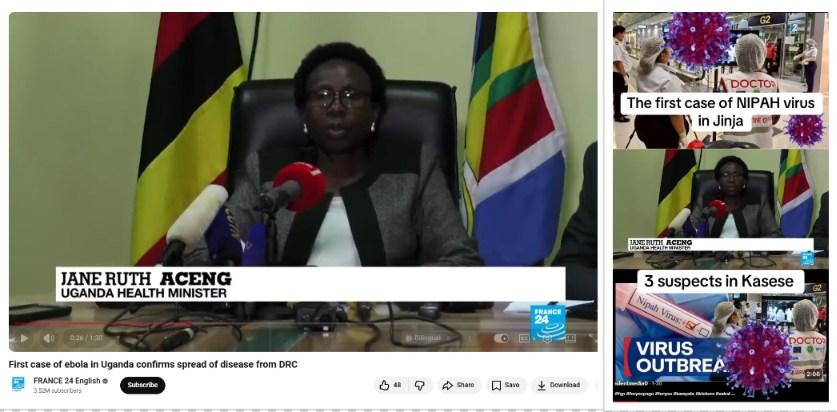
The footage in the TikTok clip corresponds with the 0’19 -1’02’’ segment of the France 24 report. However, at 0’44’’, immediately following Aceng’s remarks, the reporter’s voice is replaced with different audio, while the footage continues without alteration.
The photo seen at the top and bottom of the TikTok clip is not part of the original video and is unrelated to Uganda.
Reverse image searches reveal that the image shows Thai health officials wearing protective masks while screening international passengers for Nipah virus at Suvarnabhumi Airport in Samut Prakan province in Bangkok, Thailand, on January 25, 2026 (archived here).
Aceng makes no mention of Nipah virus in the original video or the false one.
Uganda’s health ministry also denied the claims in the video on February 3, 2026 (archived here).
PRESS RELEASE: The video circulating on social media alleging an outbreak of Nipah Virus is false.
— Ministry of Health- Uganda (@MinofHealthUG) February 3, 2026
Please note that #Uganda has NOT registered any outbreak of Nipah Virus. #MOHatWorkpic.twitter.com/AJ8MOtD3XH
“The Ministry of Health informs the public, partners, and the international community that a video circulating on social media alleging an outbreak of Nipah virus in Uganda is false,” reads the statement.
“Uganda has not registered any case or outbreak of Nipah virus,” it adds. “To date, no alerts, samples, or laboratory results suggestive of Nipah virus have been received or confirmed.”
The ministry further urged the public to “disregard the circulating video and avoid sharing unverified information”, warning that “misinformation can generate unnecessary fear”, adding that “any verified public health threat” would be communicated through official channels.
AFP Fact Check found no credible reports or updates from the World Health Organization (WHO) confirming positive cases of Nipah virus in Uganda.
Covid-19 vs Nipah virus
The additional claim that the Nipah virus “looks like” or behaves like Covid-19 is inaccurate (archived here and here).
Covid-19, caused by the SARS-CoV-2 virus, spreads efficiently through airborne transmission, which allowed it to cause a global pandemic in 2020. In contrast, Nipah virus is primarily zoonotic, transmitted from animals -- particularly fruit bats -- to humans, often through contaminated food or close contact with infected individuals. Sustained human-to-human transmission has been limited in past outbreaks.
Although both diseases may begin with similar nonspecific symptoms such as fever and headache, they differ markedly in progression. Covid-19 typically affects the respiratory system, with symptoms advancing to severe respiratory complications such as pneumonia. Nipah virus is more likely to cause severe neurological complications, including encephalitis -- inflammation of the brain -- which can result in seizures and coma.
Nipah virus is also generally far less contagious than Covid-19, but has a higher fatality rate (archived here). Unlike Covid-19, for which multiple vaccines were developed and deployed globally, significantly reducing severe illness and death, there is no currently approved vaccine for Nipah virus. Past outbreaks of the disease have recorded a fatality rate ranging from 40 to 75 percent, according to the WHO (archived here).
Additionally, the assertion that Nipah virus can kill 2,000 people in a minute is scientifically unfounded. The virus spreads slowly through direct contact with infected animals or individuals, and not via airborne transmission like Covid-19, making such an immediate and high death toll unrealistic (archived here).
Finally, keyword searches regarding border restrictions linked to Nipah virus outbreaks found no evidence of any countries that have imposed formal travel bans in response, contrary to the claim in the audio.
The WHO explicitly stated that it did not recommend travel or trade restrictions owing to Nipah virus (archived here).
A review of the TikTok account “silentmedia0” that published the clip shows that it has repeatedly shared false claims about a Nipah virus outbreak in Uganda.
The audio appears to be personal commentary added by the account owner.
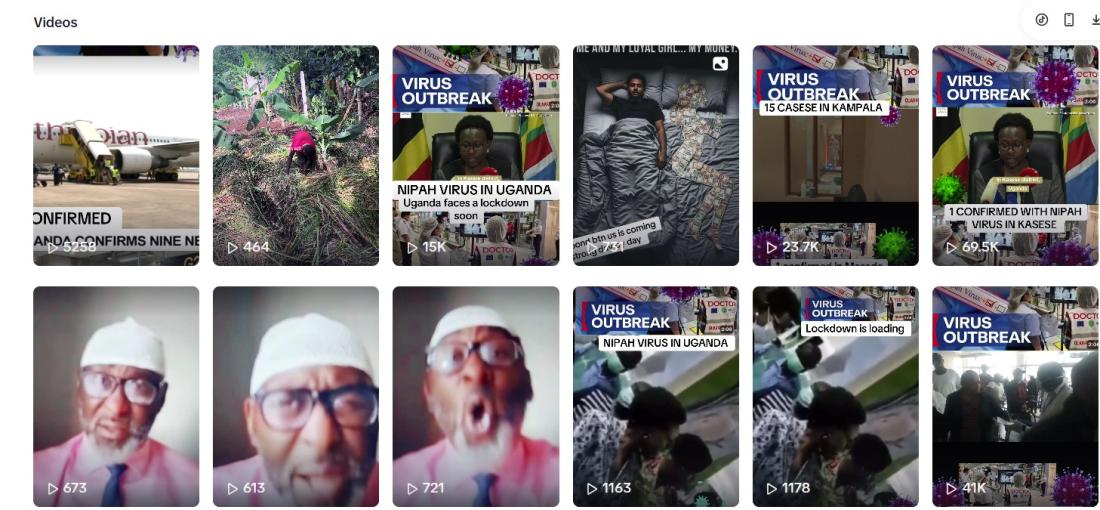
AFP Fact Check has previously debunked claims related to Nipah virus here and here.
Copyright © AFP 2017-2026. Any commercial use of this content requires a subscription. Click here to find out more.
Is there content that you would like AFP to fact-check? Get in touch.
Contact us