Declassified US records misrepresented in false claims about 1980 S. Korean pro-democracy movement
- Published on January 10, 2026 at 09:09
- 3 min read
- By Hailey JO, AFP South Korea
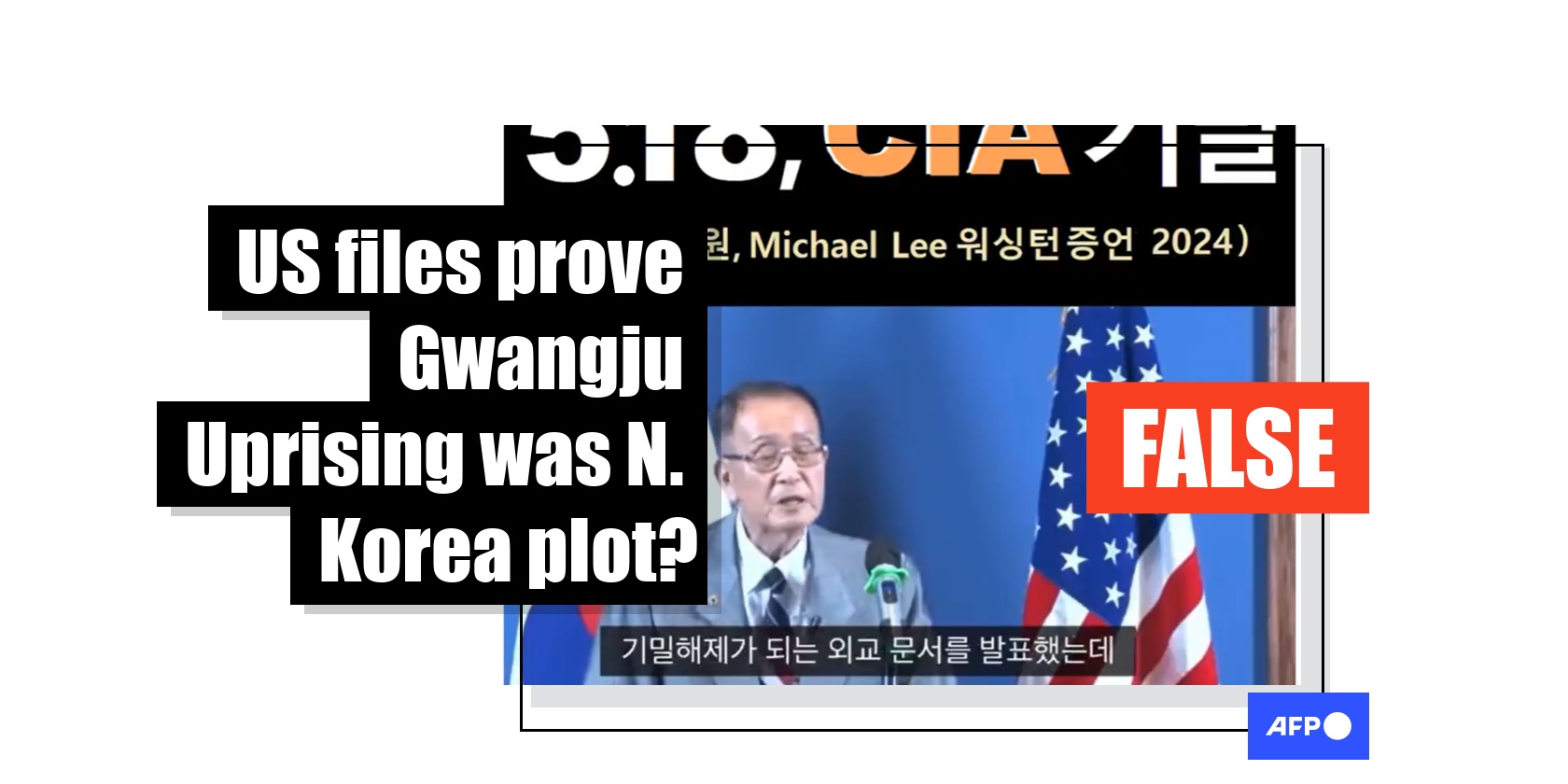
Conservatives in South Korea still believe the country's pro-democracy Gwangju Uprising in the 1980s was backed by Pyongyang. A speech from a supposed former Central Intelligence Agency (CIA) agent has circulated online where he baselessly claimed declassified US government documents provided proof of the claim. The records he mentioned in fact attribute the assertion to the South Korean military without endorsing it, while other US records from the same period reject claims of involvement from the North.
"US CIA documents related to the May 18 Gwangju were declassified in May 2020. Michael Lee, who was a CIA agent at the time in May 1980, testifies the facts surrounding it," reads the Korean-language caption of a clip shared on X on November 9, 2025.
The video shows Lee standing in front of South Korean and US flags speaking at an event at a restaurant in Annandale, a suburb of Washington, in June 2024 (archived here and here).
Some media reports have said Lee worked for the CIA for over two decades, dealing with North Korean intel, but AFP was unable to independently verify his past affiliation with the agency (archived here and here).
"On May 10, 2020, the US CIA and the State Department released declassified diplomatic documents. I'll say this exactly as it was stated word for word," he says in the circulating video.
"The May 18 Gwangju incident was a riot caused by North Korean agents with the aim of overthrowing the state. This is the stance of the US government."
Conservatives in South Korea still consider the 1980s pro-democracy movement -- when demonstrators protesting against dictator Chun Doo-hwan's declaration of martial law confronted his troops and 10 days of violence ensued -- as a Communist-inspired rebellion backed by the North (archived link).
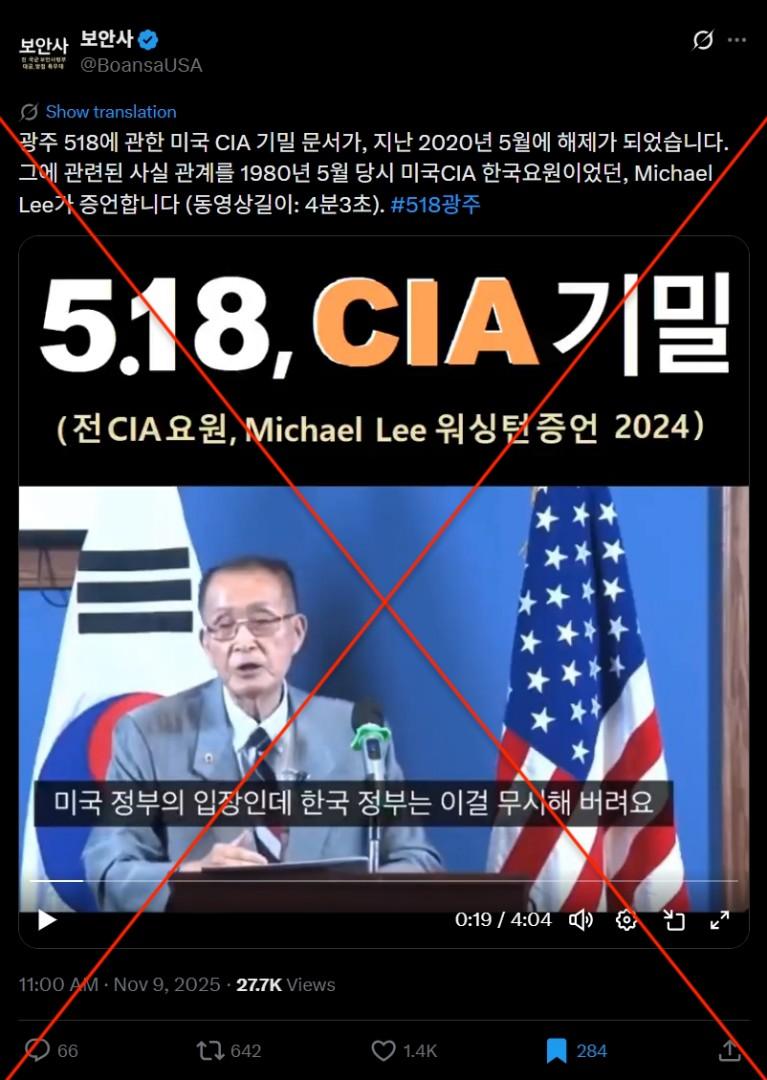
The clip was shared elsewhere on Facebook, as well as on Threads.
Over the past decades, including in May 2020, the US government has released batches of previously classified records on the Gwangju Uprising (archived here and here).
However, keyword searches on Google and in US government databases found the document Lee is citing does not represent a conclusion by the United States.
Seoul's claim, not Washington's
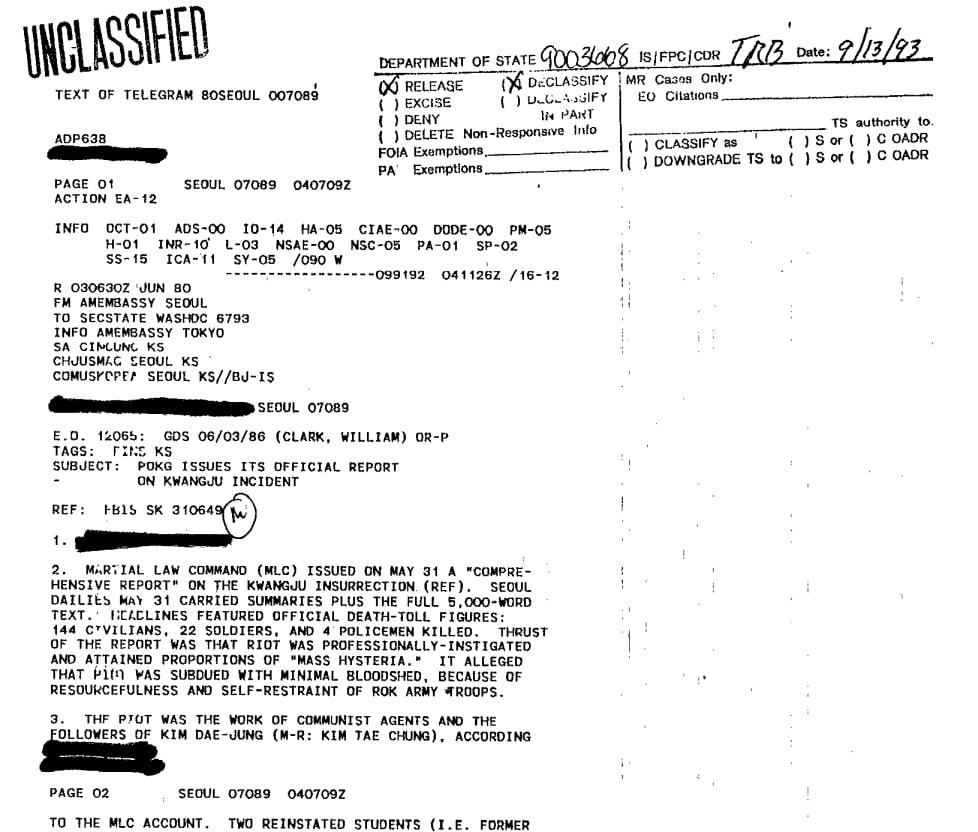
A declassified June 3, 1980 diplomatic cable sent from the US embassy in Seoul to the Secretary of State in Washington, some parts of which remain redacted, states, "Martial Law Command (MLC) issued on May 31 a 'comprehensive report' on the Kwangju insurrection" (archived link).
It goes on to summarise the report from the South's military leadership at the time, stating, "It alleged that plot was subdued with minimal bloodshed, because of resourcefulness and self-restraint of ROK Army troops," using South Korea's official name, the Republic of Korea (archived link).
"The plot was the work of communist agents and the followers of Kim Dae-jung (M-R Kim Tae Chung), according… to the MLC account," it adds -- without supporting or endorsing the allegations of North Korean involvement in the uprising.
Gwangju -- previously spelt "Kwangju" -- was a key stronghold for Kim, who was a prominent opposition politician and democracy campaigner hailing from the surrounding Jeolla region.
He later served as president from 1998 to 2003 and won a Nobel prize for brokering peace talks with North Korea (archived link).
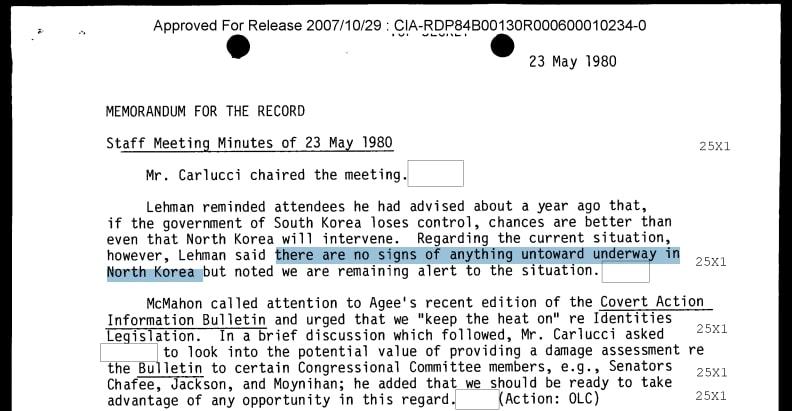
Separate CIA records from May 21 and May 23, 1980 also note there were "no signs" from North Korea related to the Gwangju Uprising and describe the incident as a domestic movement (archived here and here).
Landon Hancock, a professor in the School of Peace and Conflict Studies at Kent State University, told AFP on January 9, 2026, that he has seen no evidence the uprising in Gwangju was Communist-inspired (archived link).
He said his review of the declassified cables between the US embassy in Seoul and State Department Headquarters in Washington from around November 1979 through 1980 found "no direct accusation of North Korean involvement".
Similarly, Dr Donald Baker, a professor in Korean history at the University of British Columbia who witnessed the uprising in Gwangju firsthand, told AFP on January 9, 2026 that the documents indicate the United States was concerned about possible North Korean intervention amid the unrest (archived here, here and here).
However, he noted US intelligence assessments found "no change" in the North's military posture along the demilitarised zone in May 1980.
Baker also dismissed claims about Washington's stance on the uprising, saying it was "never an official position of the US government that the Gwangju Uprising was a North Korean plot".
AFP has previously debunked false claims about Gwangju here, here and here.
Copyright © AFP 2017-2026. Any commercial use of this content requires a subscription. Click here to find out more.
Is there content that you would like AFP to fact-check? Get in touch.
Contact us