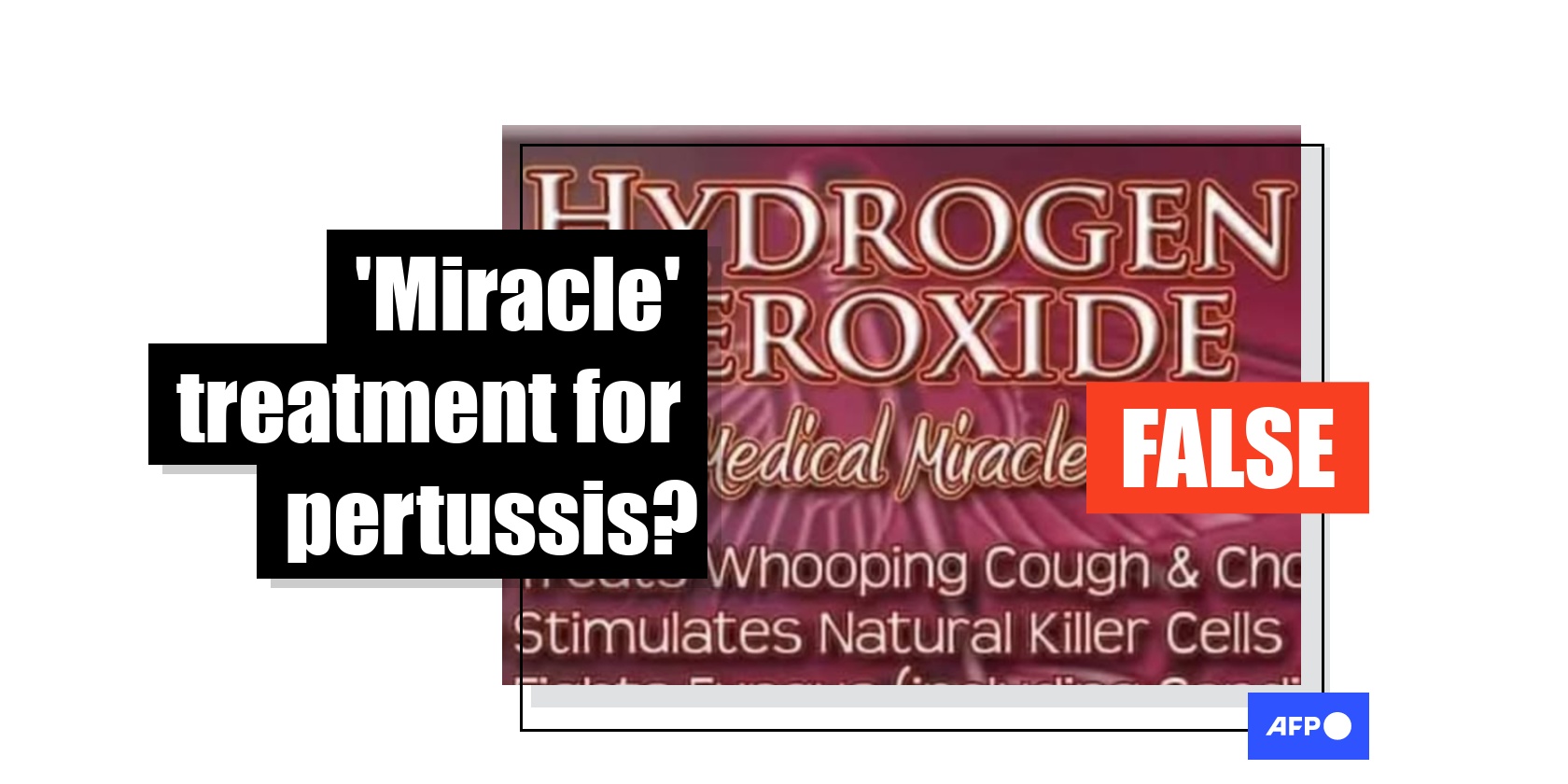
Hydrogen peroxide is not a treatment for whooping cough
- Published on December 4, 2025 at 19:36
- 3 min read
- By Marisha GOLDHAMER, AFP USA
Whopping cough cases in the United States reached levels in 2025 far higher than before and during the Covid-19 pandemic. But social media posts recommending hydrogen peroxide as a remedy are misguided; the illness can be prevented with vaccination and fought with antibiotics, experts said, while the liquid composed of hydrogen and oxygen is an unproven and potentially dangerous treatment.
"Hydrogen peroxide is one of the few 'miracle substances' still available to the general public," says a November 14, 2025 Facebook post. "It is safe, readily available, and dirt cheap. And best of all, it works!"
The post shares an image detailing multiple uses for hydrogen peroxide, including as a treatment for whooping cough.

The same image has spread across Facebook, Instagram and TikTok as far back as 2012, regaining popularity in October and November as respiratory illness cases begin to tick up in North America.
The text is correct that hydrogen peroxide can effectively disinfect surfaces and kill E. coli and salmonella (archived here). It is also used in mouthwash, toothpaste and for whitening clothes (archived here, here and here).
But experts said the solution is not effective at treating whooping cough.
Treatment
Whooping cough, also called pertussis, is a highly contagious illness caused by a bacterial infection (archived here).
Symptoms can progress to extreme coughing fits and, in babies, lead to gagging or struggling to breathe. The disease is unusual in that most children catch it from adults who are carrying it with only mild symptoms.
"The only way to cure that is with antibiotics," said Kari Guffey, co-coordinator for the graduate pediatric nurse practitioner program at the Baylor University School of Nursing (archived here). "One round of azithromycin or a macrolide will cure pertussis."
She recommended December 2 that parents with concerns about a child's cough seek medical care. Antibiotics are more effective when taken early in the illness (archived here). Given the transmissibility of the bacteria, the entire family may be offered treatment.
The child's cough may temporarily persist, but antibiotics "decreases their illness significantly," said Guffey, who works as a nurse practitioner in pediatric critical care in Texas.
Unproven and dangerous remedies
False claims that inhaling hydrogen peroxide can cure respiratory illnesses have persisted since the Covid-19 pandemic.
Some social media posts recommend adding hydrogen peroxide to a nebulizer, but the Asthma and Allergy Foundation of America warns strongly against breathing in the solution (archived here).
Guffey agreed that there is no good reason to use it in a nebulizer or humidifier.
"It certainly is not going to do anything effectively to a bacteria that's now settling in the child's airway," she said. "In fact, it could irritate the airway and make them cough even more."
Other posts suggested putting drops of hydrogen peroxide in a sick child's ear. But Zach Farley, assistant professor of public health at Western Kentucky University, said in a December 2 email that "there is simply no biological mechanism by which putting drops in the ear could address a bacterial infection in the lungs and airways" (archived here).
Additional posts push the substance as a cancer treatment, but experts say there is no evidence to support such use.
Drinking hydrogen peroxide is also dangerous. It can cause tissue damage and headaches, dizziness, nausea, and vomiting, according to the Agency for Toxic Substances and Disease Registry, part of the US Department of Health and Human Services (archived here).
AFP previously reported on similarly unproven remedies for influenza and respiratory syncytial virus.
Prevention
To prevent whooping cough, the DTaP vaccine series -- which protects against diptheria, tetnus and pertussis -- is given to infants and young children (archived here). The Tdap boosters are administered to adults and recommended during the third trimester of pregnancy to help protect newborns (archived here).
"Vaccination is unequivocally the most effective prevention strategy we have in our toolkit," Farley told AFP.
Vaccination dramatically cut infection rates and subsequent deaths against whooping cough (archived here). Before it became wildly available via the combination DTaP shot in the 1940s, as many as 9,000 children died annually in the United States (archived here).
But the data from the US Centers for Disease Control and Prevention showed preliminary case report numbers were "elevated in 2025 compared to immediately before the pandemic" (archived here).
Farley said the case increase "coincides with a reduction in vaccine coverage among children in the United States."
Routine vaccination rates for kindergarten children in the United States have fallen since 2019, with requests for exemptions from school mandates increasing (archived here).
In 2024, there were 10 deaths reported, and the state of Kentucky has reported three deaths in unvaccinated children in the last 12 months (archived here and here).
"From a public health professional perspective, these deaths are a terrible and unacceptable occurrence, as most cases of and deaths from whooping cough are preventable through vaccination and monitoring of early warning signs," Farley said.
In addition to vaccination, experts recommend good hygiene, including thorough handwashing and covering coughs, to prevent infection (archived here).
Find more of AFP's reporting on health misinformation here.
Copyright © AFP 2017-2026. Any commercial use of this content requires a subscription. Click here to find out more.
Is there content that you would like AFP to fact-check? Get in touch.
Contact us