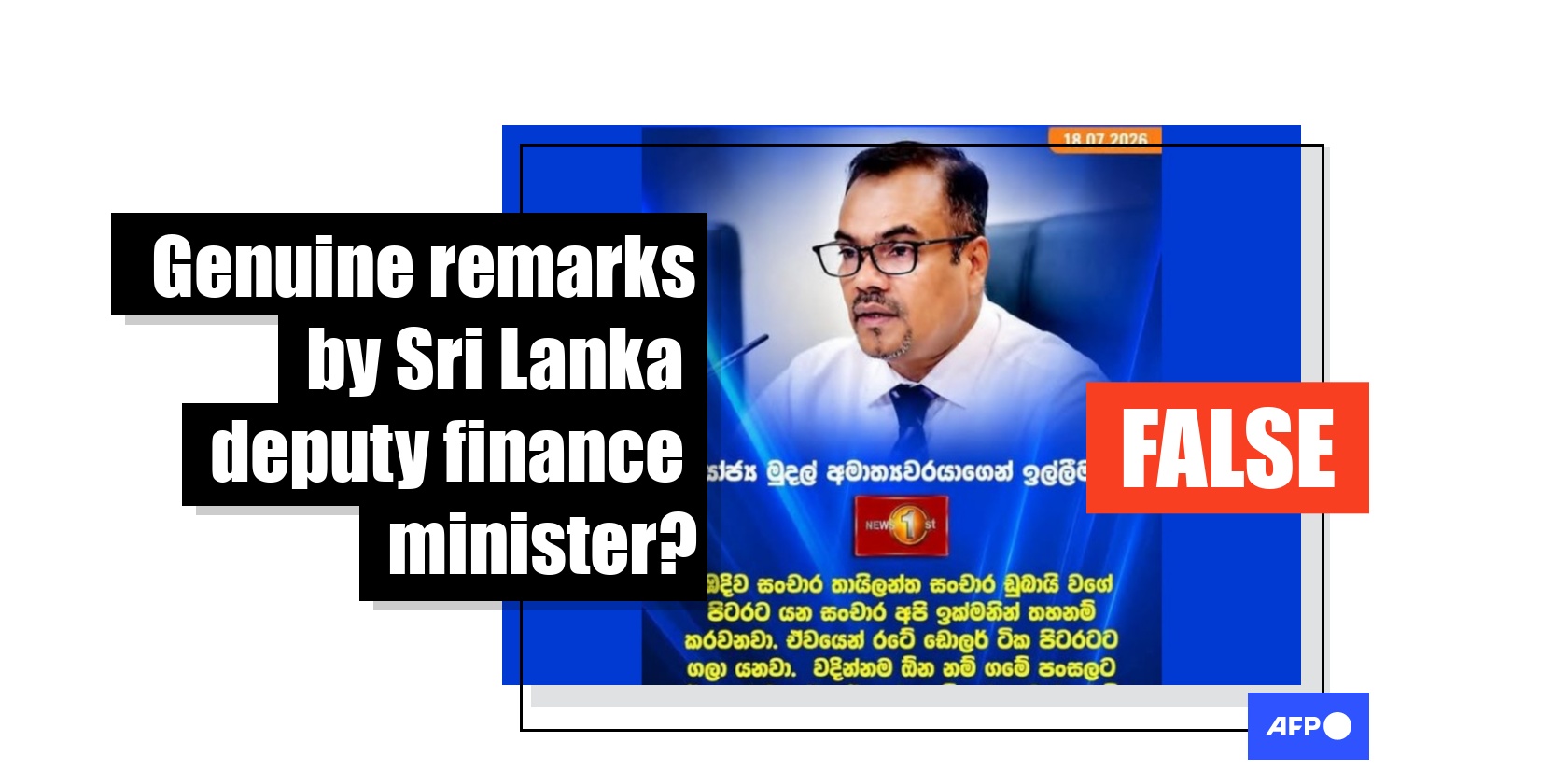
Officials reject false claim of foreign travel ban on Sri Lankan nationals
- Published on August 7, 2026 at 11:14
- 3 min read
- By Harshana SILVA, AFP Sri Lanka
Sri Lanka's rupee depreciated and its foreign reserves fell in the first half of 2026, but the South Asian country had not barred its citizens from travelling overseas in an attempt to curb the outflow of foreign currencies, contrary to a false claim circulating online. The news outlet that has supposedly reported on the ban said the graphic in the false posts did not come from them, while the minister targeted in the claim said he has never made the announcement.
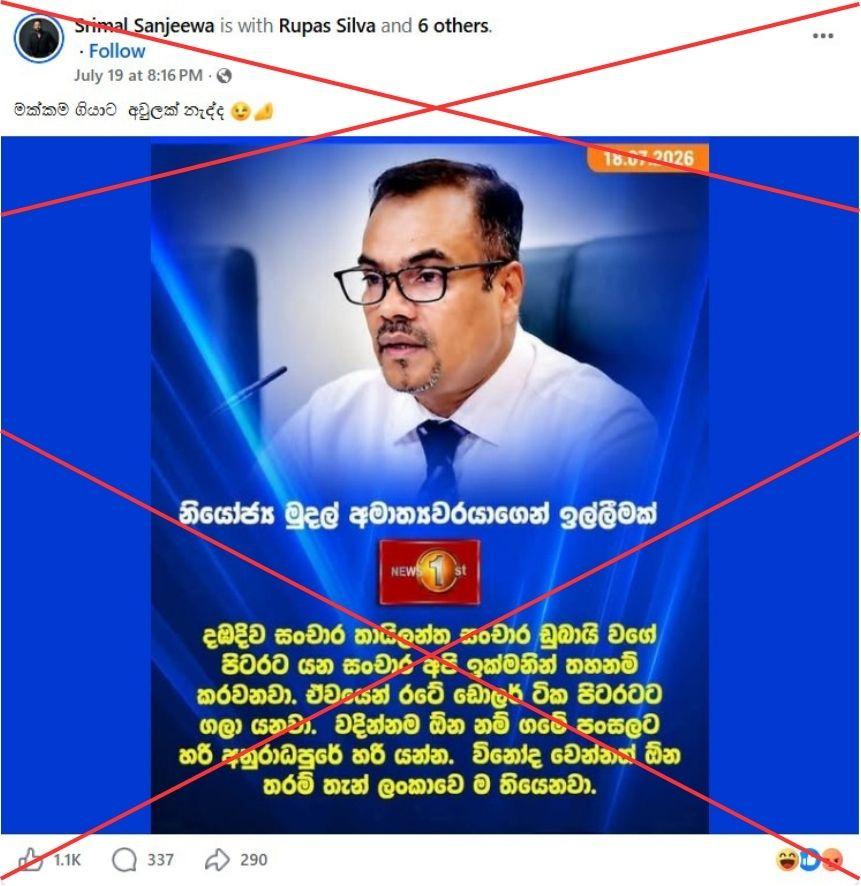
The purported ban was reported in a news graphic containing a quote attributed to Deputy Finance Minister Anil Jayantha Fernando (archived link).
"We will soon ban foreign trips like Dambadiva, Thailand and Dubai. These are the ones that drain the country's dollars," reads a Sinhala-language overlaid text on an image shared on Facebook on July 19, referring to pilgrimage sites mostly found in India visited by Sri Lankan Buddhists annually (archived link).
"If you want to go, go to the village temple or Anuradhapura. There are enough places in Sri Lanka to have fun."
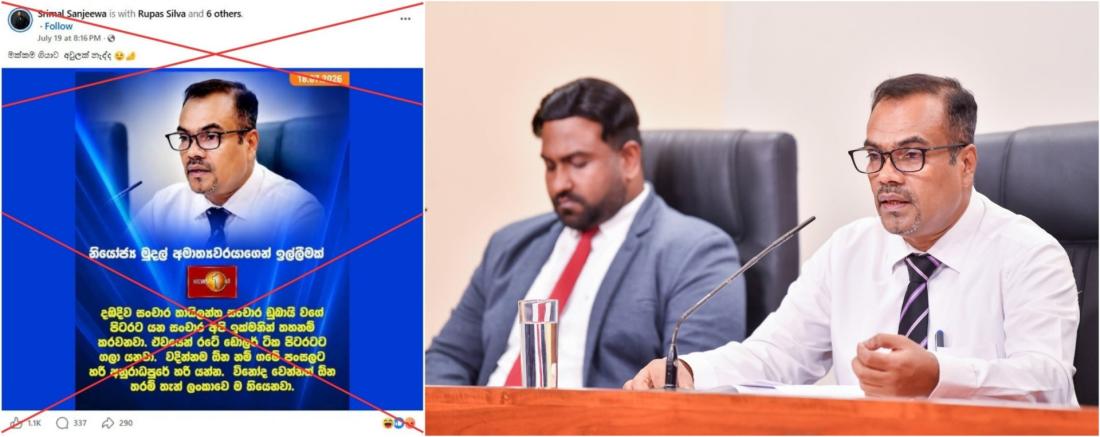
The image appears to mimic news graphics from Sri Lankan broadcaster Newsfirst and includes a photo of Jayantha speaking before a mic (archived link).
The Sri Lankan rupee has weakened by 7.9 percent during the first half of 2026 while official reserves have declined, according to the Central Bank of Sri Lanka (archived here and here).
"Although the Sri Lanka rupee recorded a slight appreciation in the early months of the year, it depreciated notably during the first half of 2026, reflecting heightened pressures on the external sector," the Central Bank wrote in its June 2026 report.
Similar claims were shared elsewhere on Facebook, as Sri Lanka was hit by the Middle East crisis while still recovering from its worst economic downturn in 2022.
Sri Lanka raised petrol and diesel prices by nearly 50 percent after the United States and Israel launched attacks on Iran on February 28, triggering a surge in energy costs (archived link).
The South Asian country imports all of its oil and also relies on imported coal for power generation. It has warned that any prolonged conflict in the Middle East could threaten its fragile economic recovery.
Comments from some users suggested that they believed the purported news graphic was authentic.
"Many people travel for various reasons, including visiting important places such as Jerusalem, France, and Italy for Christians and Mecca for Muslims. Then you can't limit it only to Buddhists," one commented.
"These people are atheists, irreligious, rootless with no nation; temples and sacred places are allergic to them. If tourists in other countries see these and their authorities tell them 'Don't go to Sri Lanka, we need to save dollars,' how will that be ?" another wrote.
However, the graphic is not genuine.
No foreign ban
Jayantha denied he said the quote attributed to him in the purported news graphic in a WhatsApp message to AFP on July 23.
"This is total fabrication," he said.
The Ministry of Labour has also rejected the claim, according to a statement published on July 20 seen by AFP (archived link).
"It appears that this alleged statement falsely attributed to the minister, which says that the minister is preparing to ban religious pilgrimages to Dambadiva and Thailand, is being disseminated by a group with narrow political objectives to destroy the socio-political and religious harmony in Sri Lanka," the statement said.
A reverse image search on Google and a keyword search on Facebook found that the photograph used in the purported news graphic was published by the official Facebook account of the president's Media Division on December 26, 2024 in a post saying it shows the minister at a press conference on policies to stabilise Sri Lanka's economy (archived link).
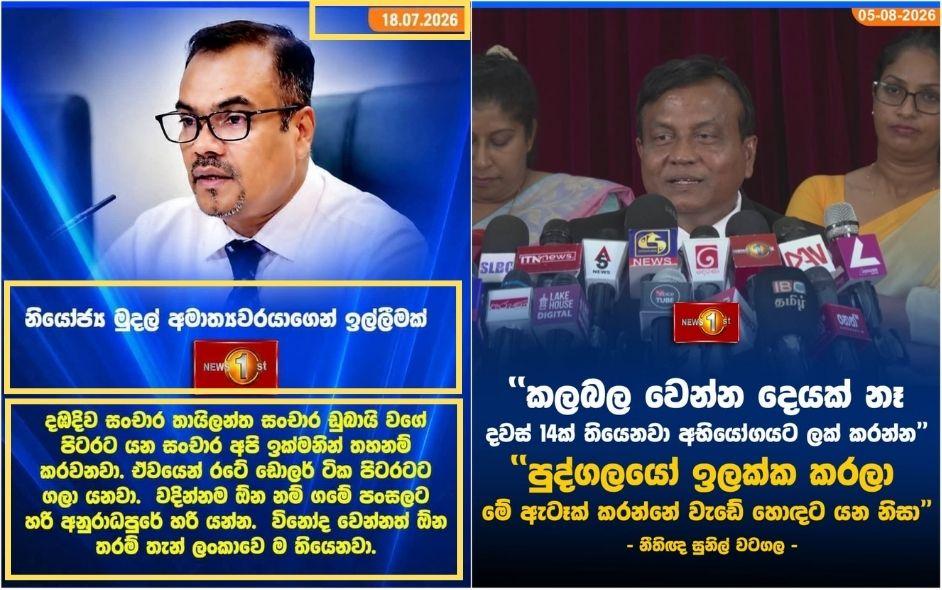
Newsfirst also denied publishing such a report or social media post in an email to AFP on July 27.
The fabricated graphic bears small differences in design from genuine Newsfirst graphics.
Its logo usually appears above the text, but it is placed in the middle in the fabricated graphic.
The outlet's usual superimposed texts are gold-yellow, whereas the colours on the purported graphic are green and yellowish.
The date stamp in the top-right corner of the official news graphic is also enclosed in an ellipse with a clipped corner, while the false graphic sets it against a rectangular box with round edges.
AFP has previously debunked false quotes attributed to Sri Lankan government ministers.
Copyright © AFP 2017-2026. Any commercial use of this content requires a subscription. Click here to find out more.
Is there content that you would like AFP to fact-check? Get in touch.
Contact us