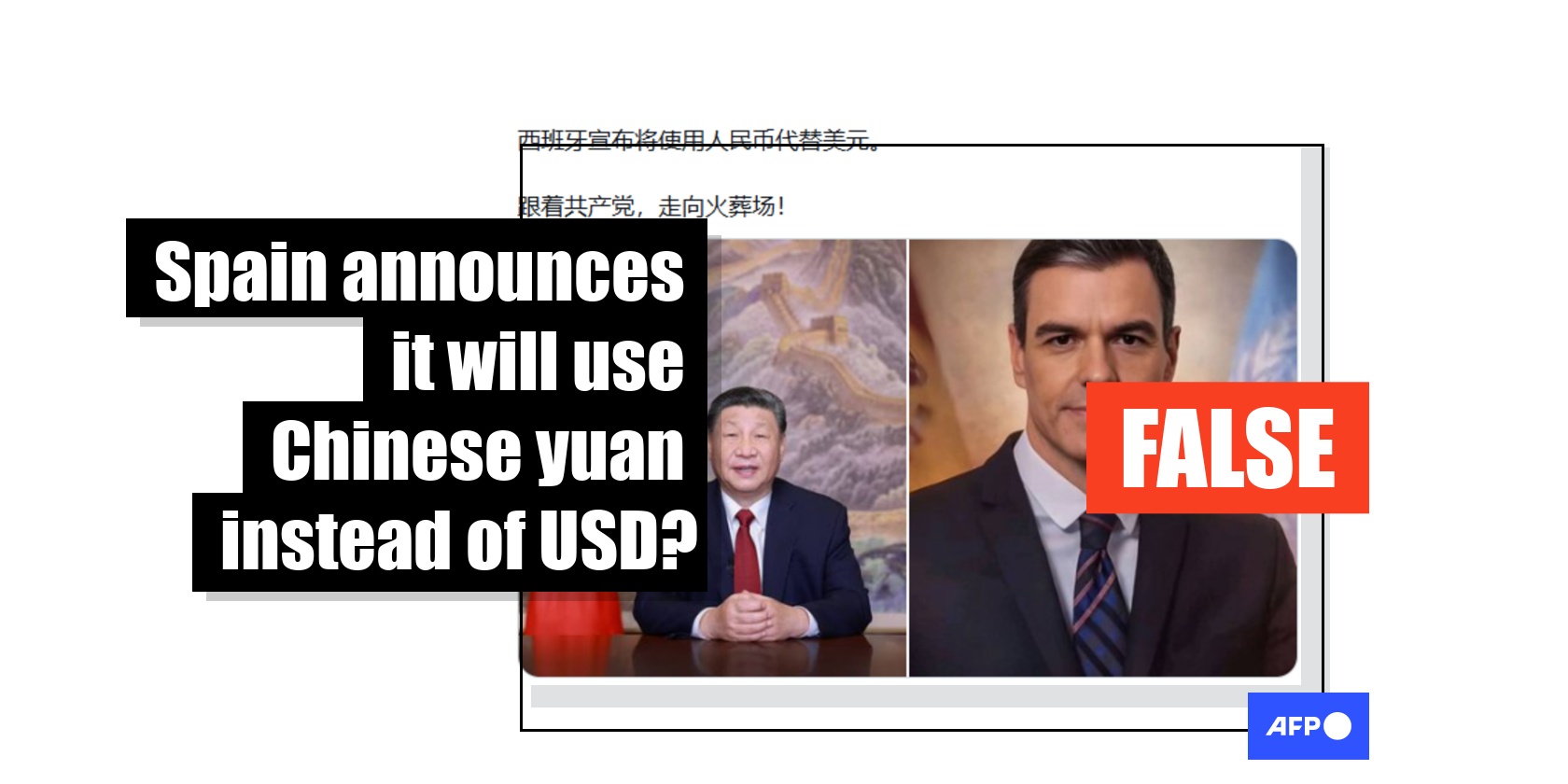
Spanish authorities refute false claims of adopting Chinese currency over dollars
- Published on August 7, 2026 at 09:21
- 3 min read
- By Sammy HEUNG, Cristina ALONSO PASCUAL, AFP Hong Kong, AFP Spain
After US President Donald Trump threatened to cut off trade relations with Spain following a tense meeting with NATO leaders in early July, social media posts falsely claimed that Madrid had announced plans to replace its use of US dollars with the Chinese yuan. But Spanish authorities have denied issuing any such directive and annual reports from the Bank of Spain indicate that the country continues to hold assets in US dollars.
"Spain announces it will use the renminbi to replace the dollar. Follow the Communist Party, head to the crematorium!" the simplified Chinese X post published on July 16, 2026 wrote.
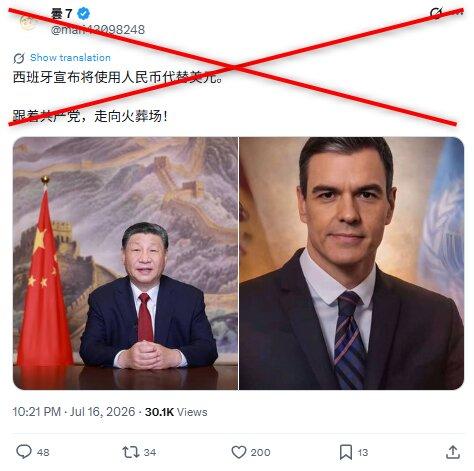
The claims surfaced after Trump described Spain as a "terrible partner in NATO" at the annual summit held in Turkey from July 7 to 8 as a bitter row unfolded over Madrid's defence spending and failure to help Washington with the Iran war (archived link).
Spanish Prime Minister Pedro Sanchez later said his country's ties with the United States were "very positive" despite the threat, adding that they had "an informal chat" about football where there was "no kind of tension" (archived link).
Earlier in March, Trump also threatened to sever all trade ties with Spain after Madrid refused to let US planes use its airspace to attack Iran.
Similar claims of Spain's supposed announcement appeared on X posts in Chinese and Turkish, as well as on Facebook, YouTube, Instagram and TikTok in English.
'No directive'
Spain joined the European Communities -- the predecessor of the European Union (EU) -- in 1986 and has used the euro as its official currency since 1999 instead of the US dollar or yuan (archived link).
The Spanish Ministry of Economy, Trade and Business has denied issuing any directive on the currency requirements for international trade.
"There is no directive from any European or national authority in the sense suggested by the [claim], nor does any EU trade agreement contain any provisions on the currency of billing, the choice of which is left entirely to the parties to each contract in accordance with their commercial interests," its press department told AFP on July 24.
Professor Chong Tai-leung, executive director of the Lau Chor Tak Institute of Global Economics and Finance at the Chinese University of Hong Kong, said governments have no authority over the currency that businesses use for international trades, as the decision is agreed between the operators, which is a practice adopted across the globe.
"If the government is selling something, it can choose what it accepts, that's up to them,” he told AFP on July 31.
Spain's foreign reserves
The Bank of Spain's annual accounts from 2025 show that 73.9 percent of its international reserve assets are in US dollars, with just one percent in Chinese renminbi (archived link).
These include current accounts, deposits, investment fund shares, debt security investments in the trading and held-to-maturity portfolios and other claims on non-euro area residents denominated in foreign currency.
Gary Ng, senior economist for Asia-Pacific at Natixis Corporate and Investment Bank, told AFP that the yuan's importance is rising in terms of China-related trade and investment, but "it is far from challenging" the global status of the US dollar or the euro.
"Yuan usage will likely grow in China-related transactions, but Beijing will need to open its financial markets far more before it can challenge the euro and the USD on the global stage. Beyond trade, China is trying to develop the yuan into an investing and financing currency."
China's President Xi Jinping has called for the country to have a "strong currency" that is widely used in "international trade, investment, and foreign exchange markets, and that holds the status of a global reserve currency" in February 2026 (archived link).
AFP has previously debunked misinformation related to currencies.
Copyright © AFP 2017-2026. Any commercial use of this content requires a subscription. Click here to find out more.
Is there content that you would like AFP to fact-check? Get in touch.
Contact us