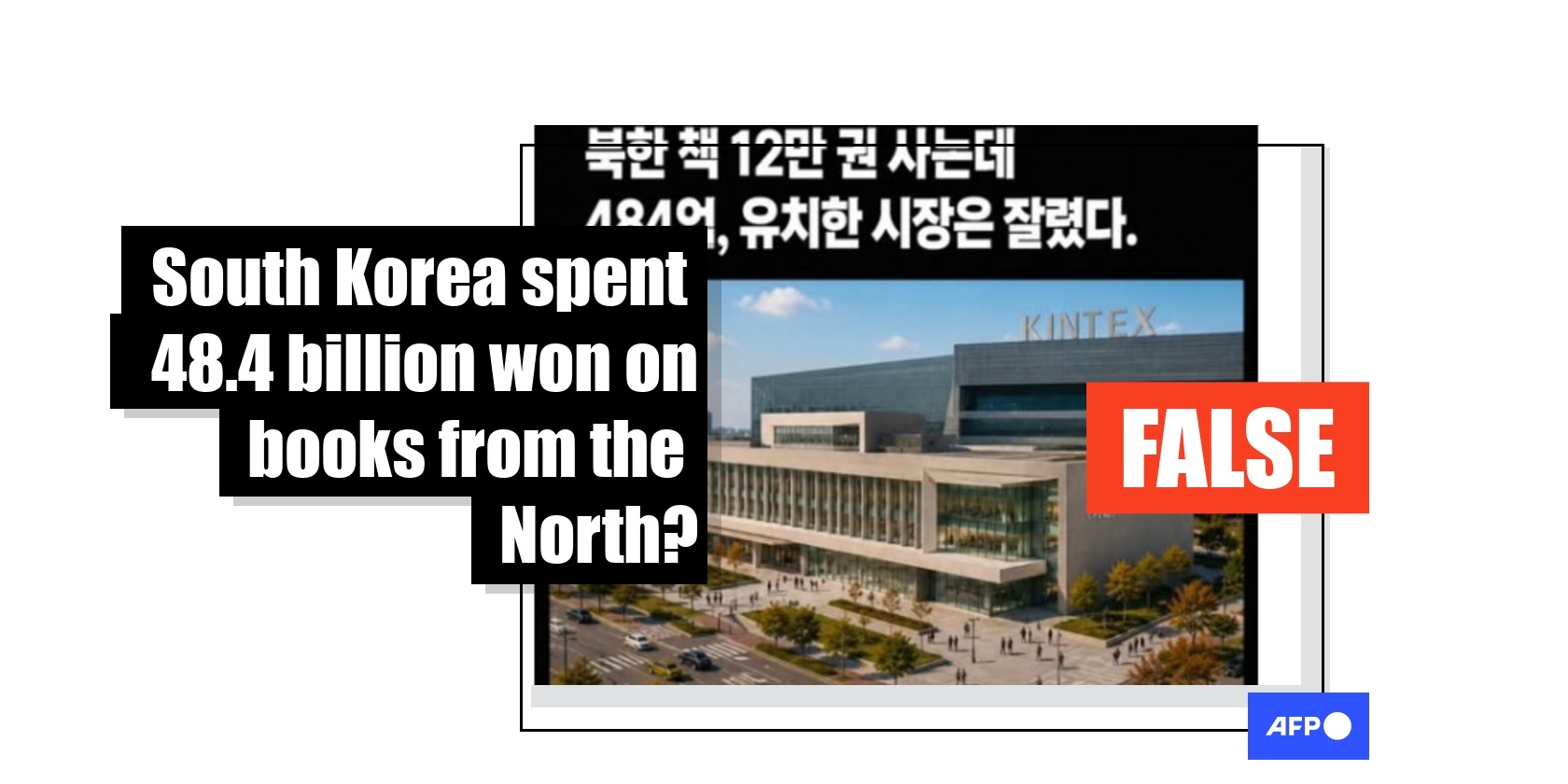
Posts spin false tale of South Korea library costs masking financial support to Pyongyang
- Published on July 31, 2026 at 08:58
- 3 min read
- By Hawon Jung, AFP South Korea
Ahead of the opening of a new library dedicated to unification and North Korea, posts falsely claimed the South Korean government was indirectly providing support to Pyongyang by spending nearly 50 billion won (US$34.8 million) to stock the facility with North Korean books. The figure in fact refers to the entire cost of the project and covers land acquisition and construction. An official told AFP a majority of the materials in the collection will come from existing archives currently housed at the national library in Seoul.
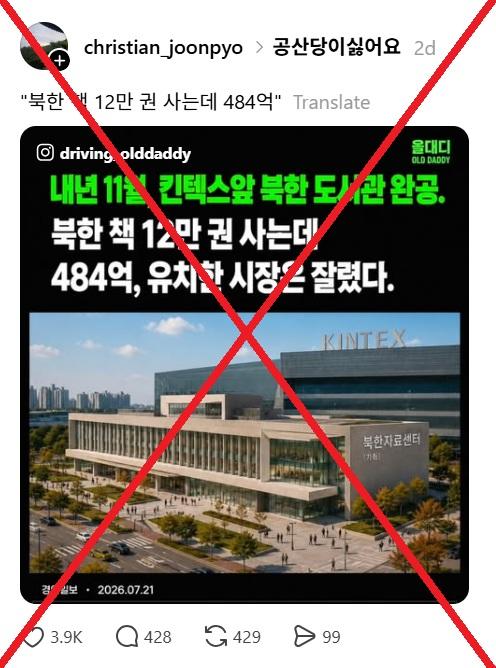
"The construction of the North Korea library... will be completed this coming November. 48.4 billion won spent to buy 120,000 North Korean books," says Korean-language text above an image shared on Threads on July 28, 2026.
The image appears to be an artist's illustration of a three-storey building, with the words "North Korea Information Centre" emblazoned on its facade.
"Kyeongin Ilbo -- July 21, 2026," reads smaller text below the image, suggesting the claim is based on reporting by a regional newspaper in Gyeonggi province.
It surfaced ahead of the planned opening of the tentatively named Northeast Asia Peace Archives in Goyang, a city northwest of the capital Seoul in the province of Gyeonggi. The facility is set to open in 2027, with construction scheduled for completion in late 2026.
It will be the only library in South Korea dedicated to unification and North Korea, said Seoul's unification ministry on December 13, 2024, as it marked the start of construction (archived link).
The two Koreas technically remain at war after the 1950-53 Korean War ended with an armistice, instead of a peace treaty, dividing the peninsula.
While South Korea's constitution contains a commitment to "peaceful unification" with the North, it maintains strict anti-communist laws (archived link). Citizens can be jailed for possessing materials published in the North, and accessing such content -- including the websites of the North's state propaganda -- is allowed only in limited cases for academic or journalistic purposes (archived link).
President Lee Jae Myung, however, has stressed the need to relax the Cold War-era censorship, saying the change would allow South Koreans an "opportunity to understand the reality of North Korea accurately" (archived link).
The claim and image were also shared elsewhere in similar Threads, Instagram, TikTok and X posts.
Some comments on the posts branded officials behind the project as "red communists" and "North Korean spies", while others questioned whether the money purportedly paid for North Korean books would circumvent UN sanctions and be funnelled into Pyongyang's nuclear weapons programme (archived link).
But the circulating posts are false.
A representative of the Kyeongin Ilbo newspaper told AFP on July 29 that they did not publish the claim.
A copy of the July 21 edition available on the newspaper's official website features no such article and a keyword search shows no similar results (archived link).
Existing archives
The 48.4 billion won figure used in the false posts appears to be based on the library project's entire budget, initially estimated at 48.4 billion won but later reduced to 45.1 billion won, according to the unification ministry.
The budget was mostly allocated for land acquisition (17.7 billion won) and construction (22.6 billion won) and does not cover book purchases, Jung Yun-kwon, director for the North Korean Information Service Division at the ministry, told AFP on July 30 (archived link).
The new library's North Korean collection will largely consist of about 130,000 documents already held at the National Library of Korea that will be transferred to the new facility, Jung said (archived link).
"So the recent claim (on social media) is completely false," he said, adding that the new library was intended to broaden access to North Korea-related materials beyond a small circle of academics and journalists to the general public.
The current collection includes some 45,000 items published by the North in print and digital formats, including copies of state-run newspapers and books.
According to Jung, they were acquired over the decades through overseas third-party sellers under a special decree by the South's intelligence agency permitting such purchases for educational or journalistic use.
"Such acquisitions have continued for decades regardless of which administration was in power and are unrelated to sanctions (on the North)," he said.
Officials plan to expand the collection with additional North Korea-related materials and general publications from South Korea, though the budget for future acquisitions remains under discussion, Jung added.
AFP has previously debunked other false claims portraying South Koreans as communist sympathisers.
Copyright © AFP 2017-2026. Any commercial use of this content requires a subscription. Click here to find out more.
Is there content that you would like AFP to fact-check? Get in touch.
Contact us