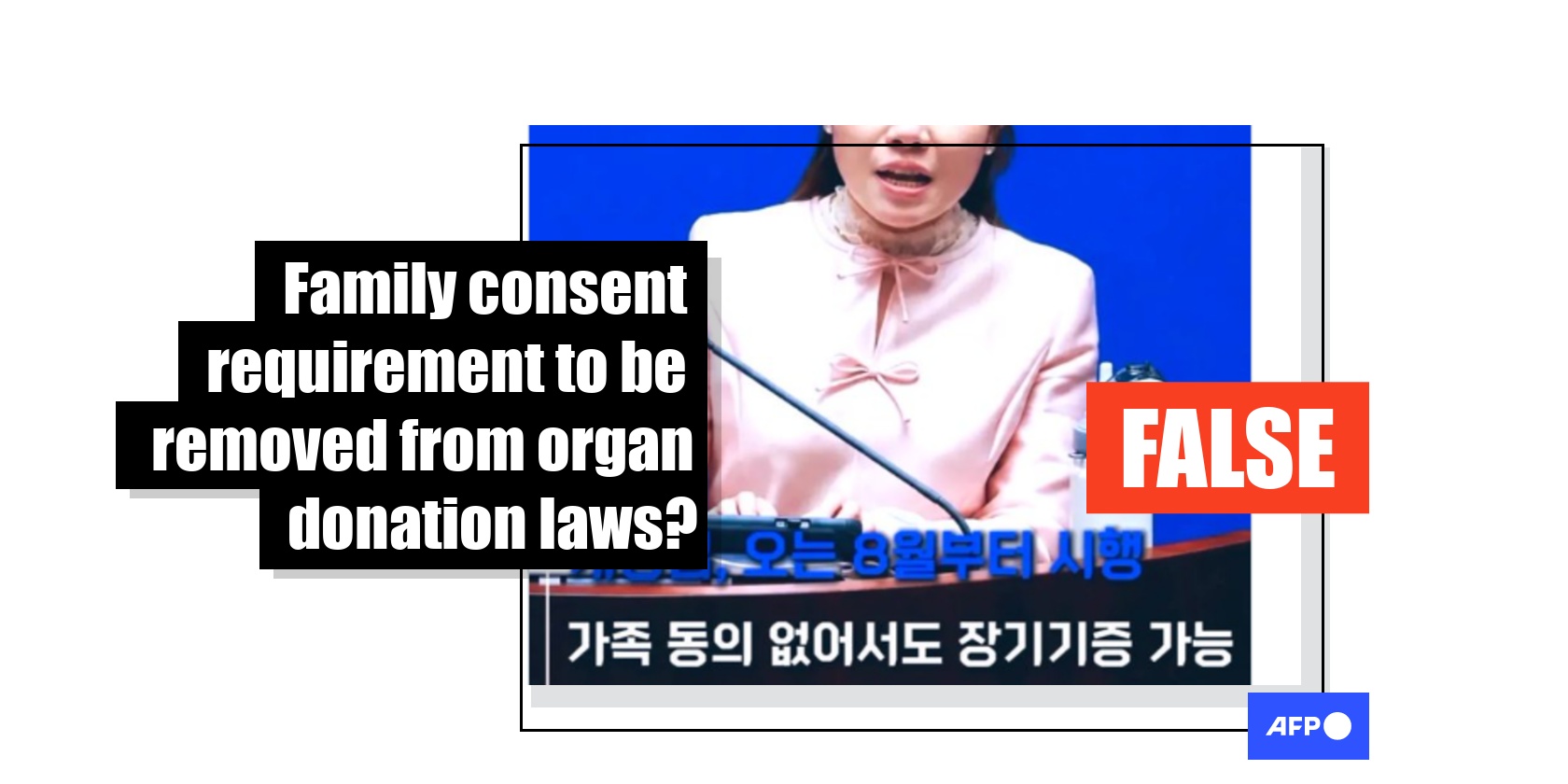
Posts claiming S. Korea altering organ donation laws rehash criticism of shelved proposal
- Published on July 24, 2026 at 10:53
- 3 min read
- By Hawon Jung, AFP South Korea
South Korea is not revising legislation to do away with the requirement for family consent before organ recovery, contrary to claims circulating on social media that the Korea Organ Donation Agency says could harm patients in desperate need of transplants. Posts repeating the false claim say the law will change from August, and target a lawmaker that floated the idea in 2024. But the lawmaker withdrew her proposal in 2025 after a wave of criticism and said she feared it could undermine efforts to promote organ donation in the country.
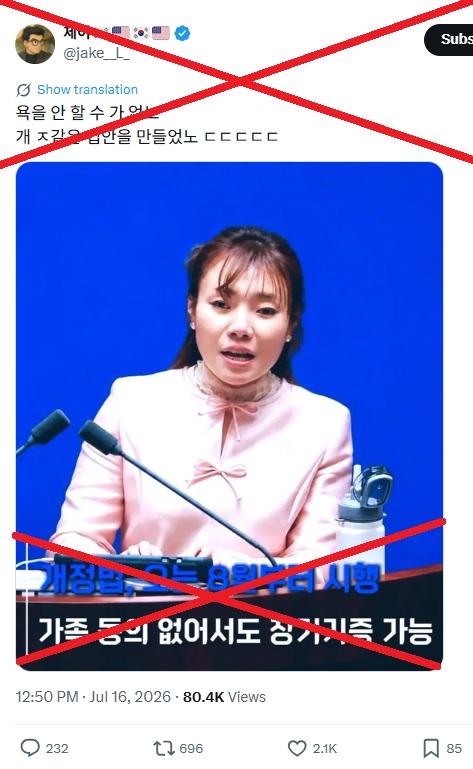
"I can't help cursing at this," says part of a Korean-language X post shared on July 16, 2026.
Attached to the post is an image of lawmaker Kim Ye-ji from the right-wing People Power Party. Superimposed text on the image reads, "The new revised law taking effect in August will make it possible to donate organs even without a family's consent."
Under South Korea's strict laws on organ donation after brain death, authorities can retrieve organs only with the consent of the patient's family (archived link).
In most cases, this means that -- even for pre-registered organ donors -- authorities cannot retrieve a patient's organs if relatives object or if no family members can be immediately contacted.
The claim about supposed changes to laws governing organ recovery circulated as South Korea grappled with a severe shortfall in organ donations.
According to health ministry data, the number of people who died while waiting for transplants rose from 2,191 in 2020 to 3,096 in 2024 (archived link). The overall organ donation figure fell from 5,883 to 5,030 over the same period.
A state survey conducted in 2025 found more than 80 percent of South Koreans said concerns about bodily damage or "vague fear" of organ donations made them reluctant to participate (archived link).
Similar posts about the purported law change were shared on X, Threads and Instagram, with commenters insulting the pictured lawmaker.
"Organ trafficking will surge... and hospitals will secretly smuggle patients to China but no one will be able to find them -- all thanks to you," reads a popular comment on one of the posts.
But a keyword search of legislative proposals on the official website of the National Assembly found no such bill would be taking effect in August (archived link).
The false posts may have misrepresented a separate law that took effect a year earlier that removed the requirement of family consent for organ donations in a very limited number of cases involving pre-registered donors with no relatives the authorities can contact after brain death (archived link).
Negative public perception
A spokeswoman for the state-run Korea Organ Donation Agency (KODA) told AFP the agency was not aware of any new law and described the claims on social media as "false" (archived link).
"It is unfortunate the false information fuels negative public perception of such noble and altruistic acts," the KODA spokeswoman said on July 23, warning it could ultimately harm patients in desperate need of organ transplants.
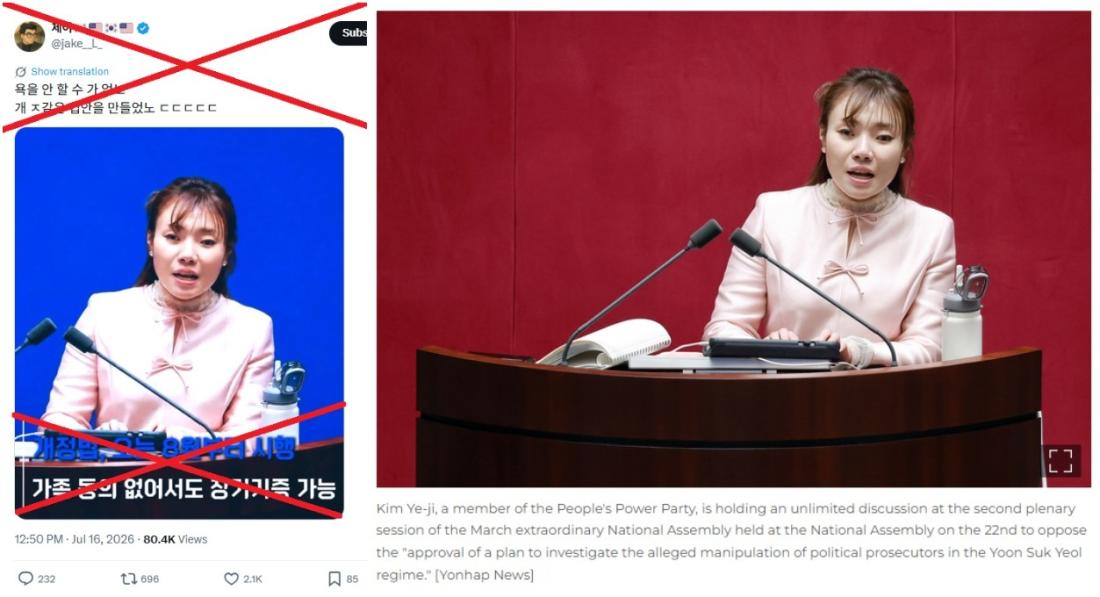
The image used in the false posts matches a photo of Kim delivering a parliamentary speech in March that was unrelated to organ donations, with only the background altered from red to blue (archived link).
Shelved proposal
The tone of the false posts appears to echo criticism directed at Kim in 2024, when she proposed a bill to allow organ transplants from overall pre-registered donors regardless of family consent (archived link).
At the time, she argued that individuals are "entitled to a right to make his or her decision to donate one's organs". The bill also allowed hopeful donors to record their wish on their driver's licence and health insurance record to guide medical staff during emergencies.
The proposal sparked a storm of opposition from critics who accused Kim of promoting "organ harvesting" or colluding with "Chinese organ traffickers". Some even accused Kim -- who is blind and a vocal advocate for disability rights -- of seeking to restore her own vision by "stealing" other people's eyes (archived link).
Kim withdrew the bill in October 2025, saying she feared "the malicious false information" surrounding the proposal would discourage potential donors and their families, ultimately undermining efforts to promote organ donation (archived link).
An aide to Kim described the recent social media claims as "completely false" in a phone interview with AFP on July 23, saying the lawmaker has not introduced any new legislation related to organ donations since withdrawing the last bill.
Copyright © AFP 2017-2026. Any commercial use of this content requires a subscription. Click here to find out more.
Is there content that you would like AFP to fact-check? Get in touch.
Contact us