Claims of proposed South Korean anti-spycam law targeting women in subways are unfounded
- Published on July 13, 2026 at 05:06
- Updated on July 13, 2026 at 11:46
- 2 min read
- By Hawon Jung, AFP South Korea
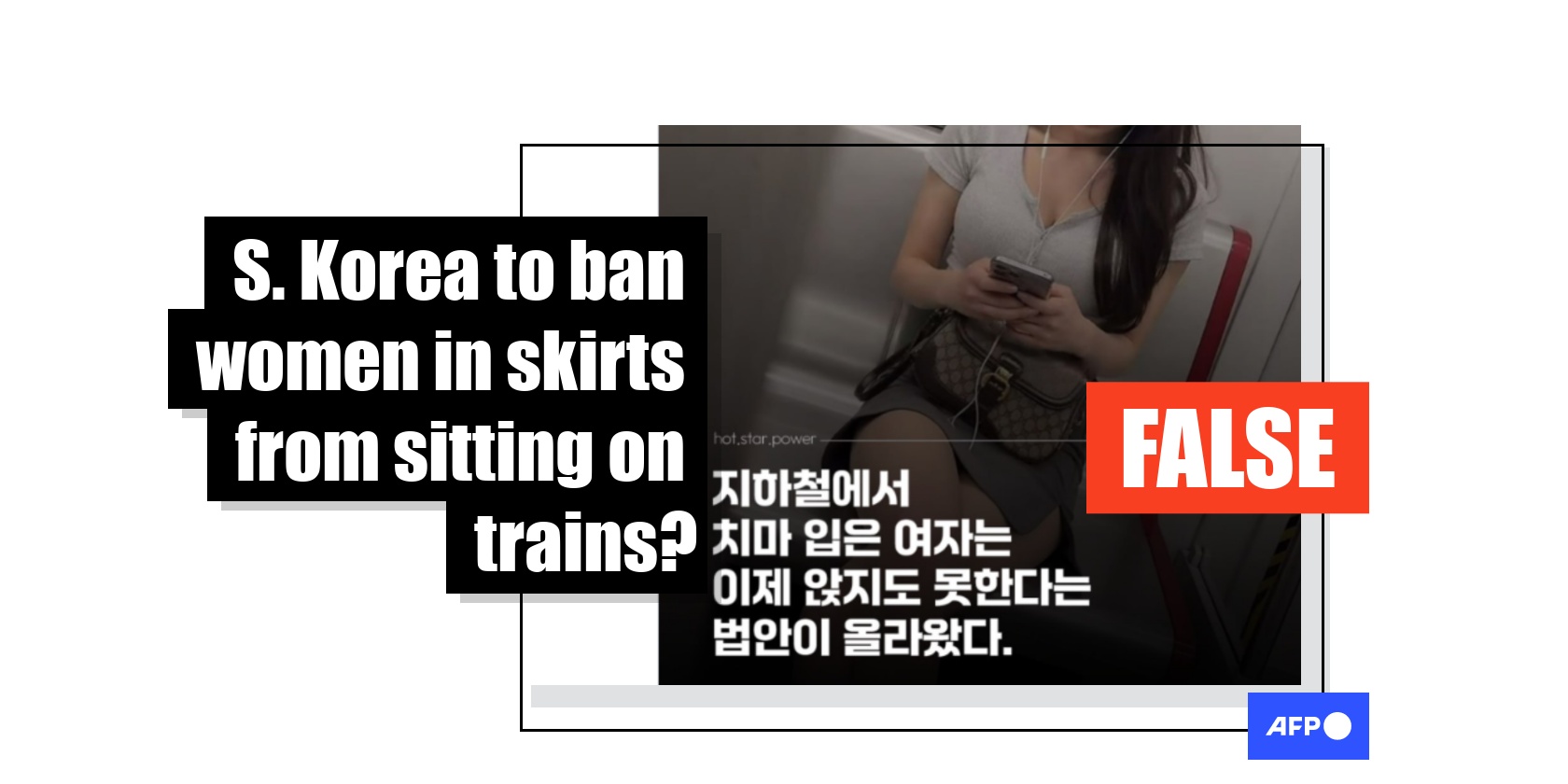
High-tech South Korea has long grappled with an epidemic of digital sex crimes, most notably the use of spycams to covertly film women in public spaces, but recent posts falsely claim that a purported new bill will bar women wearing skirts from sitting in subway trains to prevent voyeuristic filming. There is no public record of the supposed legislation introduced in parliament, and major women's rights groups also told AFP they are unaware of any such "ridiculous" law.
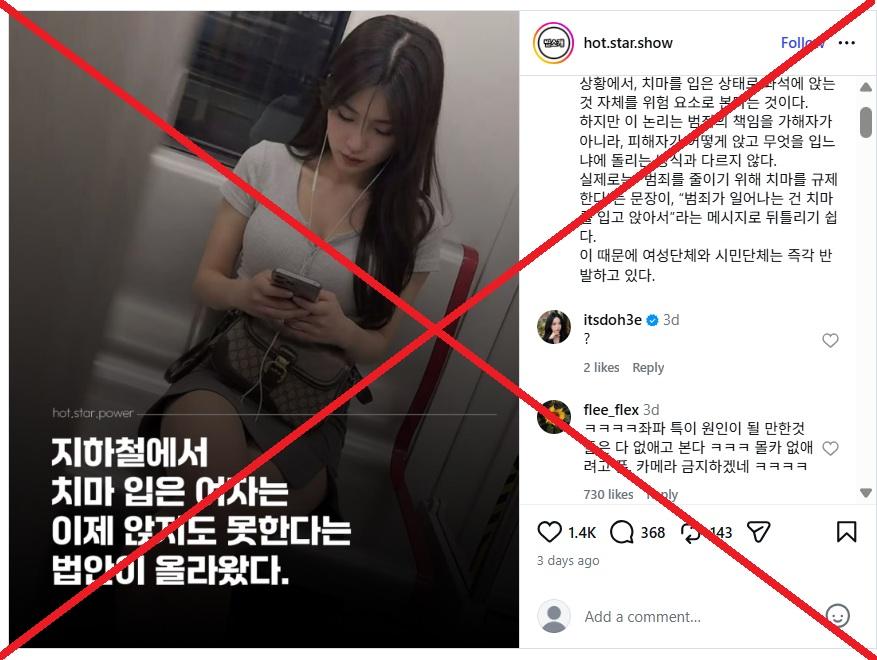
"A new law was proposed that women in skirts can't even sit on subways," reads the superimposed text on a lengthy Korean-language Instagram post shared on July 5, 2026.
The post, which shows a young woman sitting on a train, claims lawmakers are proposing the bill to prevent women from being victims of spy cams. It further claims that the purported bill shifts the blame onto victims, adding that women's rights groups are protesting against it.
South Korea -- home to the world's leading smartphone and memory chip makers -- takes pride in its tech prowess, from ultra-fast Internet to cutting-edge smartphones.
But these advances have also given rise to an army of tech-savvy Peeping Toms who secretly film women in public spaces -- from subway trains to public toilets -- using smartphones or ultra-mini cameras hidden inside shoes, bags, baseball caps, car keys, or even neckties (archived link).
All manufacturers of smartphones sold in the South are even required to ensure their devices make a loud shutter noise when taking photos -- a move designed to curb covert filming (archived link).
Despite this, about 6,000 spycam porn cases are reported in the country each year, according to police statistics. Many offences -- often involving special apps to mute camera shutter sounds -- take place on subway trains or buses (archived links here, here).
The claim was shared elsewhere on Instagram, X, Threads and a popular South Korean online forum.
Top comments on the circulating false posts expressed outrage at the purported bill, such as "Are politicians even thinking before introducing a law?' and "Who came up with a bill like this?", indicating that many social media users believe the bill is genuine.
Nonexistent proposal
A keyword search of legislative proposals on the official website of the National Assembly found no such bill (archived link).
Four major women's rights groups in South Korea including Womenlink, Korea Women's Hot-Line, and Korea Sexual Violence Relief Center, told AFP on July 9, that they had never heard of such legislation, nor had they made any statements responding to the alleged bill (archived links here, here, here).
Kim Yeo-jin, the head of the nonprofit Korea Cyber Sexual Violence Response Center, said the original poster of the "ridiculous" claim appeared to seek more engagement through sensational claims involving women and their bodies (archived link).
"The poster seems to know the golden rule on social media that content that portrays women in sexualised, sensational ways helps boost engagement -- thus profit," Kim told AFP on July 9.
She pointed to other posts on the account with sexist titles such as "Women these days date older men only when they need money," or "When there are many female employees at work, all men cheat without exception".
"The recent claim seems to criticise the non-existent bill for allegedly shifting blame onto victims of sex crimes. But it actually appears to be just another attempt to profit from false narratives that sexualise women."
AFP previously debunked false claims involving gender inequality or sexism in South Korea.
Copyright © AFP 2017-2026. Any commercial use of this content requires a subscription. Click here to find out more.
Is there content that you would like AFP to fact-check? Get in touch.
Contact us