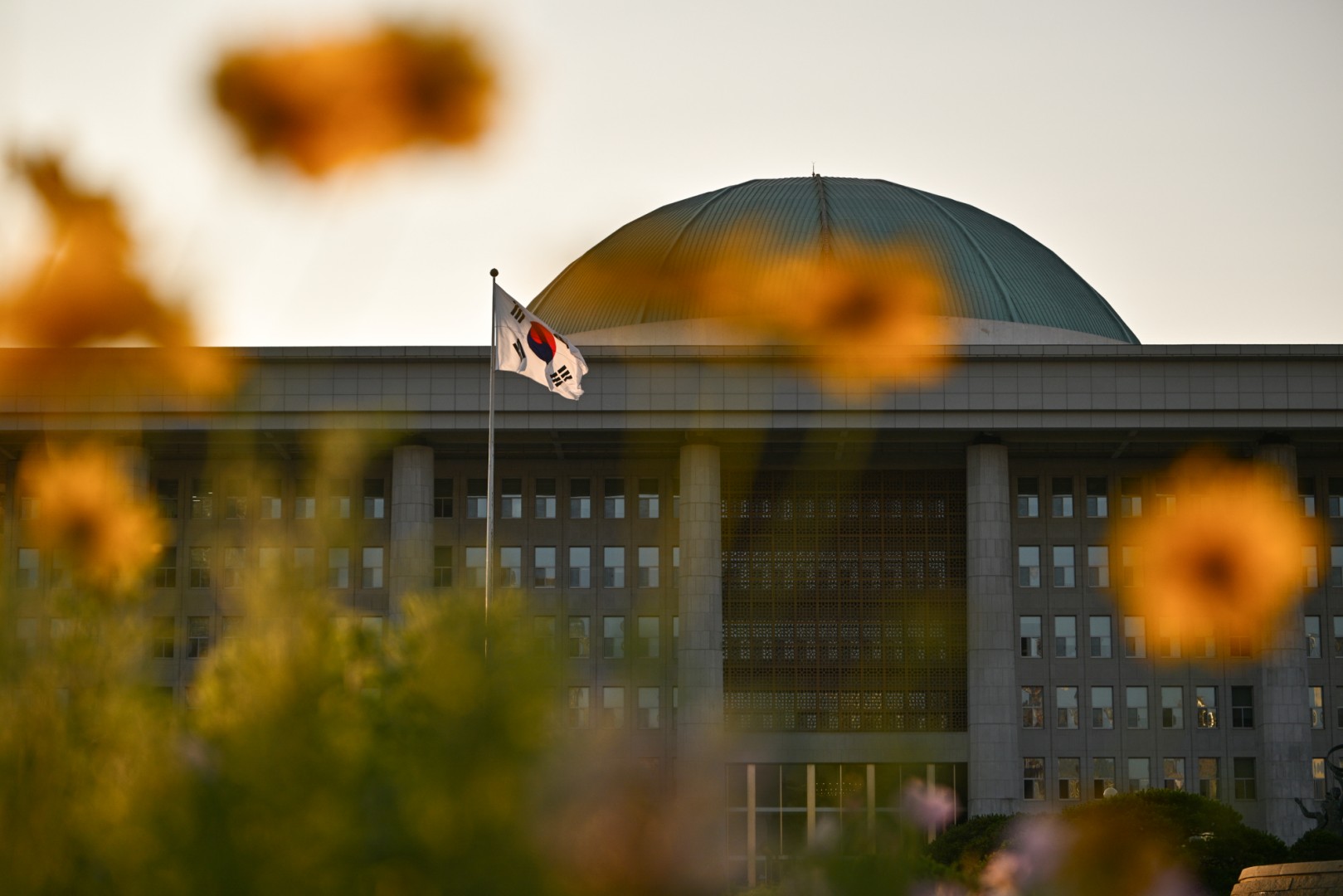
Posts misrepresent revised South Korean law targeting false information online
- Published on July 10, 2026 at 10:26
- 4 min read
- By Grace MOON, AFP South Korea
Concerns about censorship have intensified following South Korea's revisions to a law targeting false information posted online, but authorities have refuted claims the statute was used to arrest a student over an innocuous social media comment. Legal experts told AFP arrests do not fall within the scope of the amended legislation, which requires major internet platforms to set up systems to respond to reports of false or manipulated information.
"The 'gag law' hasn't even taken effect yet, but it's already being enforced as if we are under China's public security police," says a Korean-language Facebook post shared on July 6, 2026, referring to South Korea's revised law targeting false information posted online.
Attached to the post is a screenshot supposedly showing a college student's witness testimony, dated July 4, about being forcibly arrested for writing a comment on internet portal Naver about having to "go to Starbucks".
The post implies the new law was used to execute a political crackdown, as Starbucks has in recent months been adopted as a symbol for several far-right groups (archived link).
Starbucks Korea launched a disastrous promotional campaign in May that evoked a deadly military crackdown on pro-democracy protests in the southern city of Gwangju in 1980 (archived link). In the aftermath of the political debacle, a high school baseball team was suspended for taunting opponents from Gwangju with chants related to Starbucks (archived link).
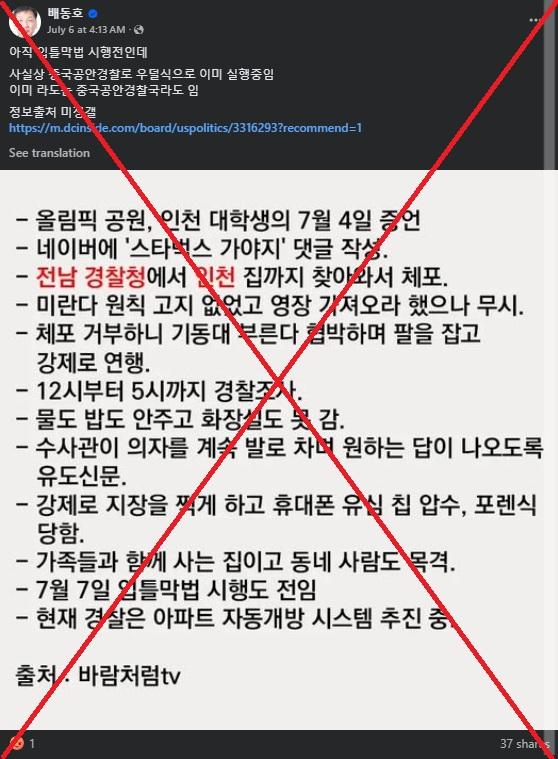
Details of the purported arrest were also shared in similar Threads and X posts in the days before the revised Information and Communications Network Act took effect on July 7 (archived link).
South Korea's National Assembly -- led by President Lee Jae Myung's ruling liberal Democratic Party -- passed revisions to the law in December 2025 after a filibuster by the conservative opposition expired (archived here and here).
It allows courts to impose hefty punitive damages of up to five times the cost of damages for spreading false or manipulated information online, while also requiring major platforms to set up new response systems.
The changes follow years of failed attempts by both major political parties to crack down on what they have called "fake news" as South Korea grapples with a surge in AI-generated "slop" and a consecutive decline in press freedom rankings (archived here, here, here and here).
But international rights organisations and media freedom groups have raised concerns that the law's vague definitions of "false" information could lead to democratic backsliding (archived here and here).
The law, however, does not authorise arrests nor does it amend South Korean criminal laws, contrary to the claims in the circulating posts.
'No such incident'
Responding to an AFP enquiry about the purported arrest detailed in the circulating posts, a spokesperson for the Korean National Police Agency said in a July 8 phone call that "no such incident" had been confirmed.
Separately, a spokesperson for the Korea Media and Communications Commission told AFP on the same day that "arrests are a matter of criminal law and do not fall within the scope" of the revised law (archived link).
Furthermore, emergency arrests in South Korea can be carried out only when there are reasonable grounds to suspect that a person has committed "a crime punishable by death, life imprisonment or imprisonment or confinement for a term of three years or more" (archived link).
Under the new law, major internet platforms with over a million daily users must respond to reports of false or manipulated information using guidelines issued by the Korea Internet Self-Governance Organisation (KISO) as a template (archived here and here).
Under KISO guidelines, "false or manipulated information" is defined as information that:
Infringes upon another person's personality rights, property rights or the public interest
Has the intent to cause harm or gain an unfair advantage
Is wholly or partially false, or has been altered in a way that causes it to be mistaken for fact
Platforms make the initial assessment of whether content falls within that definition and can also take temporary measures -- including removing posts, blocking access to content or restricting monetisation.
Affected online users can challenge the decision through South Korea's courts.
"In reality, a person will not be forcibly arrested simply for saying they are 'going to Starbucks'," said Shim Seog-tae, an attorney and special professor at Semyung University's graduate school of journalism (archived link).
But the case highlights the risk that people may frame even mildly sensitive issues as false, he added.
"Anyone -- not just alleged victims -- can file a report or bring a lawsuit if they believe something is false or manipulated," Shim told AFP on July 7. "The impact on everyday expression could be far greater than people expect."
Yun Soo Jeong, a professor at Kangwon National University's graduate school of law, also warned that granting private operators broader authority to block content could lead to "the privatisation of censorship" (archived link).
"Information that should be openly debated in the marketplace of ideas could be removed due to pre-emptive moderation by platforms seeking to avoid legal consequences," Yun told AFP on July 7, adding that "people may also be discouraged from speaking on controversial issues".
Copyright © AFP 2017-2026. Any commercial use of this content requires a subscription. Click here to find out more.
Is there content that you would like AFP to fact-check? Get in touch.
Contact us